REVIEW · MOSTAR TOURS
Herzegovina Highlights Tour from Mostar
One road opens up five sides of Herzegovina. This private trip from Mostar packs Blagaj’s Dervish house and the Roman ruins at Mogorjelo into one easy outing, then gives you time at Kravice Falls. I like the comfort of traveling by private vehicle, and I like the mix of nature, Ottoman architecture, Roman remains, and religious sites.
The main consideration is the pace. You visit five places in roughly five to six hours, so stops are focused rather than leisurely. Kravice gets about an hour, but Pocitelj and Mogorjelo receive only 30 minutes each. The $173.52 per-person price makes better sense for a small private group than for a solo visitor, and at least two people must book.
In This Review
- Five worthwhile reasons to take this trip
- What this Mostar day trip is really like
- Blagaj and the Buna spring
- Pocitelj’s stone lanes and Ottoman form
- Mogorjelo and the Roman chapter
- Kravice Falls, the natural highlight
- Medjugorje and the power of pilgrimage
- Why the private vehicle matters
- The pace, timing, and comfort trade-off
- Who will get the most from this tour?
- Should you book the Herzegovina Highlights Tour?
- FAQ
- Where does the tour start?
- What time does the tour start?
- How long does the tour last?
- Is transportation included?
- Is this a private tour?
- How many people are required to book?
- Which entrance fee is included?
- Are food and drinks included?
- Can I cancel for a full refund?
Five worthwhile reasons to take this trip
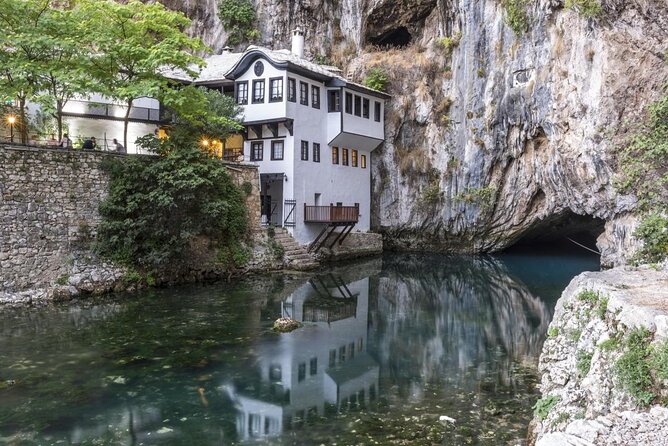
- Blagaj begins the day beside the Buna River spring, where a Sufi Dervish house sits below a rocky cliff.
- Pocitelj gives you Ottoman-era stone lanes and hillside views over the Neretva River.
- Mogorjelo adds Roman ruins to a day otherwise centered on medieval, natural, and religious sights.
- Kravice Falls is the outdoor highlight, with a horseshoe-shaped drop and a lake below where swimming may be possible.
- Medjugorje offers a major Catholic pilgrimage site, adding modern religious history to the route.
- A private vehicle and guide keep the day flexible, with only your group taking part.
What this Mostar day trip is really like
Mostar is a rewarding city, but Herzegovina begins to make more sense once you leave its famous bridge and old town behind. This tour takes you south through a region shaped by rivers, karst springs, Roman settlement, Ottoman rule, and religious pilgrimage.
You meet at the Franciscan Church on Franjevačka Street in Mostar at 9:00 a.m. Round-trip private transport is included, along with an authorized professional guide. Since the activity is private, your group does not share the vehicle with strangers. That matters here because the route has several short stops, and a private setup should make the day feel less like a race against a large group.
The exact transfer times depend on traffic. The five stops together allow about three hours and 15 minutes on site, before adding the driving between them. In practical terms, plan for a compact five to six-hour excursion. It is a good fit if you want to see a lot beyond Mostar without arranging a rental car, but it is not the right choice if you want long walks, extended meals, or several hours at each site.
A few more options to weigh up in Mostar
- From Dubrovnik: Mostar and Kravica Waterfall Day Trip
★ 4.7 · 4,709 reviews - Dubrovnik: Kravica Waterfalls, Mostar and Pocitelj Day Trip
★ 4.5 · 3,045 reviews - Discover Herzegovina Day Tour from Mostar: Kravice Waterfalls, Blagaj, Počitelj
★ 5.0 · 742 reviews
Blagaj and the Buna spring
The first stop is Blagaj, about 12 kilometers south of Mostar. The town grew beside the Buna River, which begins at one of Europe’s largest karst springs. Water emerges from the rock with striking force, creating the natural setting for Blagaj’s best-known building, the Dervish house, or tekija.
The tekija is tied to Sufi tradition and remains a pilgrimage site. Its location beside the spring gives it much of its appeal. You are not simply looking at an old building in a town square. The house sits against rock and water, in a place chosen for its quiet and spiritual character.
You have about 45 minutes here, and admission is included. That is enough time to see the Dervish house, take in the spring, and listen to the guide explain why Blagaj matters to Muslim visitors from around the world. The town’s name is linked to the Bosnian word blaga, meaning mild, a reference to the area’s gentle weather.
I would treat Blagaj as a scene-setting stop. It introduces the region’s geography and religious traditions before the tour moves toward its medieval and Roman remains. The short visit is useful, though anyone hoping for a slow café break or a long look inside every part of the site may want more time than the schedule allows.
Pocitelj’s stone lanes and Ottoman form
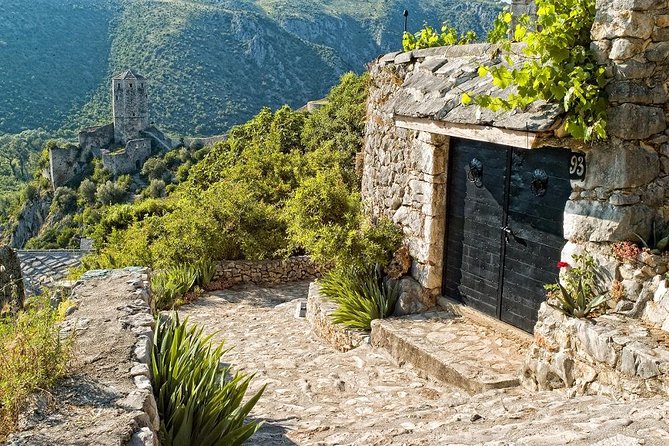
From Blagaj, the route continues to Pocitelj, about 25 kilometers from Mostar. This former medieval town rises along a rocky slope above a bend in the Neretva River. From a distance, the buildings seem to grow out of the hillside, with the town arranged almost like a natural amphitheater.
Pocitelj’s appeal comes from its shape as much as its age. Stone houses, narrow stone paths, high walls, and inner courtyards give the town a distinct Ottoman character. The architecture turns inward, protecting private courtyards from the street. That design tells you something about how daily life once worked here without needing a long lecture.
You get about 30 minutes, with no separate admission charge listed. Use the time for the main lanes, the views across the valley, and the town’s old stone buildings. Wear shoes you can trust on uneven paths. The visit is brief, so you may not have time to wander far uphill or inspect every corner.
Pocitelj is also one of the stops where the guide adds real value. Its past is still studied, and a good explanation helps connect the medieval settlement to its position on the route toward the Adriatic Sea. I would listen closely here, since the town’s compact size can make it look simple at first glance.
Mogorjelo and the Roman chapter
Mogorjelo changes the subject again. Near Capljina, this archaeological site contains the remains of a Roman villa rustica, a rural estate associated with agriculture and elite country life. Objects found here date back to the fourth century.
The ruins are set among Mediterranean vegetation, which helps you picture the site as more than a collection of broken walls. The surviving architecture is valued as one of the region’s finest examples of late antique construction. You have around 30 minutes, and admission is free.
This stop is important because it widens the story of Herzegovina beyond Ottoman and religious landmarks. Roman influence is often easy to miss when a day is built around more visually dramatic locations, but Mogorjelo shows how long people have used this fertile part of the Neretva region.
The drawback is simple: half an hour passes quickly at an archaeological site. If you enjoy studying masonry, floor plans, and construction details, you might want longer. If you prefer a varied route, the short visit works well because it gives you Roman history without taking over the day.
A completely different kind of day:
- Herzegovina Day Tour from Mostar: Blagaj, Pocitej, Kravice falls (Join Us! :D)
★ 5.0 · 372 reviews - Mostar and Kravice Waterfalls Full-Day Tour from Split
★ 4.8 · 308 reviews - Break-up of Yugoslavia & The War in Mostar: Life Under Siege
★ 5.0 · 136 reviews - Mostar & Kravice Waterfalls: Guided Day Trip from Dubrovnik
★ 4.3 · 134 reviews
Kravice Falls, the natural highlight
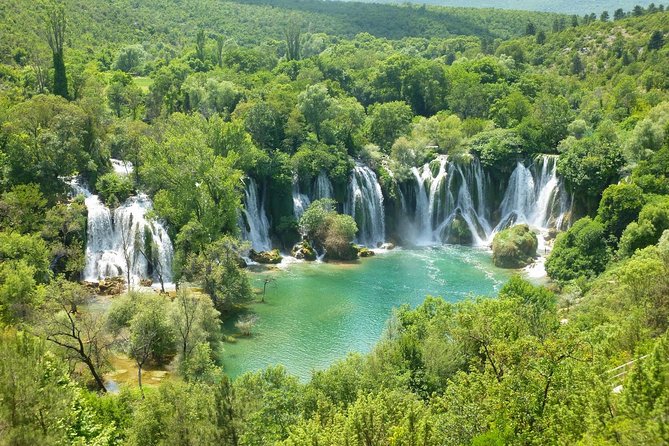
Kravice Falls is the stop most likely to become the day’s lasting picture. Here the river drops into a horseshoe-shaped canyon from a height of roughly 26 to 28 meters. Below is a lake about 120 meters in radius, surrounded by grass, moss, figs, hemp, and poplars.
Admission is included, and you have about one hour. That is the longest stop on the route, which makes sense. Kravice is a place to pause, look, and enjoy the sound of the water rather than move from one historic explanation to the next.
The falls form over calcium deposits, giving the rock a layered surface covered in moss and grass. The combination of water, cliff, and plants makes this a very different setting from dry stone Pocitelj or the Roman remains at Mogorjelo.
Swimming is a possible highlight, based on the experience details and the account of a visitor who had a swim there, but conditions and personal comfort will determine whether you want to do it. Bring suitable clothing if you hope to get in the water, and do not assume you will have unlimited changing time. The tour only allocates an hour, so you need to balance swimming with walking and enjoying the view.
This is the one stop I would protect if you are choosing where to spend your attention. The historic sites explain Herzegovina, but Kravice gives you room to enjoy it without a timetable pressing quite so hard.
Medjugorje and the power of pilgrimage
The final stop is Medjugorje, a Herzegovina village known worldwide among Catholics. In 1981, six teenagers reported seeing the Virgin Mary in the hills between Medjugorje and nearby Bijakovici. The reported apparitions continued, and the village became a major Catholic pilgrimage destination.
The tour allows about one hour, with no admission charge. That time gives you a chance to understand the importance of the site and observe its religious atmosphere. The visit is not presented as a formal worship service, so your experience will depend on how much time you spend at the site and how the guide frames its story.
Medjugorje is also a useful reminder that this is not only a scenery tour. The region’s identity includes active religious traditions, and the village draws people for reasons very different from those that bring visitors to a waterfall or Roman villa. More than 15 million people are estimated to have visited since the reported apparitions began, making it one of the world’s major Catholic pilgrimage locations.
You do not need to be Catholic to find the stop worthwhile. You do need to approach it with respect. If religious sites are not a priority for you, Medjugorje may feel less compelling than Blagaj or Kravice. If you want to understand the beliefs that have changed this small village, the hour provides useful context.
Why the private vehicle matters
The private transport is more than a comfort feature. Five stops spread across the Herzegovina region would be awkward to arrange by public transport in one morning and afternoon. A vehicle removes the need to coordinate separate connections and lets you focus on the guide’s explanations.
The tour is private, but the booking requires at least two people. That makes the price easier to justify for a couple, family, or small group. At $173.52 per person, you are paying for transport, a professional authorized guide, the Kravice entrance fee, and the convenience of covering several outlying locations in a single outing.
Food and drinks are not included. Since the tour lasts about five to six hours, plan for that cost yourself. The supplied details do not specify a meal stop, so do not count on a full lunch break. This is another reason to think of the trip as a sightseeing circuit rather than a relaxed day away from Mostar.
The guide can make a major difference. A private outing allows you to ask about the Ottoman buildings in Pocitelj, the Roman site at Mogorjelo, or the religious traditions at Blagaj and Medjugorje. One especially praised experience was led by Selmir, who guided a two-person group through villages and countryside and helped turn the route into more than a series of photo stops.
The pace, timing, and comfort trade-off
The 9:00 a.m. start is sensible. It gives you most of the day while avoiding a late return, though the exact timing depends on traffic. Transfers are approximate, so keep later plans in Mostar flexible.
The route covers five very different places, which is its strength and its limitation. You see more variety than you could easily manage alone, but you will not have time to explore each site at length. Blagaj gets 45 minutes, Pocitelj 30, Mogorjelo 30, Kravice one hour, and Medjugorje one hour.
Most people can participate, and the meeting point is near public transportation. The vehicle is especially helpful for anyone who wants to avoid driving on unfamiliar roads. Still, the stone paths and hillside setting at Pocitelj may require care, and the natural setting at Kravice is not a polished museum environment.
Who will get the most from this tour?
I would recommend it most strongly to a couple or small group staying in Mostar for several days. It gives you a broad view of the surrounding region without asking you to rent a car or build a complicated route.
It also suits you if you want variety. In one outing, you get a spring and Sufi shrine, an Ottoman hillside town, Roman ruins, a waterfall, and a Catholic pilgrimage village. That range is the real value.
You may want another plan if your priority is slow travel. The timetable will feel tight if you want extended photography, long walks, a proper meal, or detailed archaeological study. You should also think carefully about how much weight you give to Medjugorje. For some people it is the emotional center of the day. For others, Kravice Falls or Blagaj will be much more memorable.
Free cancellation is available if you cancel at least 24 hours before the 9:00 a.m. start. Confirmation is sent within 48 hours of booking, subject to availability, so do not leave the reservation until the last minute if your schedule is fixed.
Should you book the Herzegovina Highlights Tour?
Book it if you want an efficient private outing from Mostar and value having a guide connect the dots. Kravice Falls and Blagaj are the strongest reasons to go, while Pocitelj and Mogorjelo add worthwhile historical depth. Medjugorje gives the route a serious religious dimension.
At $173.52 per person, the cost is not bargain-level, but it is reasonable for a private vehicle, guide, multiple admission sites, and a route that would be difficult to reproduce easily without your own car. I would choose it for two or more people who want a full regional snapshot in five to six hours.
Skip it if you prefer to stay in one place, travel independently, or spend an entire afternoon at the waterfall. For everyone else, this is a smart way to see the Herzegovina beyond Mostar, with enough variety to make the short stops worthwhile.
FAQ
Where does the tour start?
The meeting point is the Franciscan Church at Franjevačka 1 in Mostar, Bosnia and Herzegovina.
What time does the tour start?
The tour starts at 9:00 a.m.
How long does the tour last?
The experience lasts approximately five to six hours. Transfer times can change with traffic.
Is transportation included?
Yes. Round-trip private transfer in a private vehicle is included.
Is this a private tour?
Yes. Only your group participates in the activity.
How many people are required to book?
A minimum of two people is required for each booking.
Which entrance fee is included?
The entrance fee for Kravice Waterfalls is included. Blagaj also lists admission as included, while Pocitelj, Mogorjelo, and Medjugorje have no admission fee listed.
Are food and drinks included?
No. Food and drinks are not included in the price.
Can I cancel for a full refund?
Yes, if you cancel at least 24 hours before the experience start time. Cancellations made less than 24 hours in advance are not refunded, and late changes are not accepted.
Just added in Mostar
- War Photo Exhibition Tour in Mostar★ 5.0 · 2 reviews
- Walking Tour in Old Town Mostar★ 5.0 · 5 reviews
- The Ottoman Experience Tour in Mostar★ 5.0 · 1 review
- Wine Tour & Tasting (Herzegovina)★ 5.0 · 1 review
- Transfer service from Mostar-Sarajevo★ 5.0 · 1 review
- Private Tour in Croatia★ 5.0 · 1 review
- Pocitelj City Tour★ 4.5 · 3 reviews
- Mystical Sutjeska National Park★ 5.0 · 3 reviews
Mostar Tours, compared.
From Dubrovnik: Mostar and Kravica Waterfall Day Trip
Read our review →
Dubrovnik: Kravica Waterfalls, Mostar and Pocitelj Day Trip
Read our review →
Discover Herzegovina Day Tour from Mostar: Kravice Waterfalls, Blagaj, Počitelj
Read our review →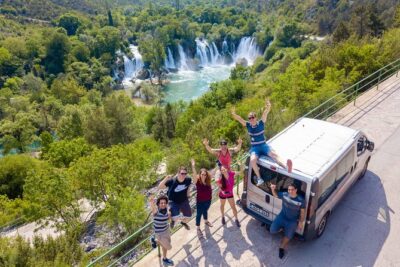
Herzegovina Day Tour from Mostar: Blagaj, Pocitej, Kravice falls (Join Us! :D)
Read our review →
Mostar and Kravice Waterfalls Full-Day Tour from Split
Read our review →
Mostar & Kravice Waterfalls: Guided Day Trip from Dubrovnik
Read our review →