
REVIEW · SARAJEVO WAR HISTORY TOURS
War Photo Exhibition Tour in Mostar
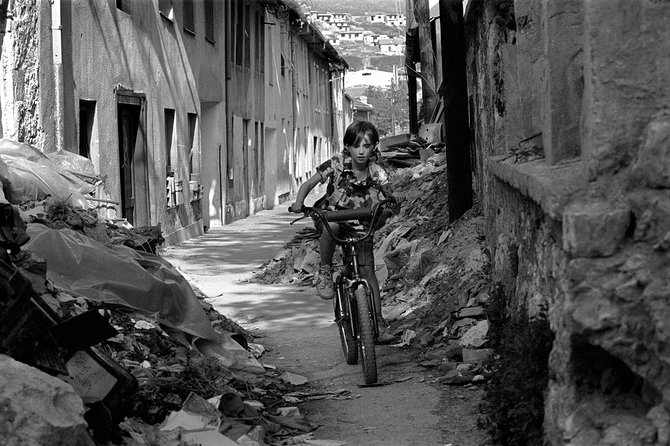
A bridge can carry a city’s memory. This private Mostar experience connects the rebuilt Old Bridge and former frontline with Wade Goddard’s 50 wartime photographs, giving you a focused look at what the city endured. I like the exhibition’s small, direct format, and I like that the guide can add personal context about growing up in Mostar.
The $24.36 price includes pickup, a certified guide, admission, and taxes, which makes it fair for a private two-hour outing. The main consideration is that the photo exhibition itself is listed as a 15-minute stop, so you should book this for thoughtful local explanation rather than a long museum visit.
In This Review
- Key points to know before booking
- Why Mostar’s bridge needs more than a postcard
- Entering the western tower above the divers’ club
- Bulevar, from frontline to city center
- What the private two-hour format changes
- Is $24.36 a good value?
- Who will get the most from this experience?
- Booking, weather, and cancellation details
- Should you book the War Photo Exhibition Tour?
- FAQ
- Where does the War Photo Exhibition Tour begin?
- Where does the activity end?
- How long does the tour last?
- Is admission included in the price?
- Are food and drinks included?
- Can I cancel for a full refund?
Key points to know before booking
- Wade Goddard’s photographs: Around 50 images record wartime Mostar through the eyes of a New Zealand photojournalist who witnessed the conflict.
- The Old Bridge setting: The exhibition occupies the western bridge tower, above the bridge divers’ club.
- Bulevar’s wartime role: This north-south street once marked the frontline between Bosnians and Croats and is now part of central Mostar.
- Private format: Only your group takes part, giving you room to ask questions and set the pace.
- Guide Sanja: Her warm, prepared approach receives especially strong praise, including her willingness to discuss Mostar’s past and what it was like to grow up there.
- Simple booking terms: You get a mobile ticket, free cancellation up to 24 hours before the start, and a refund or alternate date if bad weather or low numbers cancel the activity.
Why Mostar’s bridge needs more than a postcard
Mostar’s Old Bridge is easy to admire and easy to misunderstand. Its graceful stone arch crosses the Neretva River, but its meaning comes from both its long Ottoman-era story and its destruction during the war.
The bridge was built in 1566 during the Ottoman Empire. On November 9, 1993, Croatian gunners shelled it during fierce fighting with Bosnian Muslims. The bridge fell into the river, turning a familiar city landmark into one of the clearest symbols of Mostar’s division and loss.
After the war, Mostar rebuilt the bridge with many of the original limestone blocks salvaged from the river. Its reopening in 2004, attended by Prince Charles, offered a public sign that ordinary life might return. UNESCO added the Old Bridge to its World Heritage list in 2005.
Those dates matter because they keep the exhibition from becoming a collection of disconnected war images. You are seeing photographs in the same city where the events happened, close to the bridge whose destruction became known around the world. The setting adds weight without needing a large museum or a long lecture.
The bridge is also part of daily life. It is not preserved as a distant monument behind glass. The tower, the divers’ club, and the surrounding streets place the exhibition inside the living center of Mostar. That combination of beauty and painful memory is the reason this experience can feel more personal than a standard sightseeing walk.
Other tours covering the siege of Sarajevo:
- Break-up of Yugoslavia & The War in Mostar: Life Under Siege
★ 5.0 · 136 reviews - The Death of Yugoslavia Tour in Mostar
★ 5.0 · 102 reviews - Mostar War Heritage Walking Tour
★ 5.0 · 6 reviews
Entering the western tower above the divers’ club
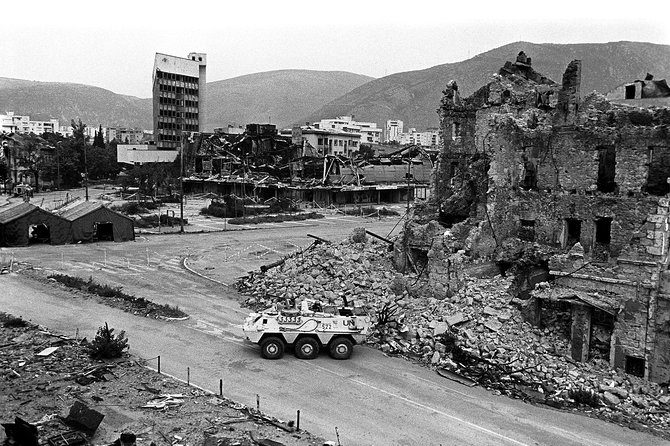
The main stop is the War Photo Exhibition in the western Old Bridge tower. It displays around 50 photographs by Wade Goddard, a New Zealand photojournalist who witnessed the war in Mostar.
The exhibition is listed as a 15-minute stop, with admission included. That timing tells you what to expect: this is a concentrated presentation, not a large gallery that takes an hour to explore. You will have time to look closely at the photographs, but the guide’s explanation is an important part of the experience.
The tower location gives the display a strong sense of place. You are not studying the conflict in a distant capital. You are above the bridge divers’ club, near the structure that was destroyed and later rebuilt. The city outside the windows and the photographs inside belong to the same story.
Goddard’s position as an outside photojournalist also gives the collection a particular viewpoint. The images are not presented as a general survey of every event in the Bosnian war. They focus on Mostar, the people caught in the fighting, and the city’s damaged streets and buildings.
I would allow yourself time to pause. Wartime photography can be difficult, and the short stop should not pressure you to rush through the images. Some people will find the collection powerful and useful. Others may find the subject matter upsetting, especially because the exhibition deals with recent events rather than a remote period.
The tour’s value comes partly from having a guide nearby. You can ask about what you are seeing, clarify the city’s divided wartime geography, and connect a photograph to the streets outside. Without that context, 50 images could become a quick sequence of dramatic scenes. With good explanation, they can help you understand Mostar as a place rather than simply look at its damage.
Bulevar, from frontline to city center
Bulevar runs north to south through Mostar. During the war, it served as the frontline between Bosnians and Croats. Today, it is part of the heart of the city and home to Mostar’s attractive city hall.
That change is central to the tour’s message. The street is not only a military line from the past. It is also a civic space used in the present. Looking at Bulevar through both lenses helps you understand how quickly a familiar road can become a boundary, and how a divided city tries to bring daily life back into the same places.
The tour information does not promise a long, separate walking route through every wartime site. The confirmed exhibition stop takes about 15 minutes, while the full experience lasts roughly two hours. That suggests the guide spends time building the wider story around the exhibition, the bridge, Bulevar, and Mostar’s recent past.
You should ask questions as you go. The private format is especially useful here because you do not have to wait for a large group to move on. If you want to know how a street functioned during the fighting, or how the rebuilt bridge fits into the city today, you can raise the subject directly.
Sanja is the guide named in the available feedback, and her personal connection to Mostar is one of the strongest reasons to value this format. She is described as kind, friendly, well prepared, and willing to talk about what it was like to grow up in the city. That sort of conversation can add a human layer that a display alone cannot provide.
One important limit remains: a guide can explain the city, but the tour cannot erase the emotional distance between you and those who lived through the war. Go with respect. This is not a light sightseeing outing dressed up with a dramatic title. Its purpose is to help you look carefully at a difficult chapter of Mostar’s life.
What the private two-hour format changes
This is a private activity, so only your group participates. That makes the tour a better choice for couples, families, or friends who want to ask direct questions without worrying about a large group’s pace.
The two-hour length also gives the experience a useful middle ground. It is longer than a quick visit to a photo display, but shorter than a full-day historical program. You can fit it into a day of exploring Mostar without giving up most of your schedule.
The included pickup begins at Hotel Kapetanovina on Gojka Vukovića bb. The activity ends back at the same meeting point. Since the meeting and return point are fixed, check the address before you book and allow enough time to reach the hotel.
The experience includes a certified guide, admission fees, and taxes. Food, drinks, breakfast, and other extra costs are not included, so plan to pay for those separately. This is not a problem for a two-hour tour, but it is worth knowing if you are combining it with a longer outing.
A mobile ticket keeps the booking simple. Confirmation arrives at the time of booking, and service animals are allowed. The activity is near public transportation, and most people can participate, although the supplied information does not give detailed accessibility notes for the tower itself.
More museums in Mostar:
- Authentic Antique Museum Home
★ 5.0 · 1 review - Fall of Yugoslavia, Sarajevo War Tour with Tunnel of Hope Museum and Frontlines
★ 5.0 · 1,314 reviews - Tunnel Museum: Bosnian & Yugoslav Wars Tour with War Veteran
★ 5.0 · 551 reviews - Tunnel of Hope Museum Tour
★ 5.0 · 38 reviews
Is $24.36 a good value?
At $24.36 per person, the price is sensible if you want context rather than only admission to a small exhibition. You are paying for a private guide, pickup, entry, taxes, and roughly two hours of attention. For a private activity, that can be a strong deal, especially when your group is large enough to benefit from the available group discounts.
The value depends on your expectations. If you want a major museum with hours of displays, this will feel brief. The exhibition itself is listed at 15 minutes, and the photo collection contains around 50 images. You should think of the photographs as the emotional center of a guided city experience, not as a full museum visit.
The guide is where the price makes the most sense. Sanja’s ability to discuss both the war and everyday life in Mostar is highlighted as a major strength. A short collection of photographs becomes more useful when someone can explain the local setting and respond to your questions.
The included pickup also saves you the small hassle of arranging where to begin. The return to Hotel Kapetanovina makes the plan easy to understand, though you should not expect meals or extra stops to be covered in the fee.
If your group prefers independent sightseeing, you could visit the bridge and explore the city on your own. You would then miss the structure that links the images, Bulevar, the bridge’s destruction, and the city’s rebuilding. I would pay for this experience when understanding the recent past matters more to you than maximizing the number of attractions in a day.
Who will get the most from this experience?
I would recommend it to anyone who wants to understand Mostar beyond its famous arch. The tour suits people interested in modern European history, photography, Bosnia and Herzegovina, postwar recovery, and the way public places carry painful memories.
It is also a good choice for families with older children or teenagers who can engage with serious subject matter. The private setting lets you decide how much to discuss and gives you a chance to explain difficult images at your own pace.
Couples and small groups may appreciate the personal tone. A guide who can discuss growing up in Mostar can help you see the city as a home, not only as a place marked by conflict. That is a more useful experience than collecting a few dates and moving on.
I would be more cautious about booking it for very young children or anyone who wants only cheerful sightseeing. The photographs concern wartime Mostar, and the subject can be upsetting. The short exhibition visit does not make the material light.
You should also book with realistic expectations about the scope. The activity focuses on Mostar, especially the bridge, Bulevar, and the exhibition. It is not described as a complete survey of the entire Bosnian war, and it does not promise a long list of battle sites.
One available account also praises Sanja for taking time to discuss Blagaj. That does not mean Blagaj is a guaranteed part of this experience, so I would not book this tour expecting that destination. If Blagaj matters to you, ask the provider before arranging it as part of your day.
Booking, weather, and cancellation details
You can cancel free of charge up to 24 hours before the experience begins and receive a full refund. Changes or cancellations made less than 24 hours before the start are not accepted for a refund, and the cut-off follows local time in Mostar.
The activity requires good weather. If poor weather forces cancellation, you can choose another date or receive a full refund. The experience also requires a minimum number of participants, and if that minimum is not met, you will be offered another date or experience, or receive a full refund.
These terms are reasonable, but note that the tour is private while still subject to a minimum number requirement. I would keep the confirmation details handy and avoid placing this at the end of a tightly packed schedule if your plans cannot shift.
Should you book the War Photo Exhibition Tour?
Book it if you want Mostar’s beauty placed beside its recent pain. The best parts are the location in the Old Bridge tower, the focused photographs by Wade Goddard, and the chance to speak privately with a guide such as Sanja about the city’s wartime past and everyday life.
Do not book it expecting a large museum or a full-day historical program. The exhibition stop is short, the subject is serious, and food and drinks cost extra. But at $24.36, with pickup, admission, a certified guide, taxes, and a private two-hour format, it offers a useful amount of local context for a modest price.
I would choose this early in a Mostar stay. It can help you read the bridge, Bulevar, and the surrounding city with sharper eyes afterward. For a small group that values meaning over a long list of stops, it is a worthwhile addition.
FAQ
Where does the War Photo Exhibition Tour begin?
The tour begins at Hotel Kapetanovina, Gojka Vukovića bb, Mostar 88000, Bosnia and Herzegovina.
Where does the activity end?
The activity ends back at the meeting point at Hotel Kapetanovina.
How long does the tour last?
The experience lasts approximately two hours. The War Photo Exhibition portion is listed as a 15-minute stop.
Is admission included in the price?
Yes. Admission, all fees and taxes, pickup, and a certified tour guide are included.
Are food and drinks included?
No. Breakfast, food, drinks, and other extra costs are your responsibility.
Can I cancel for a full refund?
Yes, if you cancel at least 24 hours before the experience start time. Poor weather or failure to meet the minimum number of participants can also lead to an alternate date or a full refund.
Just added in Mostar
- Walking Tour in Old Town Mostar★ 5.0 · 5 reviews
- Transfer service from Mostar-Sarajevo★ 5.0 · 1 review
- The Ottoman Experience Tour in Mostar★ 5.0 · 1 review
- Wine Tour & Tasting (Herzegovina)★ 5.0 · 1 review
- Herzegovina Highlights Tour from Mostar★ 5.0 · 2 reviews
- Private Tour in Croatia★ 5.0 · 1 review
- Pocitelj City Tour★ 4.5 · 3 reviews
- Mystical Sutjeska National Park★ 5.0 · 3 reviews
Sarajevo War History Tours, compared.
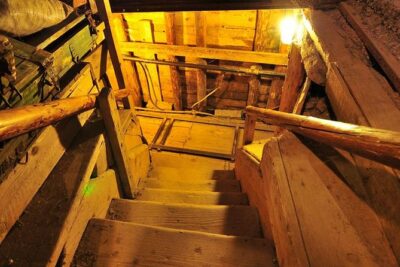
Fall of Yugoslavia, Sarajevo War Tour with Tunnel of Hope Museum and Frontlines
Read our review →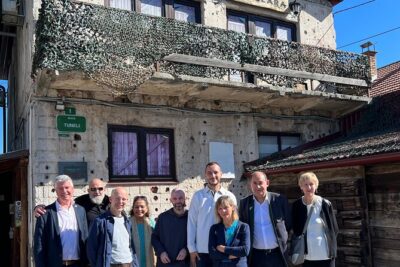
ROSES OF SARAJEVO (Official WAR + CITY tour)- Story of a Survivor
Read our review →
Tunnel Museum: Bosnian & Yugoslav Wars Tour with War Veteran
Read our review →
Sarajevo War Tour: A Veteran’s Story of the Siege (fees included)
Read our review →
Break-up of Yugoslavia & The War in Mostar: Life Under Siege
Read our review →
Sarajevo to Srebrenica: Genocide Study Tour with War Veteran
Read our review →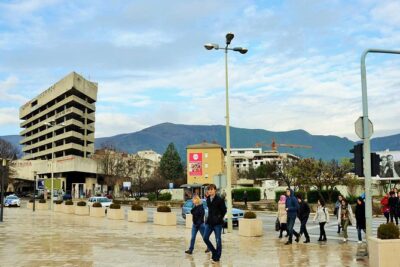
Sarajevo Grand Tour: Old Town, War Tunnel, Olympic Sites & More
Read our review →Browse the lists this tour appears in