
REVIEW · SARAJEVO WAR HISTORY TOURS
Break-up of Yugoslavia & The War in Mostar: Life Under Siege
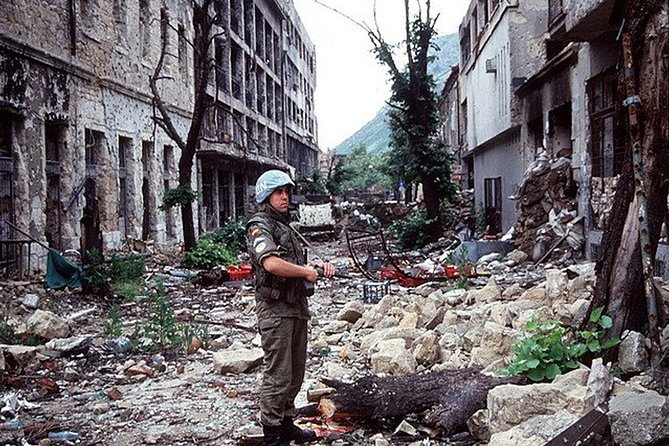
Mostar’s beauty has a difficult story. This three-hour tour connects the famous bridge and old town with the abandoned Yugoslav aircraft hangar, a war museum, damaged buildings, and the former front line that split Mostar during the Bosnian War. I especially like the guide’s use of a hand-drawn map to explain the breakup of Yugoslavia, and the chance to hear personal family stories from guides such as Esmer. The main consideration is emotional weight: this is an information-heavy tour about civilians, siege conditions, and wartime loss, not a light sightseeing outing.
The small group, capped at eight people, makes it easier to ask direct questions and discuss difficult subjects. Hotel pickup and drop-off in Mostar also make the morning simple, though the tour can run longer than its advertised three hours when the guide is particularly passionate. At $42.33 per person, I consider it a strong value if you want to understand Mostar rather than simply photograph it.
In This Review
- Key points to know before booking
- Why Mostar needs more than a bridge photograph
- The abandoned Yugoslav aircraft hangar south of Mostar
- The Mostar War Museum and the map that explains the conflict
- Walking the former front line through central Mostar
- A guide-led lesson with room for conversation
- Is $42.33 a fair price for three hours?
- Who will get the most from this Mostar war tour?
- How to fit it into a day in Mostar
- Should you book Life Under Siege?
- FAQ
- How long does the tour last?
- What places are visited?
- Is hotel pickup available?
- How many people can join the tour?
- Is the museum entrance included?
- Can I cancel for a full refund?
Key points to know before booking
- A hidden aircraft hangar comes first: Visit an abandoned Yugoslav military facility built inside the mountain south of Mostar, where fighter jets were kept out of sight and protected from attack.
- The guide makes a tangled war understandable: A board, a map of former Yugoslavia, and a clear timeline help explain events that can otherwise feel impossible to follow.
- Personal stories give the tour its force: Guides including Esmer have shared family experiences of the siege and life in wartime Mostar.
- You walk across the former front line: Šantića Street, Spanish Square, and Boulevard Street reveal how the old battle line still shapes the city.
- The experience is small and flexible: Groups can include no more than eight people, and the guide may adjust the pace or offer local suggestions when time allows.
- Plan for serious subject matter: The stories can be heartbreaking, and the tour is best suited to adults and mature teenagers who want context rather than entertainment.
Why Mostar needs more than a bridge photograph
Mostar is easy to visit badly. You can cross Stari Most, buy a souvenir, eat ćevapi, and leave with a fine photograph but only a thin idea of what this city endured. The war tour changes that by showing how the conflict affected streets, homes, families, and the city’s present-day divisions.
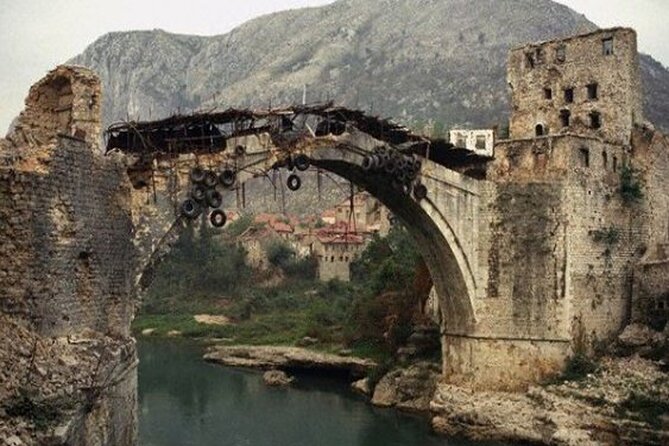
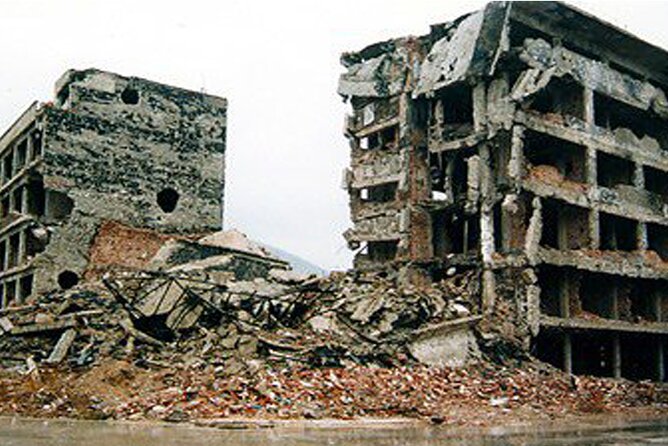
The Bosnian War lasted from 1992 to 1995, following the breakup of Yugoslavia. Mostar suffered heavily, and fighting between Bosnian and Croatian forces cut through the city itself. The scars are not confined to a distant battlefield. They appear in damaged buildings, surviving bunkers, memorial displays, and the invisible line between parts of Mostar.
I value the way this experience links the larger political story to ordinary life. The guide does not simply recite dates. He explains how decisions made in a collapsing state affected people who had to find food, protect relatives, and survive bombardment.
This is also why I suggest taking the tour early in your Mostar stay. Once you understand the war’s effect on the city, the old bridge, the surrounding streets, and even the modern divisions carry more meaning.
Other tours covering the siege of Sarajevo:
- The Death of Yugoslavia Tour in Mostar
★ 5.0 · 102 reviews - Mostar War Heritage Walking Tour
★ 5.0 · 6 reviews - War Photo Exhibition Tour in Mostar
★ 5.0 · 2 reviews
The abandoned Yugoslav aircraft hangar south of Mostar
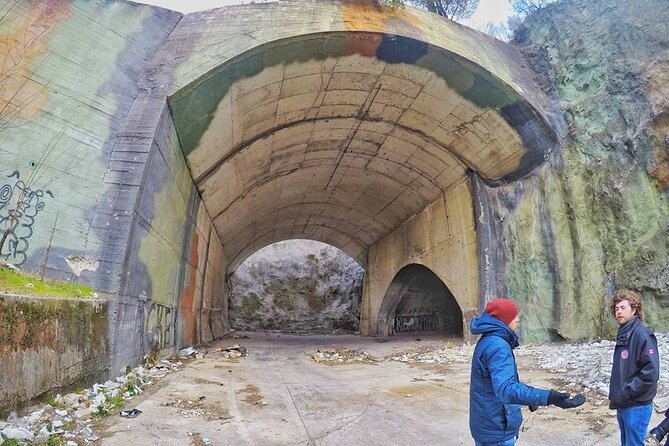
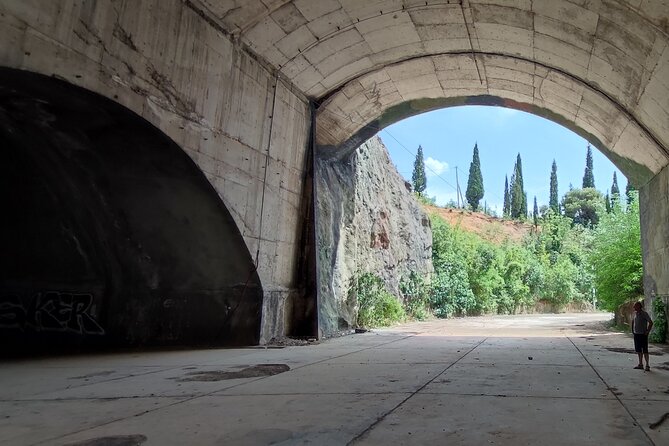
The first stop is an abandoned aircraft hangar about five minutes south of Mostar. It was built into the mountain during the Yugoslav period, using the rock as a natural fortress. Fighter jets could be stored deep inside, protected from attack and hidden from citizens, spies, and prying eyes.
The hangar is unusual because it reveals an earlier chapter of the region’s story. Before the Bosnian War, Yugoslavia maintained a large military system under Josip Broz Tito. This facility shows the secrecy and defensive planning of that era in a direct, physical way.
You spend about 50 minutes here, with no separate admission charge. The stop is less polished than a standard museum. That is part of its appeal, but you should expect an abandoned military site rather than a restored attraction with extensive displays.
The darkness, concrete, and rough condition help you picture how the facility worked. You are not just hearing that Yugoslavia prepared for attack. You are standing inside one of its preparations.
The setting also adds a little variety to a serious morning. You might hear about the military purpose of the hangar, the wider political system, and how the former Yugoslav state eventually fractured. One guide even picked a wild pomegranate during a visit, a small local moment that made the stop feel less rehearsed.
Photography may be tempting, but this is not mainly a picture stop. The hangar matters because it gives physical form to the military world that existed before the war. I would pay attention to the explanation rather than rush around looking for dramatic angles.
The Mostar War Museum and the map that explains the conflict
The second stop is the Mostar War Museum on Gojka Vukovića Street. You spend about 50 minutes here, and the entrance fee is included.
This is the intellectual center of the tour. The guide uses a board to draw a map of former Yugoslavia and explain the chain of events that led to war. That simple visual aid is especially useful because the conflict involved shifting political aims, several communities, changing alliances, and fighting across different parts of Bosnia and Herzegovina.
A written account can leave you with a pile of names and dates. The map gives you something to follow. The guide can show where places sit in relation to one another, how military movements affected Mostar, and why the city became so divided.
The museum focuses on Mostar’s local experience. You hear about civilian life, the siege, the damage to the city, and what happened between the lines. The guide also explains what it means to live in a divided city after the shooting has stopped.
This is where the personal side becomes strongest. Esmer, one of the guides praised for this tour, has spoken about his family’s experience during the siege. Other named guides include Harun, Huran, and Vedad, who have also been described as clear, friendly, and deeply committed to teaching the subject.
It is important to understand the limits of personal testimony. A guide who was a child during the war cannot personally remember every military event, but he can offer a local family perspective and explain what happened with years of study and reflection. That combination is valuable, particularly when a guide takes care to discuss the actions and suffering of more than one side.
The museum visit can be intense. Stories about civilians being targeted and families trying to survive have brought some people to tears. You should not book this expecting a neutral collection of old photographs with no emotional effect.
At the same time, the tone is not built around hatred. The most effective guides explain the wrongs committed by different sides, discuss forgiveness, and speak about the need to live together. That balance gives the tour moral seriousness without turning it into a political speech.
You are encouraged to ask questions. That matters because many people arrive knowing only the broadest outline of the conflict. If you are unsure about terminology, borders, or the difference between political and military developments, this is the moment to ask.
Walking the former front line through central Mostar
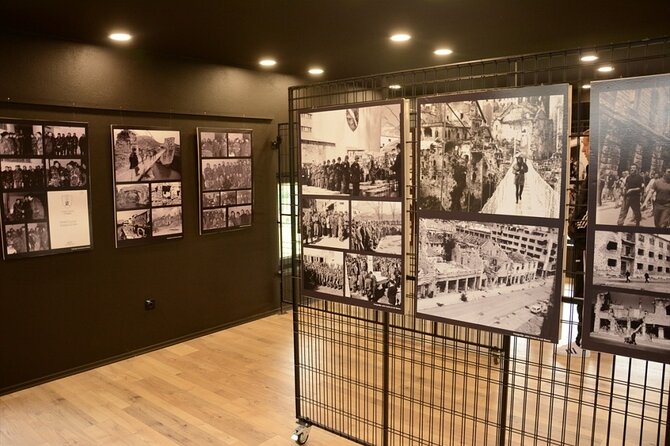
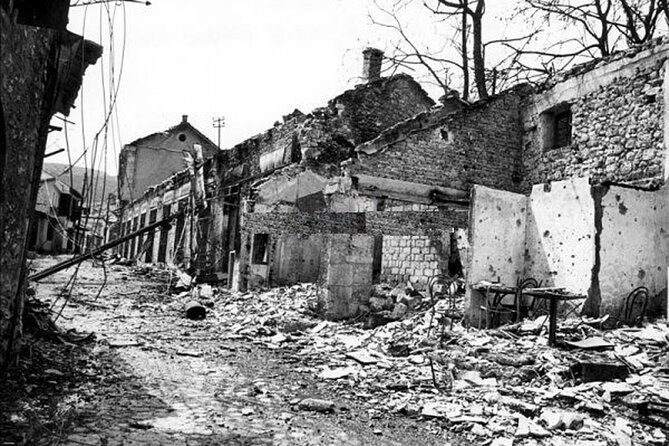
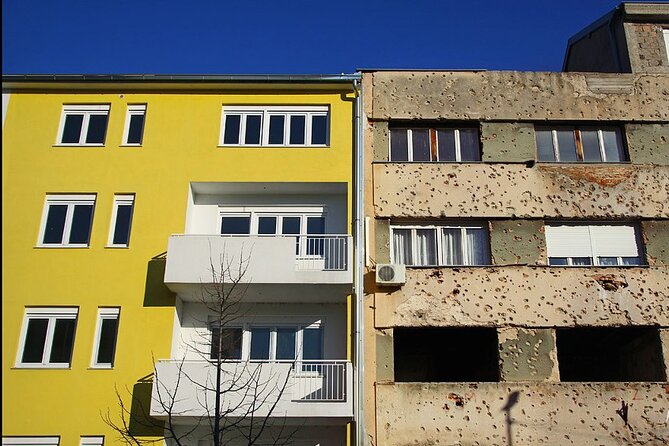
The final part takes you through the city, including Šantića Street, toward the former west front line. This was where Bosnian and Croatian forces fought at close range. The fact that bunkers and war-damaged structures remain near the center makes the history unusually visible.
You may notice that this is not a conventional historic walking tour. The sites are not dressed up for easy viewing, and some buildings remain damaged rather than restored into formal monuments. One useful part of the route is the comparison between wartime photographs and the streets as they look today.
Near Spanish Square and Boulevard Street, the guide shows images of the area during the conflict. The contrast helps you understand both the scale of the destruction and the city’s recovery. A street that now appears ordinary may once have been a dangerous line of fire.
The route also explains the present-day, invisible division within Mostar. The front line is no longer marked by sandbags and active gunfire, but the city’s political and social divisions have not simply vanished. The guide discusses current concerns and hopes for the future, giving you a more honest view than a simple story of damage followed by perfect reconciliation.
This section is valuable after the museum because you can connect the map and stories to real places. You see where people lived, where fighting occurred, and how close the opposing positions were to homes and public spaces.
The drawback is that the remains can feel stark rather than scenic. If your main goal is panoramic views and postcard images, the hangar and front line may seem modest. Their importance is historical and human, not decorative.
Some versions of the experience have also included a view of Mostar from a nearby mountain. That perspective can help you understand the city’s position, though the supplied tour details focus mainly on the hangar, museum, and former front line. Do not book it solely for a mountain viewpoint.
A few more options to weigh up in Mostar
- From Dubrovnik: Mostar and Kravica Waterfall Day Trip
★ 4.7 · 4,709 reviews - Dubrovnik: Kravica Waterfalls, Mostar and Pocitelj Day Trip
★ 4.5 · 3,045 reviews - Discover Herzegovina Day Tour from Mostar: Kravice Waterfalls, Blagaj, Počitelj
★ 5.0 · 742 reviews - Herzegovina Day Tour from Mostar: Blagaj, Pocitej, Kravice falls (Join Us! :D)
★ 5.0 · 372 reviews
A guide-led lesson with room for conversation
The guide is the heart of this experience. The strongest part is not a particular building but the ability to ask a local person how the war affected families, neighborhoods, and daily life.
Esmer receives especially warm praise for explaining a complex sequence of events in plain language. He is also described as objective, patient, and willing to discuss the difficult political situation today. Harun and Huran are praised for their clear teaching style, while Vedad has been noted for offering useful views of the city and its wartime remains.
Names can vary depending on the departure date, so you should not assume a specific guide when booking. What does seem consistent is the local, personal approach.
The best guides do more than deliver a memorized speech. They greet people in the streets, answer questions, and connect the war to everyday Mostar. In one account, the guide took the group to a small coffee place that was not aimed at sightseeing. He also explained the ritual of drinking Bosnian coffee and recommended places for ćevapi.
Those extras are not guaranteed parts of the advertised itinerary, but they show how the tour can become a wider introduction to Mostar. You may leave with food suggestions, documentary links, or a better sense of how locals see their city now.
I also appreciate the stated openness to questions. The breakup of Yugoslavia and the Bosnian War are not subjects that fit into a tidy good-versus-bad story. A guide who can explain competing claims while acknowledging civilian suffering is far more useful than one who simply repeats slogans.
Is $42.33 a fair price for three hours?
At $42.33 per person, the price is reasonable for a small-group tour that includes transport, a professional guide, and admission to the Mostar War Museum. Hotel pickup and drop-off add real value, especially if your accommodation is outside the immediate old-town area.
The maximum group size is eight. That is small enough for questions and conversation, but the group may not always reach that number. On some departures, the experience can feel almost private, and one couple reported that the guide continued rather than canceling when attendance was low.
The advertised length is about three hours, with roughly 50 minutes at each main stop. In practice, the morning can run longer because the guide may continue answering questions or explaining a point. If you have a bus, train, or onward connection, leave extra time.
The cost is easiest to justify if you have already seen Mostar’s main sights and want to understand them. It is less useful if you want a fast orientation or a tour focused on architecture, food, or the Old Bridge.
Pickup is offered from accommodation in Mostar. If your address is not listed during booking, you need to provide it. The vehicle is air-conditioned, which helps when moving between sites, though you should still expect walking at the final stop.
Confirmation is provided within 48 hours, subject to availability. Free cancellation is available up to 24 hours before the start time. Changes or cancellations inside that 24-hour window are not accepted for a refund.
Who will get the most from this Mostar war tour?
I recommend it most strongly to anyone who wants the recent past explained by someone connected to the city. It suits adults, mature teenagers, history students, and people visiting Bosnia and Herzegovina as part of a wider Balkan trip.
It is particularly useful if you are traveling from Croatia or Montenegro and want to understand the regional connections rather than treat Mostar as a quick stop between Dubrovnik and Split. The tour gives you a framework for thinking about Bosnia and Herzegovina after you leave.
You should also consider it if you know very little about the war. The guide’s map and timeline help you follow the story without requiring a specialist background.
This may not suit young children, anyone uncomfortable with wartime testimony, or someone looking for a relaxed morning of sightseeing. Children must be accompanied by an adult, and the subject matter calls for attention and maturity.
Wear practical shoes because the experience includes walking through city streets and exploring an old military facility. The tour is near public transportation, and most people can participate, but the supplied details do not promise a specific accessibility arrangement. If you have mobility concerns, ask the operator before booking.
How to fit it into a day in Mostar
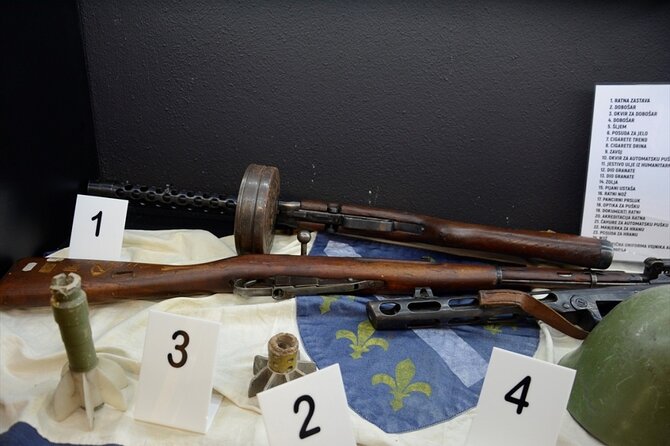
Take this tour early if you can. The morning pickup makes it easy to use the afternoon for the Old Bridge, the bazaar streets, cafés, and museums with a better grasp of what you are seeing.
If you have already crossed Stari Most, the tour can provide the missing context. You may look at the bridge differently afterward, not only as an Ottoman-era landmark but also as a symbol tied to the destruction and rebuilding of Mostar.
Do not pack the rest of your day too tightly. The tour is scheduled for about three hours, but discussions can extend the experience. Give yourself time afterward for a quiet meal or coffee rather than rushing straight to another major activity.
A guide may also point you toward ćevapi, Bosnian coffee, documentaries, or other local experiences. These suggestions can help you continue learning without turning every hour of your visit into a formal tour.
Should you book Life Under Siege?
Yes, if you want to understand Mostar’s recent past and are prepared for a serious, sometimes painful morning. The hidden aircraft hangar, local war museum, damaged streets, and former front line create a clear structure, but the guide’s personal stories are what make the experience memorable.
I would book it early in a Mostar visit, keep the afternoon flexible, and come ready to ask questions. At $42.33, the small group and included transport make it good value, especially for a first visit or a short stay.
Skip it only if you want a purely scenic tour or know that wartime accounts will make your holiday uncomfortable. For anyone willing to listen, this is one of the most useful ways to see Mostar as a living city, not just a beautiful stop on a Balkan itinerary.
FAQ
How long does the tour last?
The tour lasts approximately three hours, with about 50 minutes planned at each of the three main stops. It can run longer if the guide continues the discussion and answers questions.
What places are visited?
The tour visits an abandoned Yugoslav aircraft hangar south of Mostar, the Mostar War Museum on Gojka Vukovića Street, and the former west front line around Šantića Street, Spanish Square, and Boulevard Street.
Is hotel pickup available?
Yes. Hotel pickup and drop-off in Mostar are offered when that option is selected. If your accommodation is not listed, provide its address to the operator.
How many people can join the tour?
The tour has a maximum group size of eight people.
Is the museum entrance included?
Yes. Admission to the Mostar War Museum is included in the tour.
Can I cancel for a full refund?
You can cancel up to 24 hours before the experience start time for a full refund. Cancellations or changes made less than 24 hours before the start time are not refunded.
Just added in Mostar
- War Photo Exhibition Tour in Mostar★ 5.0 · 2 reviews
- Walking Tour in Old Town Mostar★ 5.0 · 5 reviews
- The Ottoman Experience Tour in Mostar★ 5.0 · 1 review
- Wine Tour & Tasting (Herzegovina)★ 5.0 · 1 review
- Transfer service from Mostar-Sarajevo★ 5.0 · 1 review
- Herzegovina Highlights Tour from Mostar★ 5.0 · 2 reviews
- Private Tour in Croatia★ 5.0 · 1 review
- Pocitelj City Tour★ 4.5 · 3 reviews
Sarajevo War History Tours, compared.
Fall of Yugoslavia, Sarajevo War Tour with Tunnel of Hope Museum and Frontlines
Read our review →
ROSES OF SARAJEVO (Official WAR + CITY tour)- Story of a Survivor
Read our review →
Tunnel Museum: Bosnian & Yugoslav Wars Tour with War Veteran
Read our review →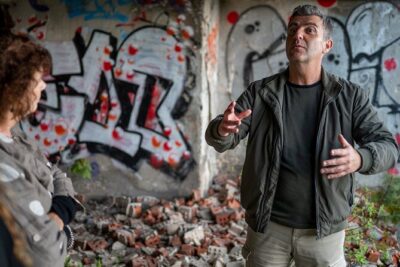
Sarajevo War Tour: A Veteran’s Story of the Siege (fees included)
Read our review →
Sarajevo to Srebrenica: Genocide Study Tour with War Veteran
Read our review →
Sarajevo Grand Tour: Old Town, War Tunnel, Olympic Sites & More
Read our review →
War Times Experience in Sarajevo – Half Day Tour
Read our review →Browse the lists this tour appears in