
REVIEW · WALKING TOURS IN SARAJEVO
Sarajevo: 2 Hours Old Town Walking Tour With Local Guide
Sarajevo reveals itself quickly. This two-hour walk brings you from Ottoman lanes to Austro-Hungarian grandness, with the city’s many faiths and cultures meeting along the way. I especially like the focus on East and West, and the small maximum of 10 people, which gives you room to ask questions instead of simply following a flag.
I also like the low price of $14.51, especially for a first morning in town. Guides such as Ahmed, Ilma, Hanan, Benjamin, Azra, Sara, and Arna have been praised for clear English, strong local knowledge, and useful advice about food and shopping. The main consideration is pace: two hours covers a lot, but several stops are viewed from outside, and this is not a dedicated tour of Sarajevo’s 1990s war sites.
In This Review
- Key points to know before you book
- Why two hours works well in Sarajevo
- Starting with Sarajevo’s oldest Orthodox church
- Baščaršija, Sebilj, and the copper street
- Sarajevo City Hall and Morica Han
- Gazi Husrev-beg Mosque and the unusual clock
- Jewish Sarajevo and the Meeting of Cultures
- The Catholic cathedral and Sarajevo’s religious mix
- Latin Bridge and the road to World War I
- What the guides add to the walk
- Price, group size, and practical value
- Who should book this Sarajevo walking tour?
- Should you book it?
- FAQ
- How long is the Sarajevo Old Town walking tour?
- Where does the tour start?
- Where does the tour end?
- Is the tour offered in English?
- Are admission fees included?
- What is the maximum group size?
Key points to know before you book
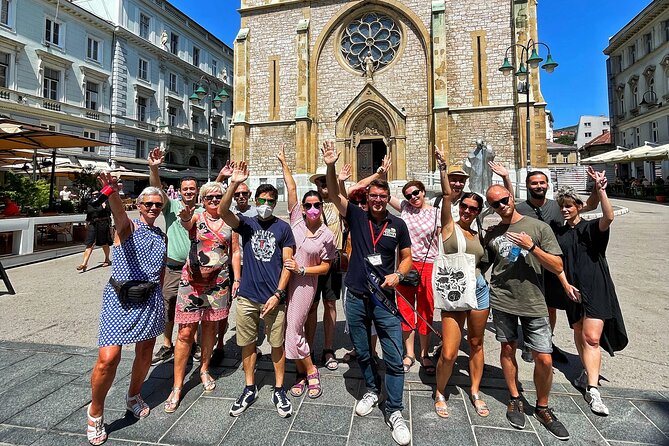
- Ottoman and Austro-Hungarian Sarajevo in one walk: See Baščaršija, Gazi Husrev-beg Mosque, Sarajevo City Hall, Latin Bridge, and much more.
- A tour about cultures meeting: The route includes Orthodox, Muslim, Jewish, and Catholic landmarks, plus the famous Sarajevo Meeting of Culture point.
- Small group size: The tour accepts no more than 10 people, and a smaller turnout may make the experience feel almost private.
- A strong first-day choice: The compact route helps you understand the Old Town before exploring on your own.
- History with local perspective: Guides explain the assassination of Franz Ferdinand, Sarajevo’s religious mix, local customs, and places to eat.
- Good value, with some extras: The guide is included, but food, drinks, and entry fees are not.
Why two hours works well in Sarajevo
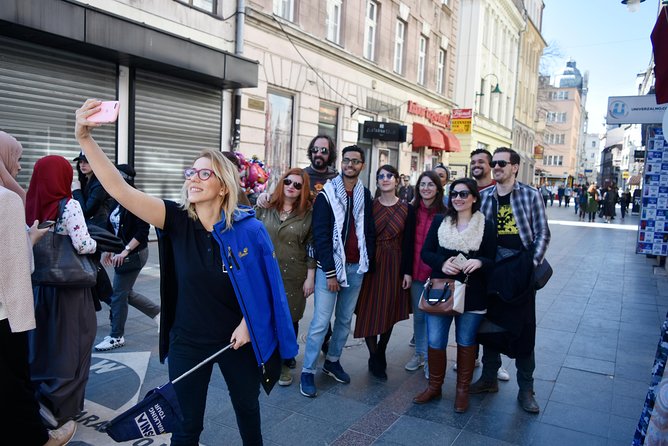
Sarajevo’s central sights sit close together. You can cross from the Ottoman quarter into the Austro-Hungarian center in a short walk, then reach the Latin Bridge without needing a bus or taxi. That makes this tour a useful way to get your bearings fast, especially if you arrive with only a day or two.
I like the route because it does not treat Sarajevo as a single-period city. You see the lanes and craft shops of the Ottoman era, the grand civic buildings of Austro-Hungarian rule, and religious sites tied to several communities. The guide’s job is to connect those pieces so the city feels like one place with many layers, not a string of unrelated monuments.
The tour begins at the Meet Bosnia Travel office on Gazi Husrev-begova Street, near the crossroads with Mula Mustafe Bašeskije. It ends back at the same point. That return is handy because you can leave your walking tour ready to eat, shop, visit a museum, or continue toward another part of Sarajevo.
The group limit is 10 people. That matters here. A large crowd can make it hard to hear in narrow streets or ask about small details. A five-person group, or an unusually quiet day with only one or two people booked, gives the guide more freedom to adjust the pace. One person received a private-style tour when they were the only booking, and the company did not cancel.
More Walking Tours in Sarajevo
- Private Walking Tour, Food Tasting and Bosnian Coffee in Sarajevo
★ 5.0 · 255 reviews - Sarajevo Grand Walking Tour
★ 5.0 · 232 reviews - Sarajevo Essential Full Walking Tour
★ 5.0 · 198 reviews
Starting with Sarajevo’s oldest Orthodox church
The opening stop at the Church of the Holy Archangels Michael and Gabriel gives you an early reminder that Sarajevo’s story is not only Ottoman or Muslim. The guide explains the church’s age, legends, and place in the city while you stand outside.
Because the itinerary lists no included admission, expect this to be an exterior explanation rather than a formal church visit. That is not a problem on a two-hour route, but it is worth knowing if you hoped to spend time inside. The stop lasts about 10 minutes, enough for orientation and context without slowing the walk.
This beginning works well because it sets up the tour’s main idea: Sarajevo has long been shaped by different religious and cultural communities living close together.
Baščaršija, Sebilj, and the copper street
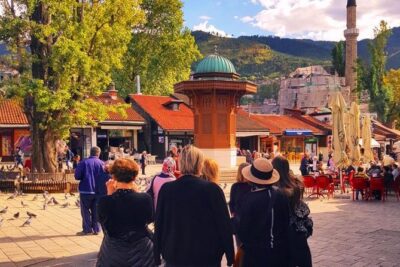
Baščaršija is the heart of old Sarajevo, and the tour gives it about 20 minutes. Here you see Sebilj, the famous wooden fountain in the square, and hear about the Ottoman period. The fountain is one of the city’s most recognizable symbols, so it is also a natural spot for photographs.
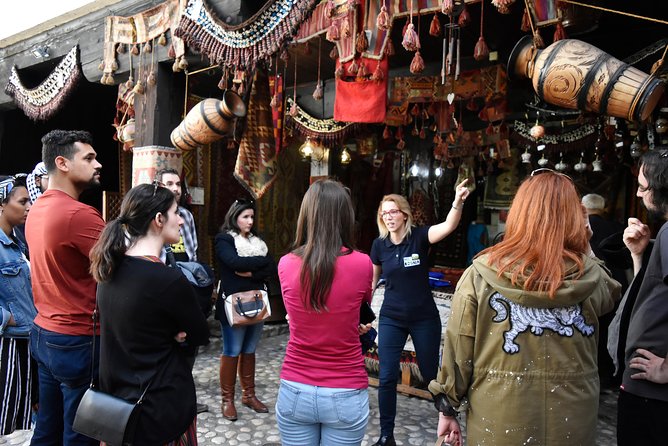
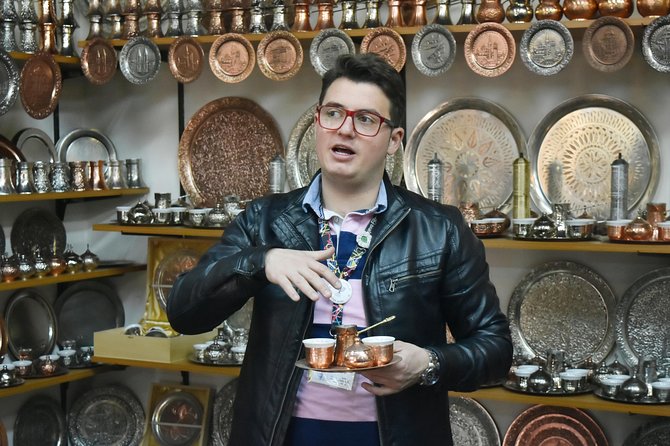
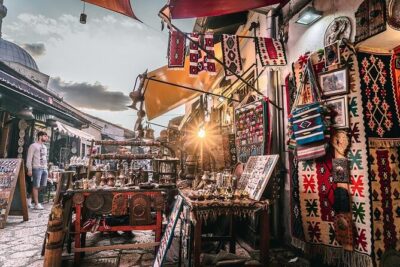
The route continues along Kazandžiluk, known as Sarajevo’s oldest street. Its name refers to the coppersmiths who made and sold household goods, coffee sets, trays, and decorative items. The craft shops give this part of the walk a more local feel than a standard list of monuments. You can see handmade copper work rather than simply hearing that Sarajevo once had an Ottoman bazaar.
There is a short, two-minute stop at Sebilj and another five minutes on Kazandžiluk, but the broader Baščaršija section lasts longer. That distinction matters. The schedule is not promising an extended shopping session. You will see the street, learn why it matters, and may have time to look at the work in the shop windows.
If you want to buy something, ask the guide for advice. One guide, Arna, was praised for connecting the tour with local food, shopping, and ordinary life. Advice like that can save you from buying the first souvenir you see.
Sarajevo City Hall and Morica Han
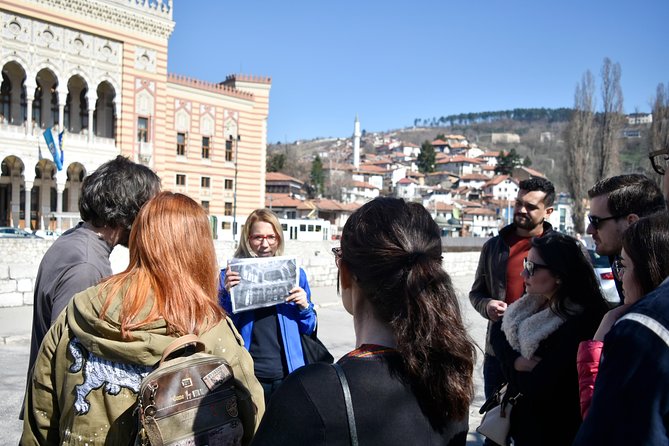
The walk then shifts from Ottoman Sarajevo to the Austro-Hungarian period at Sarajevo City Hall, known locally as Vijećnica. The building is one of the city’s grandest landmarks, with a striking historic design and a complicated past. It once served as the national library, and the guide explains its former role along with the building’s construction.
The planned stop lasts around 15 minutes. Admission is not included, so do not assume the tour ticket covers an interior visit. The main value here is the guide’s explanation and the chance to appreciate how sharply the building contrasts with the small Ottoman streets nearby.
After the city hall comes Morica Han, a former caravanserai for merchants and other people on the road. The courtyard is described as one of the most authentic surviving caravanserais in the Balkans. Today it serves a different purpose, but the layout helps you imagine Sarajevo as a trading stop where people, goods, and ideas passed through.
I find this pairing useful. City Hall shows imperial civic ambition, while Morica Han shows the practical life of merchants under Ottoman rule. Within a few minutes, you are looking at two very different ways Sarajevo functioned.
A completely different kind of day:
- Sarajevo: Mostar, Konjic, Blagaj Tekke, Pocitelj & Waterfall
★ 4.9 · 1,335 reviews - Fall of Yugoslavia, Sarajevo War Tour with Tunnel of Hope Museum and Frontlines
★ 5.0 · 1,314 reviews - Sarajevo: Mostar, Konjic, Sufi House, Pocitelj & Kravice Falls
★ 5.0 · 1,179 reviews - ROSES OF SARAJEVO (Official WAR + CITY tour)- Story of a Survivor
★ 5.0 · 770 reviews
Gazi Husrev-beg Mosque and the unusual clock
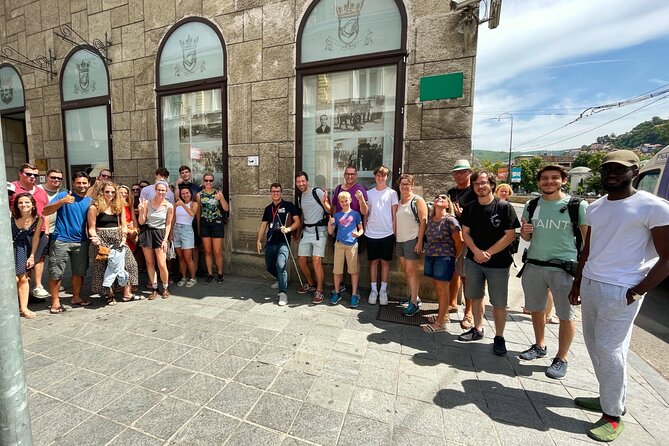
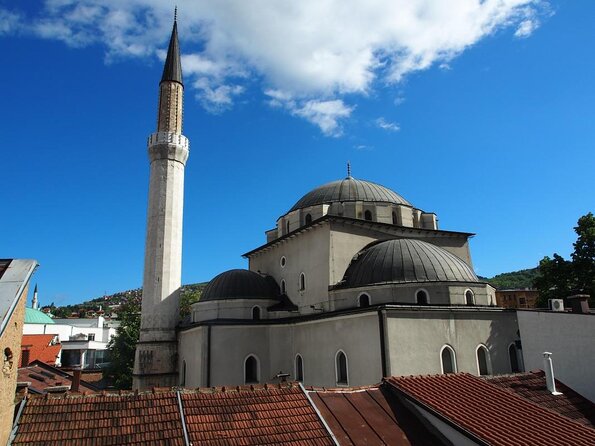
The tour allows about 20 minutes around Gazi Husrev-beg Mosque, the largest and one of the best-known mosques in Sarajevo. The guide points out its design and ornamentation, then connects the mosque to the nearby clock tower.
The mosque is an active religious site, so visitors should follow the guide’s instructions and dress and behave respectfully. The supplied information does not promise an interior visit, and admission is not included. You may spend much of this stop viewing the exterior and learning its place in Sarajevo’s Ottoman center.
The nearby Old Sarajevo Clock Tower is a small but memorable detail. Its clock shows lunar time, meaning it keeps the traditional time used for Muslim prayer schedules rather than ordinary modern clock time. That makes it unusual in a city already full of reminders that different eras and customs overlap.
The clock tower stop lasts about five minutes. Do not expect a long visit, but do pay attention. Small details like this often make the walk more rewarding than a quick parade past famous facades.
Jewish Sarajevo and the Meeting of Cultures

The Jewish Museum of Bosnia and Herzegovina occupies a former Sephardic synagogue. The guide tells the story of Jews in Bosnia and Herzegovina, adding another important strand to Sarajevo’s past.
Entrance is optional and not included. The tour schedule allows roughly 15 minutes, which gives you time to decide if you want to go inside, depending on the museum’s opening arrangements and your group’s timing. If you are interested in Jewish history, ask whether there is enough time for a visit. If not, the exterior and guide’s explanation still add useful context.
From there, the route reaches Sarajevo Meeting of Culture. A line in the pavement marks the change from the Ottoman-influenced eastern side of the center to the Austro-Hungarian western side. It is a simple spot, but it makes the city’s geography easy to understand.
This is one of the most effective parts of the tour because you can see the change with your own eyes. One direction leads toward the market lanes and mosque courtyards. The other points toward European-style streets, the Catholic cathedral, and later Austro-Hungarian buildings.
The Catholic cathedral and Sarajevo’s religious mix
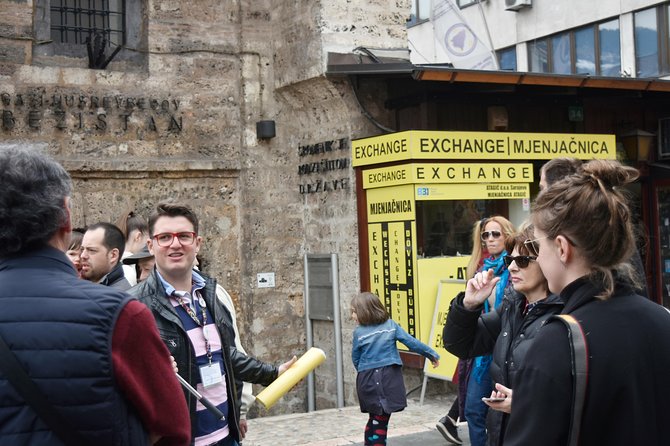
The Cathedral of the Sacred Heart of Jesus is the route’s Catholic landmark. The guide explains the role of Catholics in Bosnia and Herzegovina and gives you time to see the church.
The stop is scheduled for about 15 minutes and is listed as free. It provides a calm counterpoint to the market streets and a chance to consider how several religious traditions have shared the central area of Sarajevo.
I appreciate that the tour does not use religious buildings as a rushed checklist. The best guides, including Hanan and Azra according to the supplied feedback, place each site in a wider story about the city and its people. You should have opportunities to ask questions, particularly if you want more than dates and architectural labels.
Latin Bridge and the road to World War I
The final major stop is Latin Bridge, where the guide explains the assassination of Archduke Franz Ferdinand and its role in triggering the First World War. The bridge itself is attractive, but its importance comes from the event linked to the nearby street corner.
The stop lasts around 20 minutes, making it one of the longer sections of the tour. That is appropriate. The assassination is easy to reduce to a single dramatic moment, but a good explanation covers what happened before it and what followed.
One guide, Alen, was praised for explaining the events leading up to the assassination and its effect on the modern world. That kind of context is what you should want here. The site is small, and without a guide it can be easy to take a photograph and move on without understanding why this corner matters.
The tour then returns to the original meeting point. Its focus is mainly Sarajevo’s longer history, especially the Ottoman and Austro-Hungarian periods. Modern history may appear where it helps explain the city, but you should not book this as a 1990s siege tour. Meet Bosnia offers separate experiences for war-related sites.
What the guides add to the walk
The strongest part of this experience is the guiding. The available feedback repeatedly praises guides for clear English, patience, warmth, and the ability to answer questions. Names that come up include Ahmed, Ilma, Hanan, Benjamin, Azra, Sara, Arna, Alen, Cecilia, Amina, Muhammad, Viki, Kiki, and Mesud.
That range suggests you may be assigned a different guide, so do not book around one particular name unless the company confirms it. The useful point is the pattern: the guides are expected to explain Sarajevo rather than simply point at buildings.
Ahmed was described as a history major with excellent English. Hanan was praised for combining city knowledge with personal insights. Arna offered practical advice about food, shopping, and local life. Cecilia handled a rainy walk with good humor, while other guides adjusted their pace and found shade during difficult weather.
One especially personal account described a guide who had been a child during the 1990s conflict. That perspective can add emotional weight, but the tour is not built around war memories. You should expect the main attention to remain on Sarajevo’s broader past and cultural meeting points.
Price, group size, and practical value
At $14.51 per person, this is inexpensive for a guided two-hour introduction. You are paying for a local and professional guide, not for meals, transportation, or a long museum program. Since the central route is walkable, the price goes toward interpretation, orientation, and access to local knowledge.
I think the value is strongest on your first day. After the walk, you will know where Baščaršija, the mosque, cathedral, city hall, Jewish Museum, and Latin Bridge are located. You will also have a useful sense of which areas deserve a second look.
The tour has a maximum of 10 people, but the actual group may be smaller. A small group gives you a better chance to ask about restaurants, copper goods, customs, and places you pass along the way. It may also let the guide slow down for photographs or explain a subject that catches your interest.
The tradeoff is that two hours is tight for 13 listed stops. Some stops last only two to five minutes, and several attractions are explained from outside. If you want to enter City Hall, the mosque, or the Jewish Museum, plan a separate visit or confirm how much time your guide can allow.
The tour is offered in English and may be led by a multilingual guide. It is near public transportation, service animals are allowed, and most people can take part. Wear comfortable shoes, since the experience is entirely on foot. Rain will not necessarily ruin the walk, but a wet-weather layer is sensible. The guides have handled rain and heat well, though the route has little room for lingering indoors.
You can cancel free of charge up to 24 hours before the start for a full refund. Changes made inside that 24-hour window are not accepted, and a minimum group requirement applies. If the company cancels because that minimum is not reached, you will be offered another date or experience, or a full refund.
Who should book this Sarajevo walking tour?
I would choose this tour if you want a clear introduction without spending half a day on foot. It suits first-time visitors, history fans, families who prefer a small group, and anyone arriving in Sarajevo with limited time.
It is also a good choice if you want the city’s religious and cultural mix explained carefully. The route includes Orthodox, Muslim, Jewish, and Catholic landmarks, then ties them together at the Meeting of Culture point.
Families may appreciate the modest duration and group limit. A private-style booking can be especially helpful if you are traveling with a child and need a slower pace. The main caution is that young children may find the history-heavy explanations long if they are not interested in buildings or past events.
I would pick another tour if your main goal is the 1990s siege, war tunnels, or memorial sites. Those subjects can come up, but they are not the center of this walk.
Should you book it?
Yes, if you want an affordable and well-organized first look at Sarajevo’s Old Town. The route covers a remarkable number of important places in two hours, and the focus on cultures meeting gives the walk more purpose than a basic monument checklist.
Book it early in your stay, then use the remaining days to return to the places that interest you most. Just remember that the low price does not include food, drinks, or entry fees, and that some landmarks are viewed from outside. For $14.51, though, this is a sensible way to understand Sarajevo before setting off on your own.
FAQ
How long is the Sarajevo Old Town walking tour?
The tour lasts approximately two hours.
Where does the tour start?
It starts at the Meet Bosnia Tours office at Gazi Husrev begova 75, near the crossroads of Gazi Husrev-begova and Mula Mustafe Bašeskije in Sarajevo.
Where does the tour end?
The activity ends back at the original meeting point.
Is the tour offered in English?
Yes. The tour is offered in English, and the guide may be multilingual.
Are admission fees included?
No. Food, drinks, and attraction entry fees are not included. Entry to the Jewish Museum is optional, and the itinerary lists admission as not included for several other sites.
What is the maximum group size?
The tour has a maximum of 10 people. The actual group may be smaller, and in some cases only one person has booked.
Just added in Sarajevo
- Sarajevo Under Siege: A War History Tour★ 5.0 · 10 reviews
- Walking Tour in Sarajevo★ 5.0 · 3 reviews
- Private Full Day Safari Tour★ 5.0 · 8 reviews
- Bosnian Pyramid: The World’s Largest Pyramid (From Sarajevo)★ 5.0 · 1 review
- Ultimate adventure★ 5.0 · 2 reviews
- Mysterious Visoko Pyramids Driving and Walking Tour★ 5.0 · 7 reviews
- Travnik, Jajce, Pliva Lakes & Mills –Medieval & Ottoman Bosnia Full Day Tour★ 5.0 · 3 reviews
- Sarajevo to/from Zagreb Transfer Day Tour (North-central Bosnia)★ 5.0 · 4 reviews
Walking Tours in Sarajevo, compared.
Private Walking Tour, Food Tasting and Bosnian Coffee in Sarajevo
Read our review →
Delicious Sarajevo: Eat, Walk & Discover City Tour
Read our review →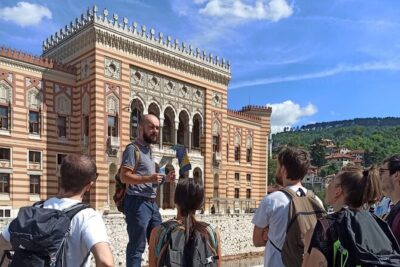
PROFESSIONAL SARAJEVO WALKING TOUR – With guide who guided STING!
Read our review →
Sarajevo genuine walking tour: Steps through history
Read our review →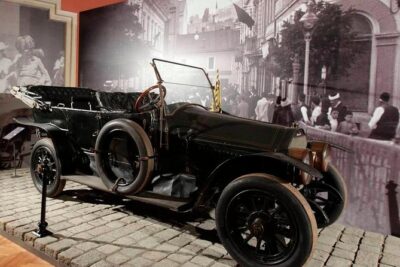
Browse the lists this tour appears in