
REVIEW · SARAJEVO WAR HISTORY TOURS
ROSES OF SARAJEVO (Official WAR + CITY tour)- Story of a Survivor
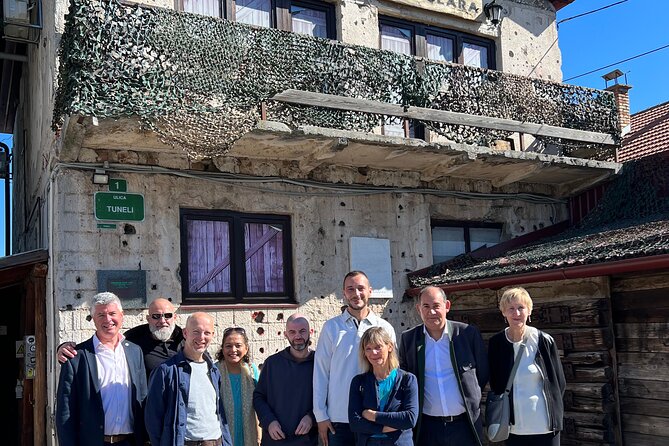
History feels close here. The Roses of Sarajevo tour combines the city’s Ottoman, Austro-Hungarian, Yugoslav, and wartime landmarks with the personal story of a Sarajevo survivor. In about four hours and 15 minutes, you travel by air-conditioned minivan from the old center to the Tunnel of Hope, Dobrinja, the former sniper positions, the Olympic bobsleigh track, the Jewish Cemetery, and several panoramic viewpoints.
I especially like two things: the tour covers a remarkable amount of ground, and the guide’s firsthand account gives the Siege of Sarajevo a human face. Guides named Mak and Alen receive especially warm praise for their clear explanations, humor, and care with painful subjects. The main consideration is emotional weight. This is not a light sightseeing outing, and the stories of childhood, shelling, displacement, and loss can stay with you.
At $53.21 per person, the tour offers strong value if you want context rather than a quick drive past famous sights. You still pay €10 for entry to the Tunnel of Hope Museum, so budget for that extra cost. The group can be as large as 15 people, with one guide limited to eight people, so ask about your group arrangement when booking.
In This Review
- Key things to know before you book
- Starting in the old city, then widening the story
- The Tunnel of Hope and Sarajevo’s survival system
- Roses, shellfire, and the geography of the siege
- Dobrinja and the survivor’s childhood
- East Sarajevo and Trebević’s sniper positions
- The Olympic bobsleigh track and Yugoslav Sarajevo
- Urijan Dedina and the best view of Sniper Alley
- The Jewish Cemetery and Sarajevo’s European Jerusalem
- Bridges, first victims, and Sarajevo’s central landmarks
- Yellow Fortress and the final city view
- What $53.21 gets you
- Who should take Roses of Sarajevo?
- Should you book this Sarajevo tour?
- FAQ
- How long does the Roses of Sarajevo tour last?
- What is included in the tour price?
- Is the Tunnel of Hope Museum admission included?
- Where does the tour start and end?
- Is the tour offered in English?
- How large is the tour group?
- Can I cancel for a full refund?
Key things to know before you book
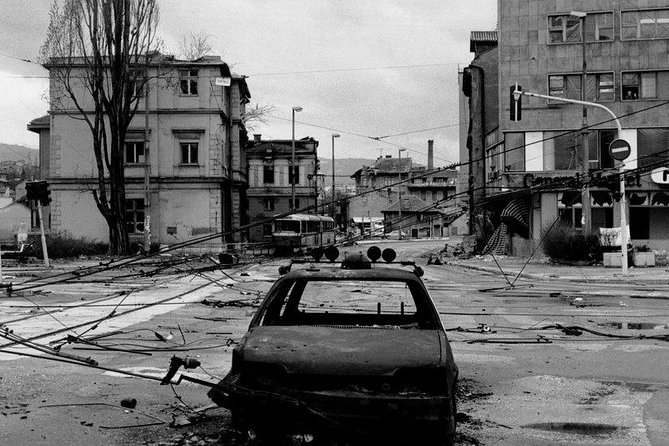
- A survivor leads the wartime story: Mak’s personal memories connect Sarajevo’s streets, frontlines, and escape routes to real family experience.
- The Tunnel of Hope is the central stop: You watch a 17-minute, 44-second film, see the war house and museum displays, then walk through part of the tunnel.
- You see Sarajevo from several angles: The route reaches Trebević, Urijan Dedina, Yellow Fortress, Satellite Hill, and the main Sniper Alley corridor.
- The tour also covers older Sarajevo: Ottoman monuments, Austro-Hungarian buildings, Jewish heritage, Yugoslav architecture, the Latin Bridge, and City Hall are part of the story.
- It is a driving tour with short walks: Most stops last 5 to 30 minutes, making this a practical choice when you have limited time or prefer not to walk across the city.
- The subject matter is serious: You will hear about the 1992 to 1995 siege, minefields, shelling, sniper positions, civilian deaths, and the war’s effect on families.
Starting in the old city, then widening the story
The tour begins at Đulagina 2, close to Sarajevo’s historic center. Early explanations set up the city before the minivan heads toward the wartime sites.
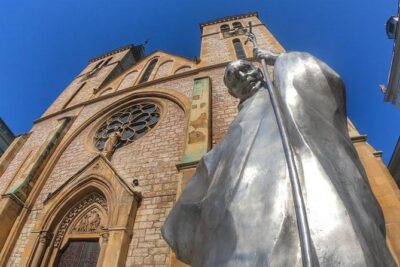
You hear about the Sacred Heart of Jesus Cathedral, one of Sarajevo’s important religious landmarks, and the city’s nickname, Little Yugoslavia. That name points to Sarajevo’s mix of cultures and communities. The tour also introduces Bosnia and Herzegovina’s Ottoman, Austro-Hungarian, and Yugoslav periods, so the later war story does not arrive without context.
One useful feature is the drive itself. More than 20 monuments are explained along the way, including landmarks from several eras. You are not simply taken from one war site to another. You begin to see how Sarajevo’s religious buildings, public institutions, streets, and hills fit together.
The guide also explains why Sarajevo is sometimes called the European Jerusalem. Jewish, Muslim, Catholic, and Orthodox communities have all shaped the city. That mix matters later, when you visit the Jewish Cemetery, the Ashkenazi Synagogue, the Cathedral, and other central landmarks.
Other tours covering the siege of Sarajevo:
- Fall of Yugoslavia, Sarajevo War Tour with Tunnel of Hope Museum and Frontlines
★ 5.0 · 1,314 reviews - Tunnel Museum: Bosnian & Yugoslav Wars Tour with War Veteran
★ 5.0 · 551 reviews - Sarajevo War Tour: A Veteran’s Story of the Siege (fees included)
★ 5.0 · 326 reviews
The Tunnel of Hope and Sarajevo’s survival system
The Tunnel of Hope Museum is the tour’s main admission stop. Entry costs €10 per person and is not included in the tour price.
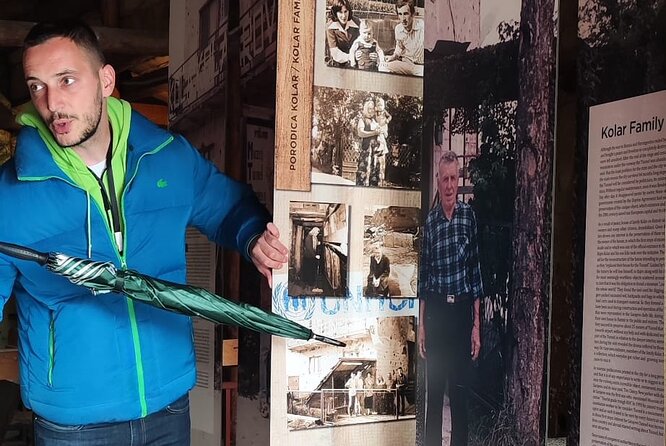
The site includes a war house connected with the Kolar family, a museum focused on the 1992 to 1995 war, a war room, a war journal area, and a section of the tunnel itself. You also watch an ongoing film lasting 17 minutes and 44 seconds. That film gives the visit a fixed historical frame before the guide adds personal and local detail.
The tunnel was part of Sarajevo’s survival route during the siege. You walk through the preserved section, then have about 10 to 15 minutes of free time. The walk is short, but the setting carries unusual force because the tunnel was tied to movement, supplies, and access during a period when normal roads were blocked or exposed.
The tour also points out minefields in the surrounding area. This is one reason the minivan matters. Some wartime sites sit outside the compact old center, and the route connects them without requiring you to work out separate transport.
Allow about two hours for the Tunnel of Hope portion and the drive around this part of the city. The museum is not a polished attraction in the usual sense. It is direct, sobering, and focused on material evidence and testimony. I would not rush this section, even though the rest of the tour has many stops.
Roses, shellfire, and the geography of the siege
The name of the experience comes from Sarajevo Roses, the red resin markings placed in mortar scars where civilians were killed. The guide explains the largest Sarajevo Rose in the city and discusses the number of victims in 1994 and 1995.
The markings are not decorative. They turn the damage left by shelling into memorials that you can recognize on ordinary pavement. This helps you understand how the siege remains present in the city’s daily spaces, rather than being confined to a museum.
You pass through the main and deadliest section of Sniper Alley. The route includes the Holiday Inn, known during the war as a place used by war journalists and also for exchanges of soldiers during the siege. You see the Historical Museum of Bosnia and Herzegovina near a key Sniper Alley position, and the guide explains the former Oslobođenje newspaper institution, whose name means Liberation Journal.
The drive continues toward Satellite Hill, where you learn about the Bosnian Army’s core defensive zone and strategy. At another central Sarajevo area, you see bullet holes on buildings and the Yellow Towers with leftover grenade damage. The guide also gives the United Nations’ official statistics for grenades fired from Trebević Mountain during the nearly four-year siege.
This section works because the guide links three things: the view from the hills, the exposed streets below, and the marks still visible on buildings. You begin to understand why Sarajevo’s geography mattered so much.
Dobrinja and the survivor’s childhood
At Butmirska cesta, you visit the survival path and Free Bosnian territory. The stop lasts about 10 minutes and is free.
The tour then reaches Dobrinja, another 10-minute stop. This is especially important because the survivor guide was born near one of the siege’s main frontlines. He explains what it was like to grow up in the area before, during, and after the war.
This personal section is the heart of the tour for many people. Dates and military maps can explain the siege, but a childhood street explains what those events meant in ordinary life. The guide’s story also reaches beyond the war itself, including escape, refuge in Switzerland, and the difficulties of returning after the conflict.
You should come prepared to listen rather than expect a staged performance. The strongest part of the experience is the directness of the account. It gives the surrounding sites a human scale, while the guide’s humor helps the tour breathe between difficult subjects.
More city tours in Sarajevo:
- Delicious Sarajevo: Eat, Walk & Discover City Tour
★ 4.5 · 37 reviews - Sarajevo City SIghtseeing / War Bike Tour
★ 5.0 · 13 reviews - Sarajevo: A City Under Siege – War Tour With Tunnel Museum
★ 5.0 · 4 reviews - Sarajevo E-Bike City Tour
★ 5.0 · 3 reviews
East Sarajevo and Trebević’s sniper positions
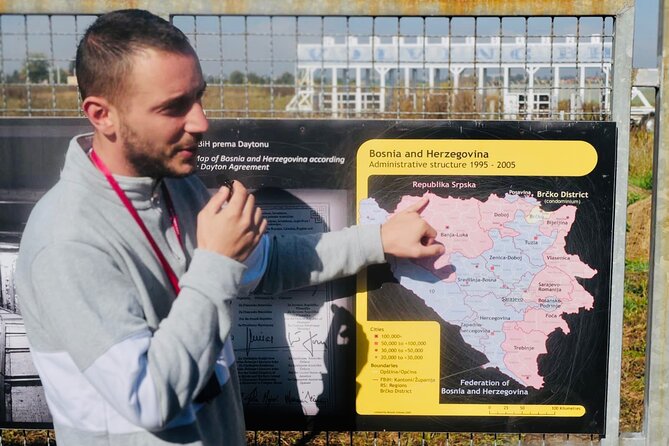
The minivan crosses into East Sarajevo, located in the Republika Srpska entity, one of the two entities that make up Bosnia and Herzegovina. The guide explains the country’s current political structure and the main differences between the two entities, along with the country’s ethnic diversity.
This is an important part of the tour because the war is not treated as a closed chapter. The political shape left by the conflict still affects how Bosnia and Herzegovina is organized. You also see current war murals in East Sarajevo.
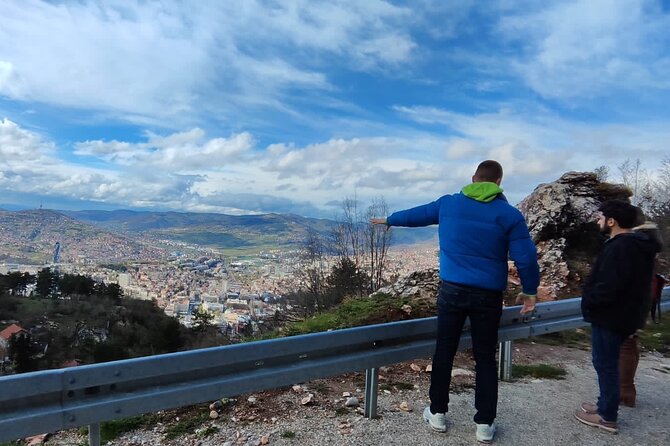
At Trebević Vidikovac, you have about 20 minutes for mountain views and an explanation of the first and second sniper zones. The guide points out SunnyLand, a modern entertainment facility known here as the Bosnian Disneyland, which occupied a former sniper zone during the 1992 to 1995 war.
That contrast can feel strange, and intentionally so. A leisure site now occupies ground connected with danger and shelling. You are asked to hold both realities in mind: Sarajevo as a city rebuilding normal life, and Sarajevo as a place where the hills once controlled the streets below.
The Olympic bobsleigh track and Yugoslav Sarajevo
The Sarajevo Olympic bobsleigh and luge track is one of the tour’s most memorable visual stops. You have about 30 minutes to walk along the famous 1984 Olympic track and reach the best photo spot.
The track also helps explain the city’s Yugoslav identity. Sarajevo hosted the Winter Olympics in 1984, before the war altered the city’s future. The tour places the Olympic site beside the communist-Yugoslav architecture and neighborhoods, showing a Sarajevo that was once presented to the world as a modern international city.
You also pass the 1984 Olympic village and explore a hilly neighborhood known as a mahala. The guide uses the neighborhood to explain local social life and the distinctive way Sarajevo’s hills and communities developed.
There is a practical note here: this is not only a photo stop. The track requires walking, and the tour’s subject matter means you may want time to look around rather than take a quick picture and return to the van. Comfortable shoes are sensible.
Urijan Dedina and the best view of Sniper Alley
At Urijan Dedina, you stop for about 10 minutes at a viewpoint over Sarajevo’s Sniper Alley. This is one of the clearest places to grasp the city’s shape.
From above, the corridor below is easier to read. The guide can point out the relationship between the main road, built-up areas, and the surrounding hills. Earlier explanations about shelling and sniper fire become easier to place when you can see the city as a whole.
The tour includes several viewpoints, but each has a different purpose. Trebević focuses on the sniper zones and defensive positions. Urijan Dedina provides a broad view of Sniper Alley. Yellow Fortress later gives a sweeping city panorama, often especially appealing near sunset.
The Jewish Cemetery and Sarajevo’s European Jerusalem
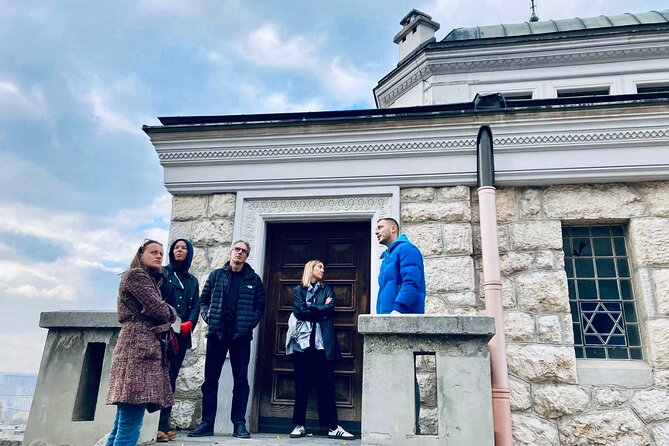
The Jewish Cemetery stop lasts about 25 minutes and is free. You see monuments dating to the 16th century, a memorial to Jewish victims of the Second World War, and the Jewish Synagogue.
The guide uses the cemetery to explain Sarajevo’s European Jerusalem identity and the life of its Jewish communities. The tour also introduces the Sarajevo Haggadah, an important illuminated Jewish manuscript associated with the city’s cultural story.
Later, the route shows the Ashkenazi Synagogue and explains Ashkenazi Jewish life in Sarajevo. This helps prevent the tour from presenting the city only through Ottoman or wartime history. Its religious and cultural story is broader, and the Jewish sites make that clear.
The cemetery is also a quieter pause in a packed itinerary. After the tunnel, frontlines, and sniper positions, the older stones and memorials create room for reflection.
Bridges, first victims, and Sarajevo’s central landmarks
At the Suada and Olga Bridge, the tour visits both sides of the Vrbanja Bridge. One side is tied to the first victim of the Sarajevo siege. The other is known through the story of a couple killed while trying to cross during the war, remembered as Sarajevo’s Romeo and Juliet.
The stop lasts about five minutes, so the explanation is brief. Still, the location carries a lot of meaning. You also see the building that was hit by the first shot at the beginning of the Sarajevo War.
The route passes the Skenderija Olympic hall and another frontline area from 1992 to 1995. It then turns toward the Austro-Hungarian center, where the architecture changes sharply. Neo-Gothic buildings, public squares, and central institutions show the city’s European imperial layer.
At the Latin Bridge, you hear about the assassination of Franz Ferdinand, the event that helped trigger the First World War. The nearby Hotel Saray adds another piece of the central-city story.
The tour also introduces City Hall, now associated with the National Library. The building has been burned twice during its history. This is a good example of how the experience connects major world events with Sarajevo’s own repeated struggles over memory, culture, and survival.
At At Mejdan Park, the guide adds another local story. The information provided for this stop is brief, but it gives you a chance to see how much of Sarajevo’s history is attached to ordinary parks, bridges, and buildings.
Yellow Fortress and the final city view
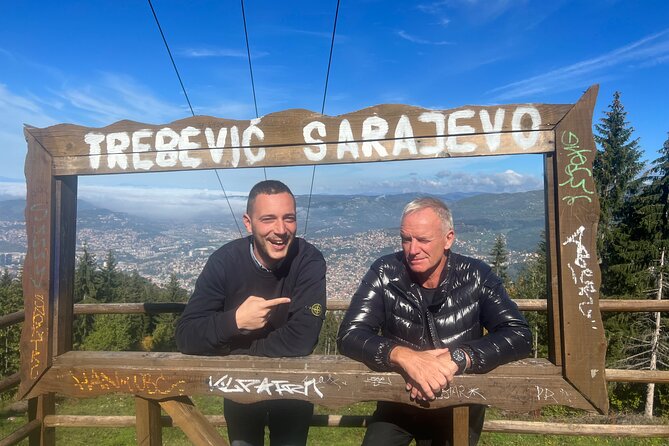
The final major stop is Yellow Fortress, where you have about 20 minutes. It is described as the best panorama and sunset spot in Sarajevo, and the guide explains the city’s Ottoman past from this elevated position.
This is a fitting end. The tour begins among central religious and historic landmarks, moves through the Tunnel of Hope and wartime frontlines, climbs toward the sniper positions, and finishes with the city spread below you.
The view does not erase what you have heard. It gives the day a wider frame. Sarajevo appears as a living city with Ottoman walls, Austro-Hungarian streets, Yugoslav buildings, Olympic facilities, rebuilt neighborhoods, and reminders of the siege all sharing the same space.
What $53.21 gets you
The $53.21 price includes the driver-guide and air-conditioned minivan. It does not include the €10 Tunnel of Hope admission fee.
I consider that a fair price for the amount of ground covered and the time saved. You would need several separate taxi rides or a carefully planned combination of transport to reach the tunnel, Dobrinja, East Sarajevo, Trebević, the bobsleigh track, Urijan Dedina, and Yellow Fortress on your own.
The value also depends on your interest in guided history. If you only want a broad city tour, you may find four hours of war detail too intense. If you want to understand the siege and its continuing effect on Sarajevo, the guide’s firsthand account makes the cost easier to justify.
The experience is offered in English, uses mobile tickets, and usually sells around 23 days before the tour date. It is often best to book ahead, particularly if you want a certain guide, such as Mak. Confirmation arrives at booking, and the tour returns to Đulagina 2.
Free cancellation is available up to 24 hours before the start time. Children must be accompanied by an adult. Most people can participate, but remember that the route includes short walks at the tunnel, bobsleigh track, cemetery, and viewpoints.
Who should take Roses of Sarajevo?
I would choose this tour early in a Sarajevo stay. It gives you a working map of the city and makes later independent visits more meaningful.
It suits you best if you:
- Want a serious explanation of the Siege of Sarajevo
- Value personal testimony alongside political and military context
- Have only one full day or limited time in the city
- Want to see the Tunnel of Hope and Olympic sites in one outing
- Prefer transport between distant hills and neighborhoods
- Are interested in Bosnia and Herzegovina’s current political structure
You may want a different tour if you prefer a relaxed food, architecture, or nightlife experience. This outing includes beautiful views and famous buildings, but the siege remains its center. The guide handles the subject with warmth and occasional humor, yet the material is still traumatic.
Should you book this Sarajevo tour?
Yes, if you want to understand Sarajevo rather than simply photograph it. The combination of the Tunnel of Hope, Sniper Alley, Trebević, the Olympic bobsleigh track, Jewish heritage sites, Ottoman landmarks, and a survivor’s childhood story gives the city unusual depth.
Book it early, bring comfortable shoes, and set aside the €10 museum fee. If possible, request Mak, whose personal storytelling and clear explanations are repeatedly praised, though Alen and other guides may also lead the tour.
I would skip it only if you know that war history will make your trip too heavy. For everyone else, Roses of Sarajevo is a powerful and efficient introduction to a city that asks you to remember while carrying on.
FAQ
How long does the Roses of Sarajevo tour last?
The tour lasts approximately 4 hours and 15 minutes and ends back at the starting point.
What is included in the tour price?
The price includes a driver-guide and transport in an air-conditioned minivan.
Is the Tunnel of Hope Museum admission included?
No. Admission costs €10 per person and must be paid separately.
Where does the tour start and end?
The tour starts at Đulagina 2, Sarajevo 71000, Bosnia and Herzegovina, and ends back at the same meeting point.
Is the tour offered in English?
Yes. The experience is offered in English and uses a mobile ticket.
How large is the tour group?
One guide can have a maximum of eight people, while the overall activity can have up to 15 participants.
Can I cancel for a full refund?
Yes. You can cancel at least 24 hours before the experience start time for a full refund. Changes or cancellations made less than 24 hours before the start time are not accepted, and the tour may also be canceled if its minimum number of participants is not reached.
Just added in Sarajevo
- Sarajevo Under Siege: A War History Tour★ 5.0 · 10 reviews
- Walking Tour in Sarajevo★ 5.0 · 3 reviews
- Private Full Day Safari Tour★ 5.0 · 8 reviews
- Bosnian Pyramid: The World’s Largest Pyramid (From Sarajevo)★ 5.0 · 1 review
- Ultimate adventure★ 5.0 · 2 reviews
- Mysterious Visoko Pyramids Driving and Walking Tour★ 5.0 · 7 reviews
- Travnik, Jajce, Pliva Lakes & Mills –Medieval & Ottoman Bosnia Full Day Tour★ 5.0 · 3 reviews
- Sarajevo to/from Zagreb Transfer Day Tour (North-central Bosnia)★ 5.0 · 4 reviews
Sarajevo War History Tours, compared.
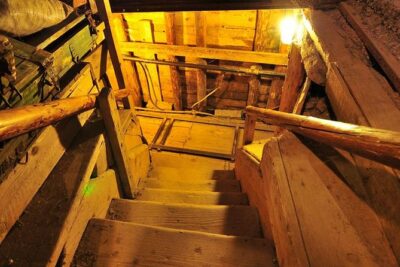
Fall of Yugoslavia, Sarajevo War Tour with Tunnel of Hope Museum and Frontlines
Read our review →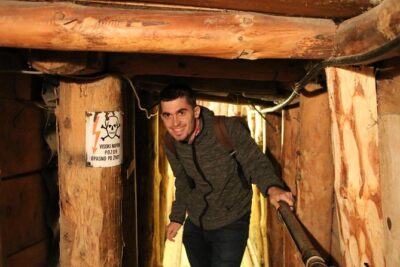
Tunnel Museum: Bosnian & Yugoslav Wars Tour with War Veteran
Read our review →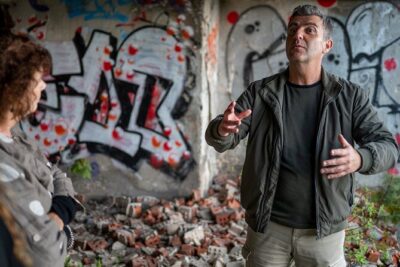
Sarajevo War Tour: A Veteran’s Story of the Siege (fees included)
Read our review →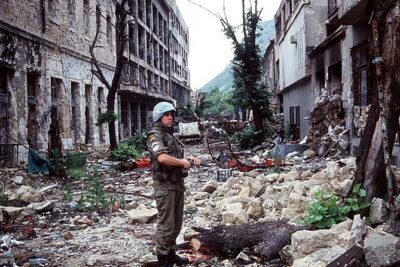
Break-up of Yugoslavia & The War in Mostar: Life Under Siege
Read our review →
Sarajevo to Srebrenica: Genocide Study Tour with War Veteran
Read our review →
Sarajevo Grand Tour: Old Town, War Tunnel, Olympic Sites & More
Read our review →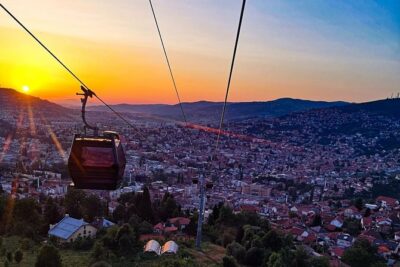
War Times Experience in Sarajevo – Half Day Tour
Read our review →Browse the lists this tour appears in