REVIEW · MUSEUMS
SARAJEVO CONCEPTUAL ART TOUR (galleries, art and arhitecture)
Sarajevo’s art scene has a story to tell. This small-group walking tour links contemporary galleries, war memorials, public art, and city architecture in a compact route through the center. I like that you get more than gallery walls: the walk includes Sarajevo Roses, a Srebrenica memorial, and a bridge with a memorable name and design.
I also like the personal touch from guide Mak, who shares his own wartime experiences and helps you reach places that are easy to miss on your own. The main consideration is pace: two to three hours covers several stops, so gallery time may feel brief if you want to study every artwork slowly.
In This Review
- Key points about Sarajevo’s art walk
- Why Sarajevo’s art scene deserves a closer look
- Brodac Gallery, art inside an old prison
- Ferhadija Street and Sarajevo’s red memorial scars
- Java Gallery and Sarajevo’s working art scene
- Veliki Park and the Srebrenica memorial
- Coffee at Gallery BORIS SMOJO and the Festina Lente bridge
- What Mak adds to the experience
- Who will get the most from this tour
- Is $33.64 a fair price?
- Should you book the Sarajevo Conceptual Art Tour?
- FAQ
- Where does the Sarajevo Conceptual Art Tour begin?
- What time does the tour start?
- Where does the tour end?
- How long does the tour last?
- What language is the tour offered in?
- How many people can join the tour?
- Is admission included at the galleries?
- Are the Sarajevo Roses included in the route?
- Does the tour visit a memorial to Srebrenica?
- Can the tour be canceled for a full refund?
Key points about Sarajevo’s art walk
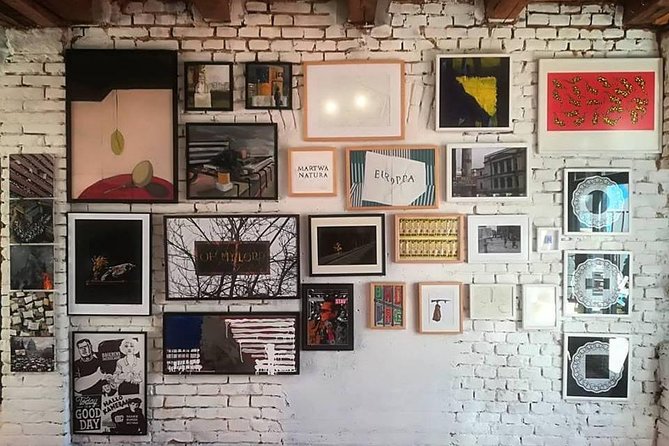
- Brodac Gallery occupies a former Austro-Hungarian-era prison, now used for contemporary Bosnian art and local craft beer.
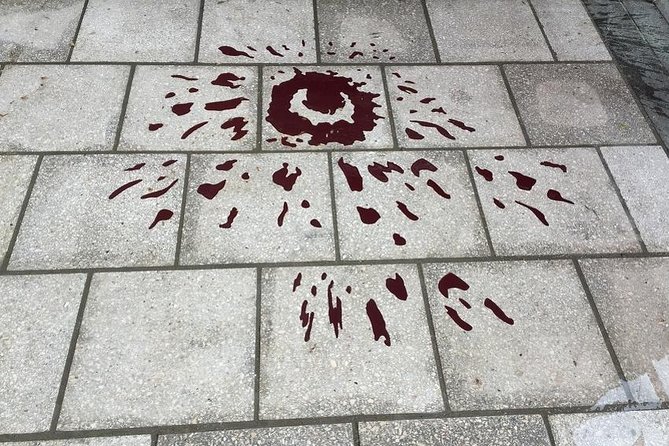
- Sarajevo Roses turn mortar scars into memorial art, making the city’s wartime past visible under your feet.
- Mak brings personal wartime experience and, according to one particularly warm review, even gave a participant a book he wrote.
- Java Gallery supports Bosnian and international artists in a central exhibition space on Titova Street.
- The tour includes Nermine, dođi, a powerful sculpture about the Srebrenica genocide in Veliki Park.
- A coffee break at Gallery BORIS SMOJO leads to the Festina Lente bridge, giving the tour a relaxed finish.
Why Sarajevo’s art scene deserves a closer look
Sarajevo is often introduced through its Ottoman streets, Austro-Hungarian buildings, and wartime scars. This tour adds another layer: the city as a place where artists respond to memory, politics, urban life, and public space.
I like the way the route joins formal galleries with art you encounter outdoors. One moment you are looking at a contemporary exhibition in an old building. Soon after, you are standing beside a red-filled mortar scar in the pavement or a sculpture in a public park. That contrast gives the tour its purpose.
The price is $33.64 per person, which is reasonable if you value a guide and several arranged gallery visits. You are not simply paying for a walk between sights. The fee covers admission to Brodac Gallery, Java Gallery, and Gallery BORIS SMOJO, along with the effort of organizing a route that would take some planning to repeat alone.
The group is limited to 15 people. That is not a private tour, but it is small enough to make questions and conversation possible. The tour is offered in English and lasts about two to three hours, beginning at 1:00 pm. Since the route uses central city streets and public areas, you should expect walking rather than a vehicle-based sightseeing trip.
More museums in Sarajevo:
- Fall of Yugoslavia, Sarajevo War Tour with Tunnel of Hope Museum and Frontlines
★ 5.0 · 1,314 reviews - Tunnel Museum: Bosnian & Yugoslav Wars Tour with War Veteran
★ 5.0 · 551 reviews - Tunnel of Hope Museum Tour
★ 5.0 · 38 reviews
Brodac Gallery, art inside an old prison
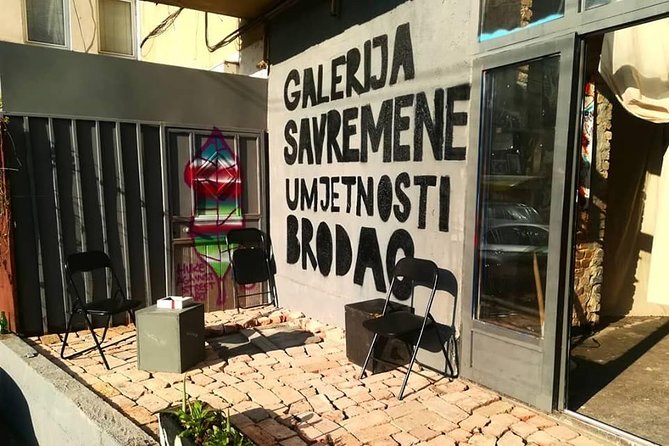
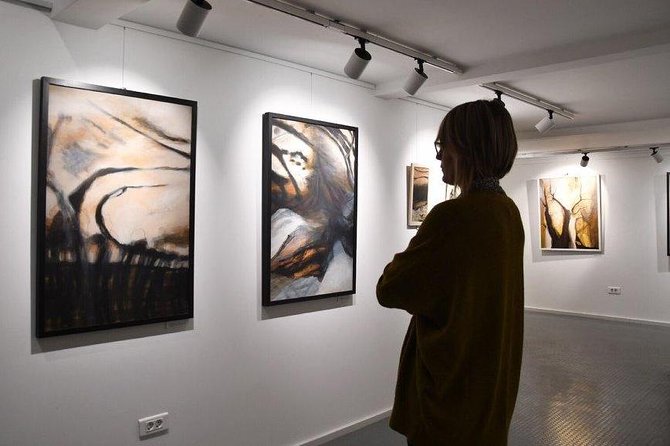
The tour begins at Đulagina 2, at Brodac Gallery. The building itself sets the tone. During the Austro-Hungarian occupation, it served as a prison. Today, it houses contemporary Bosnian art exhibitions from time to time and also serves local craft beer, including Gelender.
That mix is part of the appeal. Brodac is not presented as a polished, formal museum with a long list of permanent rooms. It is a smaller, more characterful setting where the building matters as much as the exhibition. You get a sense of how Sarajevo’s creative life can occupy unexpected spaces.
The planned visit lasts about 45 minutes, and admission is included. That gives you time to look at the current exhibition and hear how the gallery fits into Sarajevo’s art scene. Because exhibitions change, the exact work on view can vary. You should arrive ready for a contemporary art experience rather than a fixed collection.
I would pay attention to the relationship between the old structure and the new work. A former prison carries a serious physical presence, while the gallery’s current use points toward artistic freedom and experimentation. The setting may be especially interesting if you enjoy art spaces with a strong sense of place.
The craft beer is a pleasant extra, but do not treat it as the main reason to book. The tour’s value comes from the gallery visit and the guide’s explanation. The beer simply makes Brodac feel more like a local cultural meeting point than a standard stop on a museum circuit.
Ferhadija Street and Sarajevo’s red memorial scars
From Brodac, the route continues toward Ferhadija Pedestrian Street, a central east-west passage running from the Vječna Vatra area toward Gazi Husrev-Begova Street. Farther east, the route continues toward Sarači Street.
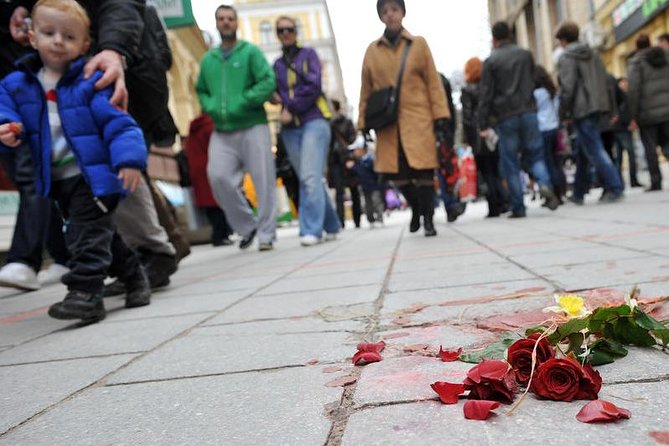
Here you see the Sarajevo Roses. These are concrete scars formed by mortar explosions during the Siege of Sarajevo. The patterns created by the blasts can look like flowers, and the scars were later filled with red resin.
The effect is simple and difficult to ignore. Instead of placing the memory of war behind a museum door, Sarajevo marks it directly on the pavement. People walk through the city while these red shapes remind them what happened there.
The visit lasts about 30 minutes, with no admission charge. That short stop matters because it gives context to the rest of the route. Sarajevo’s contemporary art is not separate from the city’s recent past. The memorials, sculptures, and gallery work exist in a place shaped by urban warfare and loss.
I would listen closely here, especially if you are not familiar with Sarajevo’s wartime history. The visual pattern of a Sarajevo Rose may seem abstract at first. Once you understand its origin, it becomes a very direct memorial.
This part of the tour is also practical for anyone who prefers a city walk with meaning. You are not spending the whole afternoon inside galleries. You are seeing how memory is built into ordinary streets and pedestrian routes.
Java Gallery and Sarajevo’s working art scene
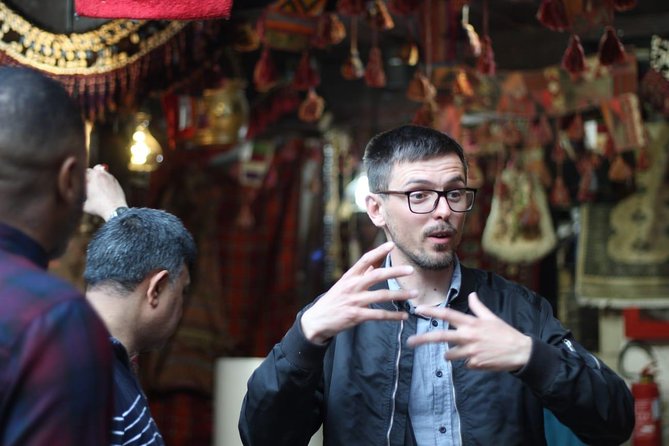
The next major gallery stop is Galerija Java, at Titova 21 in the center of Sarajevo. Java has helped build and support the city’s contemporary art scene by giving artists a place to show their work in an attractive exhibition setting.
The gallery works with Bosnian and international artists and presents different artistic mediums. That range is useful because it avoids giving you a narrow idea of what Sarajevo’s contemporary art looks like. Depending on the exhibition, you might encounter different forms and approaches rather than one fixed style.
The planned visit lasts about an hour, making Java the longest gallery stop. That extra time is welcome. After the more historical setting of Brodac and the public memorial work on Ferhadija, Java gives you room to focus on the art itself.
I like this stop for its local connection. The gallery is not simply a place where you view art made elsewhere. Its stated role is to support artists and help develop the contemporary scene in Bosnia and Herzegovina, while also working with artists from abroad.
Still, you should keep your expectations realistic. The tour cannot guarantee a particular artist or exhibition. Gallery programs change, and the experience depends partly on what is showing when you visit. If one current exhibition speaks to you, the hour may pass quickly. If contemporary art is not your usual interest, the guide’s explanation will be important.
A few more options to weigh up in Sarajevo
- Sarajevo: Mostar, Konjic, Blagaj Tekke, Pocitelj & Waterfall
★ 4.9 · 1,335 reviews - Sarajevo: Mostar, Konjic, Sufi House, Pocitelj & Kravice Falls
★ 5.0 · 1,179 reviews - ROSES OF SARAJEVO (Official WAR + CITY tour)- Story of a Survivor
★ 5.0 · 770 reviews - Sarajevo: Mostar, Konjic, Počitelj, Sufi House, & Waterfalls
★ 4.9 · 572 reviews
Veliki Park and the Srebrenica memorial
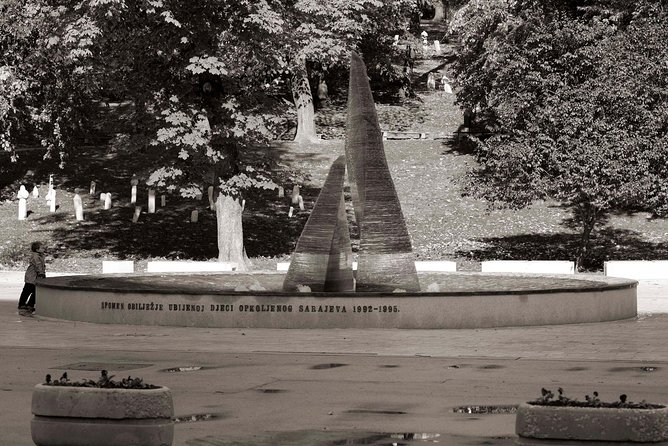
In Veliki Park, one of Sarajevo’s best-known parks, the tour pauses at Mensud Kečo’s sculpture Nermine, dođi. The work is dedicated to the genocide in Srebrenica.
The sculpture uses concrete, reinforcement bars, plastic, and silicon. It represents the distressing documented photograph that inspired the artist. Even from the materials alone, you can expect a work that feels raw rather than decorative.
This is the most emotionally demanding stop on the route. The tour does not treat public art as decoration for a pleasant walk. It places a difficult subject in front of you and gives you time to consider how an artist responds to a photograph connected with mass violence.
The visit lasts about 30 minutes and is free. You may find the setting in a public park surprising. People pass through ordinary green space while the sculpture carries a painful historical memory. That contrast is part of the work’s force.
I appreciate that the memorial is included alongside contemporary galleries. It shows that Sarajevo’s art scene is concerned with more than style, design, or gallery culture. Art here can also record grief and keep a public memory alive.
This stop may not suit someone looking only for light sightseeing. The subject is serious, and the materials and image behind the sculpture are distressing. If you are comfortable with memorial art, though, it gives the walk a stronger sense of purpose.
Coffee at Gallery BORIS SMOJO and the Festina Lente bridge
The final part of the route reaches Skenderija Bridge, where you take a coffee break at Gallery BORIS SMOJO. Admission is included for this part of the experience.
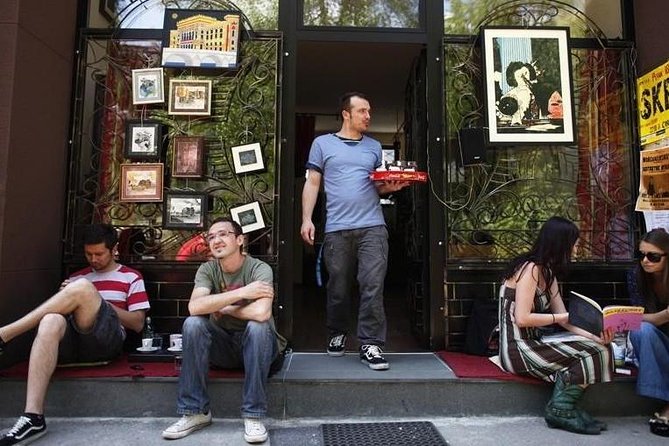
A scheduled pause is useful after several gallery and memorial stops. It gives you a chance to ask Mak questions, reflect on what you have seen, and enjoy a less formal moment before the final bridge visit. The coffee break also keeps the tour from feeling like a nonstop march through exhibition rooms.
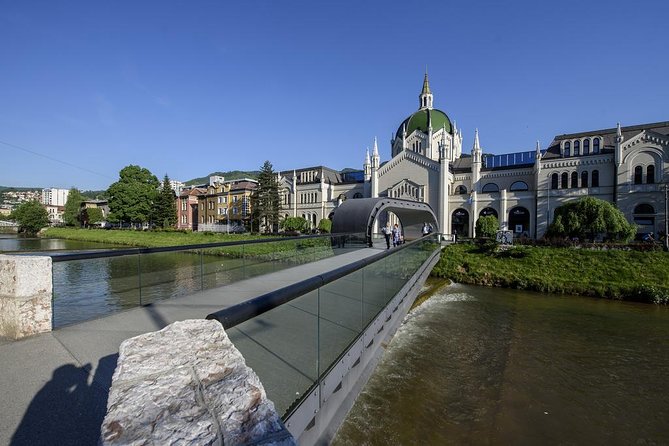
After the break, you go to see Festina Lente, the distinctive bridge at Skenderija. The name is Latin for make haste slowly, a fitting idea for the end of a walking tour that asks you to pause and look carefully at the city.
The provided details do not describe the bridge’s exact design or the length of time spent viewing it, so I would treat this as a short public-art and architecture stop rather than a full architectural lecture. Its place in the route gives the tour a broader finish. You have seen art in galleries, memorials in streets and parks, and now a piece of urban design connected with Sarajevo’s public space.
The tour ends in the Skenderija area rather than returning to the starting point. That matters when you plan the rest of your afternoon. The end point is listed as Skenderija, Sarajevo, while the meeting point is Đulagina 2.
What Mak adds to the experience
The strongest personal detail attached to this tour is the guide, Mak. One especially positive account describes him as warm, helpful, and able to explain both the city’s history and his own experiences during the war.
That personal connection can change the tone of the walk. A guide who simply identifies artworks gives you information. A guide who can relate Sarajevo’s recent past to lived experience may help you understand why these works matter to the city.
Mak also reportedly gave a participant a book he had written. I would not expect a book as a standard part of the tour, but the detail suggests a guide who takes an active interest in sharing Sarajevo beyond the scheduled stops.
The tour has a maximum of 15 people, so you should have a fair chance to ask questions. Still, the group size means the experience will not be as quiet or flexible as a one-to-one art walk. If you want to linger for a long time at every work, you may need to balance your own interests with the group’s schedule.
Who will get the most from this tour
I would recommend this tour to you if you like modern art, public memorials, architecture, and local stories more than a standard list of famous buildings. It is a good fit if you want an introduction to Sarajevo’s contemporary culture but do not know which galleries to choose.
It also suits first-time visitors who want help finding central art spaces. The tour removes the need to locate Brodac, Java, BORIS SMOJO, and the public memorials on your own. That is useful in a city where a modest entrance or an unmarked scar can be easy to pass.
You should also consider it if you want a guide who can discuss the war in a personal and direct way. Mak’s own experiences, as described in the available feedback, are one of the tour’s most praised qualities.
I would hesitate if you prefer traditional painting, major museums, or a relaxed café walk with little discussion of difficult subjects. The route includes genocide memorial art and the physical evidence of shelling. It is thoughtful, but not carefree.
The tour is offered in English, and most people can participate. It is near public transportation, though the route itself is presented as a walking experience. Wear shoes suitable for city streets and allow enough time to move between the stops.
Is $33.64 a fair price?
At $33.64, the tour offers a solid value if you would otherwise need to research Sarajevo’s contemporary galleries and memorial sites yourself. Admission is included at Brodac Gallery, Java Gallery, and Gallery BORIS SMOJO, while the Sarajevo Roses, Veliki Park, and Festina Lente are free public sights.
The larger value is the connection between the stops. You are not paying only to enter galleries. You are getting a planned route, an English-speaking guide, historical context, and access to a personal perspective on Sarajevo’s wartime past.
A self-guided walk could cost less, particularly if you only visit the free sites. But you would need to find current gallery locations, confirm what is open, understand the background of the memorials, and build a sensible route. If you want a short, organized introduction, the price is reasonable.
The two to three hour length also works well for a city visit. It is long enough to give the subject weight without taking your entire day. Since the tour begins at 1:00 pm, you can use the morning for Sarajevo’s other sights and keep the afternoon for contemporary art.
Should you book the Sarajevo Conceptual Art Tour?
Book it if you want Sarajevo explained through art, memory, and public space, not only through famous monuments. The combination of Brodac’s old prison setting, Java’s contemporary exhibitions, the Sarajevo Roses, the Srebrenica sculpture, and Festina Lente gives you a clear look at several sides of the city.
I would especially choose it for Mak’s personal perspective and the chance to ask questions in a group capped at 15 people. The tour is best for curious visitors who are comfortable with serious subjects and want more than a checklist of sights.
Skip it if your main goal is a broad architectural tour or a large museum collection. The gallery visits are focused, the schedule is fairly compact, and the war memorials carry real emotional weight.
You can cancel for a full refund up to 24 hours before the 1:00 pm start time. The experience requires a minimum number of participants, so if it is canceled for that reason, you are offered another date or experience, or a full refund.
FAQ
Where does the Sarajevo Conceptual Art Tour begin?
The tour begins at Đulagina 2, Sarajevo 71000, Bosnia and Herzegovina.
What time does the tour start?
The start time is 1:00 pm.
Where does the tour end?
The tour ends in the Skenderija area of Sarajevo.
How long does the tour last?
The experience lasts approximately two to three hours.
What language is the tour offered in?
The tour is offered in English.
How many people can join the tour?
The maximum group size is 15 people.
Is admission included at the galleries?
Admission is included at Brodac Gallery, Galerija Java, and Gallery BORIS SMOJO.
Are the Sarajevo Roses included in the route?
Yes. The tour visits Sarajevo Roses on Ferhadija Pedestrian Street, and there is no admission charge.
Does the tour visit a memorial to Srebrenica?
Yes. In Veliki Park, the tour visits Mensud Kečo’s sculpture Nermine, dođi, which is dedicated to the genocide in Srebrenica.
Can the tour be canceled for a full refund?
Yes. You can cancel at least 24 hours before the experience starts for a full refund. Changes or cancellations made less than 24 hours before the start time are not accepted for a refund.
Just added in Sarajevo
- Sarajevo Under Siege: A War History Tour★ 5.0 · 10 reviews
- Walking Tour in Sarajevo★ 5.0 · 3 reviews
- Private Full Day Safari Tour★ 5.0 · 8 reviews
- Bosnian Pyramid: The World’s Largest Pyramid (From Sarajevo)★ 5.0 · 1 review
- Ultimate adventure★ 5.0 · 2 reviews
- Mysterious Visoko Pyramids Driving and Walking Tour★ 5.0 · 7 reviews
- Travnik, Jajce, Pliva Lakes & Mills –Medieval & Ottoman Bosnia Full Day Tour★ 5.0 · 3 reviews
- Sarajevo to/from Zagreb Transfer Day Tour (North-central Bosnia)★ 5.0 · 4 reviews