
REVIEW · PRIVATE DRIVERS
Sarajevo to/from Dubrovnik Two-day Transfer Tour via Mostar
One road, two countries, and a very good overnight. This two-day transfer links Sarajevo with Dubrovnik, Kotor, or Split while taking you through Herzegovina’s strongest sights. I like the small group size of up to eight and the way the route mixes Ottoman towns, wartime stories, waterfalls, wine, and Mostar after the day crowds have gone.
I also like that key entrance fees, a four-star Mostar hotel, breakfast, and a local wine tasting are included. The main drawback is the pace: you cover a lot of ground in two days, so several stops are brief and the long road days may feel tiring if you prefer slow travel.
In This Review
- Key points to know before booking
- Why this transfer is more than a ride between cities
- Konjic and the road beside Jablaničko Lake
- Inside Tito’s 270-metre underground bunker
- Blagaj, the Buna spring, and a Dervish house
- Mostar after the day visitors leave
- Počitelj, a stone town above the Neretva
- Kravice Falls and a summer swim
- Herzegovina wine at Brkić cellar
- Medjugorje and Radimlja’s medieval tombstones
- Vjetrenica Cave and the final stretch
- What the $515.63 price really covers
- Who should book this two-day route?
- Should you book it?
- FAQ
- How long is the Sarajevo to Dubrovnik tour?
- Can I take the tour in the opposite direction?
- Is accommodation in Mostar included?
- Are the attraction entrance fees included?
- How many people can join the tour?
- Can I swim at Kravice Falls?
Key points to know before booking
- Tito’s Bunker gives the first day real substance: You spend about 90 minutes inside a secret Cold War facility built 270 metres underground.
- Mostar gets an overnight, not just a quick photo stop: A two-hour walking tour covers the Old Bridge, bazaar, and Old Town, with free time after the crowds thin out.
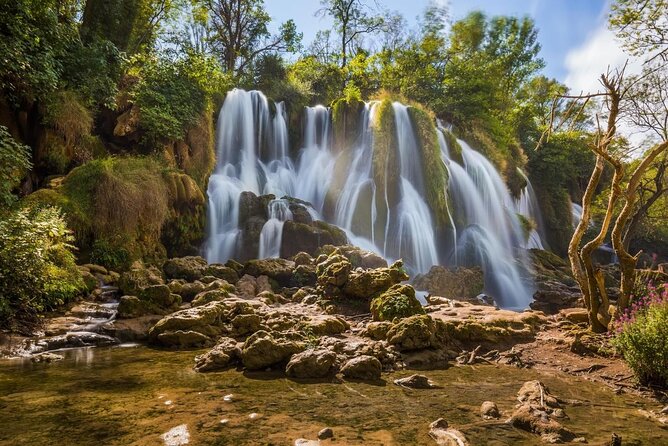
- Kravice Falls is the visual highlight: In summer, you can bring a swimsuit and cool off in the water.
- Herzegovina’s food and wine are part of the route: The tasting features four local wines, including Blatina and Žilavka, with snacks.
- The itinerary reaches less familiar places: Počitelj, Radimlja, and Vjetrenica give you more than the standard Sarajevo to Dubrovnik transfer.
- It works in either direction: You can begin in Sarajevo and finish in Dubrovnik, Kotor, or Split, or travel the reverse route.
Why this transfer is more than a ride between cities
A normal transfer from Sarajevo to Dubrovnik gets you from one hotel to another. This one turns the journey into the main event. You cross central and southern Bosnia and Herzegovina, following the Neretva River and stopping at places that explain the region’s Ottoman, Yugoslav, Catholic, and medieval past.
That matters because Herzegovina is easy to rush through. From a car window, you see sharp mountains, limestone hills, river valleys, and old stone towns. With this tour, you get out often enough to understand what you are seeing.
The group limit of eight is a practical advantage. You are not moving a large crowd through narrow lanes or waiting for a full coach to reload. Pickup is offered, and the advertised start time is 8:00 am. The exact pickup point depends on your booking, so confirm that detail before setting off.
The tour costs $515.63 per person. That is a serious price for a two-day transfer, but it includes much more than transport: one night in a four-star Mostar hotel with breakfast, Tito’s Bunker, the Dervish House in Blagaj, Kravice Falls, a winery visit and tasting, Radimlja Necropolis, Vjetrenica Cave, and a guided Mostar walk. Meals are not included, so your final cost will rise with lunches and dinners.
More private transfers in Sarajevo:
- Sarajevo to/from Dubrovnik Transfer Tour via Mostar & Herzegovina
★ 5.0 · 115 reviews - Sarajevo to Belgrade: Transfer With East Bosnia Tour
★ 5.0 · 63 reviews - Sarajevo to/from Belgrade UNESCO Transfer Day Tour (Fees Incl.)
★ 5.0 · 54 reviews
Konjic and the road beside Jablaničko Lake
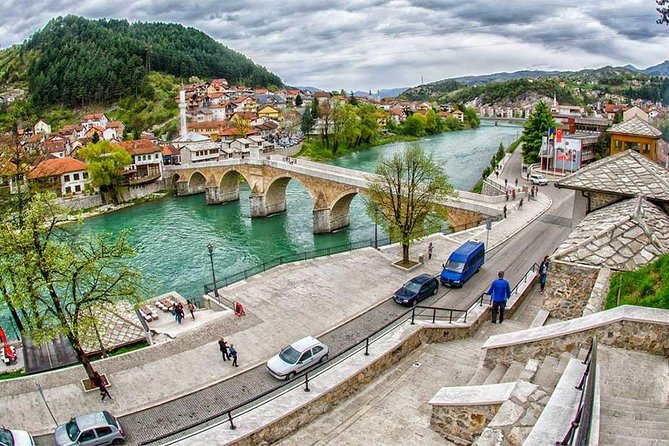
The first stop is Konjic, an old town beside the turquoise Neretva River. You get about 30 minutes to see the historic center and its famous six-arch bridge, which dates from the 17th century.
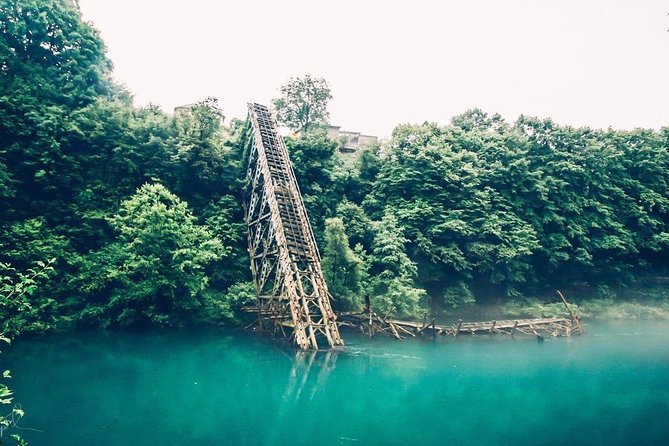
Konjic is a good opening stop because it gives you several layers of the region in a short time. You hear about the bridge’s destruction during the final days of the Second World War, Tito’s secret bunker, rafting on the upper Neretva, and nearby Boračko Lake. The town is also described as having very old settlement roots, adding another thread to an already busy morning.
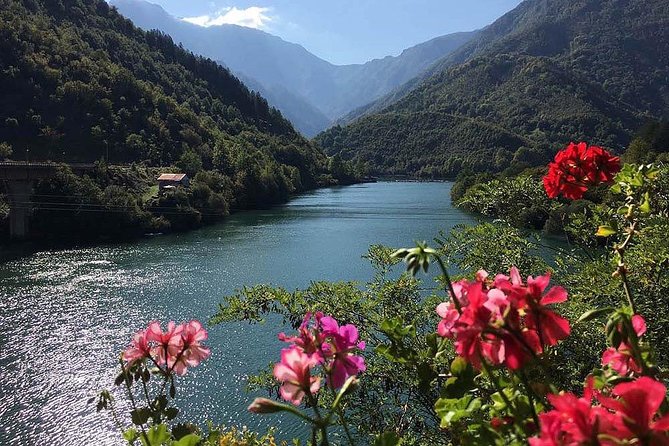
After Konjic, the road follows Jablaničko Lake and the Neretva canyon. The route is scenic, with views toward Prenj mountain. There may be a short photo stop along the lake and river, but do not expect a long nature walk. This is a road-based tour, and the scenery is best enjoyed from several brief pauses.
The next short stop is Jablanica. Here, the guide explains the Second World War Battle of the Neretva and introduces the local tradition of lamb roasted on a spit. You get around 30 minutes. It is more of a cultural and food story than a full attraction visit, but it helps connect the countryside to the events that shaped modern Bosnia.
Inside Tito’s 270-metre underground bunker
Tito’s Nuclear Bunker, also called ARK D-0, is the first major admission visit. The facility sits about 270 metres underground and took 26 years to build, from the early 1950s until 1979.
The bunker was designed to protect 350 people for six months after a nuclear attack. It had space for the country’s leadership to live and work without going outside. The reported construction cost, converted to modern British and American figures, was enormous, which makes the plain corridors and functional rooms even more striking.
You spend about 90 minutes here, and the entrance fee is included. That is important because this is not a quick corridor visit. You have time to understand the facility’s purpose and the scale of Yugoslavia’s Cold War fears.
I would give this stop close attention, even if military sites are not normally your priority. It is one of the places on the route that cannot be reduced to a pretty photograph. At the same time, the visit is indoors and built around political and military history, so you should know what kind of attraction you are getting.
Blagaj, the Buna spring, and a Dervish house
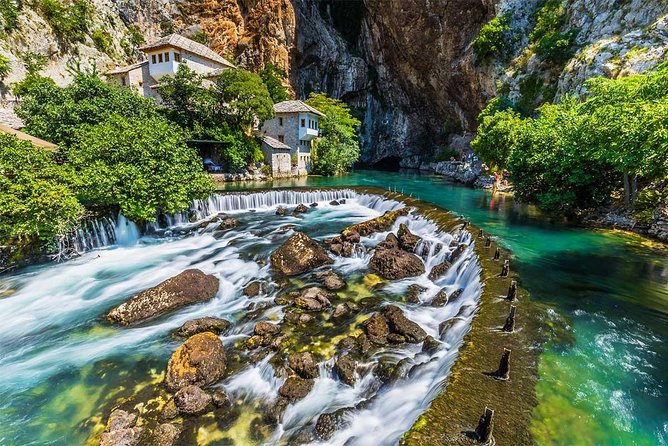
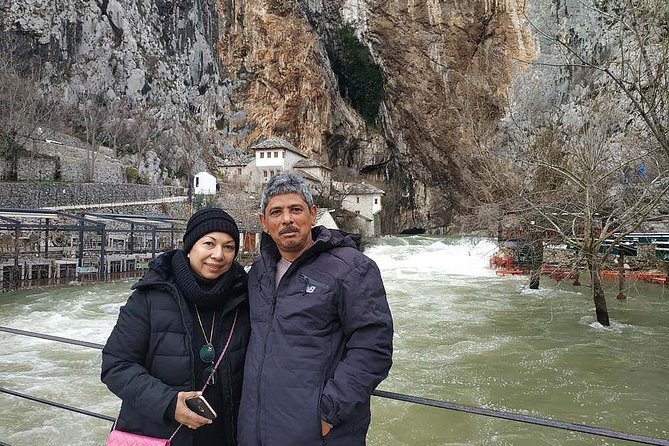
Blagaj brings a sharp change of mood. The Buna River rises from a deep cave below a high rock face, producing a powerful spring with an impressive flow. The water is described as clear and drinkable, and the setting is one of the most memorable natural stops on the route.
Next to the spring is the Blagaj Tekke, a Dervish house associated with the early Ottoman period. The complex offers a useful introduction to Islamic religious life in Bosnia and Herzegovina. The entrance fee is included, and the stop lasts about two hours.
This is one of the tour’s best pairings: nature and culture in one place. You can look at the rock and water, then learn why the Tekke matters. Muslim visitors may also be interested in the fact that prayers are held there five times a day and can be attended.
Blagaj can become crowded, especially during popular visiting periods. The tour does not promise a quiet private visit, so your experience will depend partly on the time of day. Still, the two-hour allocation gives you more breathing room than a quick roadside stop.
A few more options to weigh up in Sarajevo
- Sarajevo: Mostar, Konjic, Blagaj Tekke, Pocitelj & Waterfall
★ 4.9 · 1,335 reviews - Fall of Yugoslavia, Sarajevo War Tour with Tunnel of Hope Museum and Frontlines
★ 5.0 · 1,314 reviews - Sarajevo: Mostar, Konjic, Sufi House, Pocitelj & Kravice Falls
★ 5.0 · 1,179 reviews - ROSES OF SARAJEVO (Official WAR + CITY tour)- Story of a Survivor
★ 5.0 · 770 reviews
Mostar after the day visitors leave
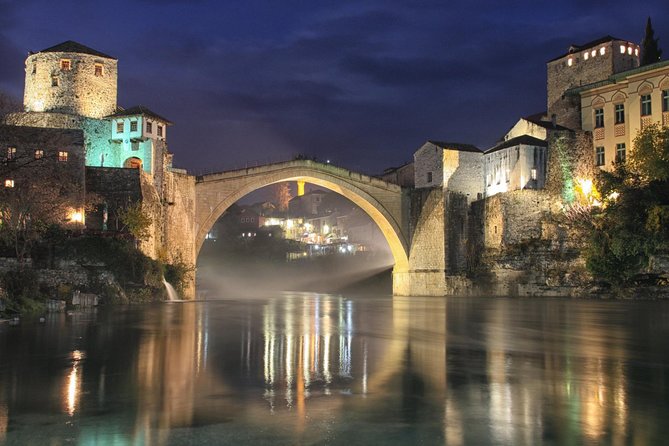
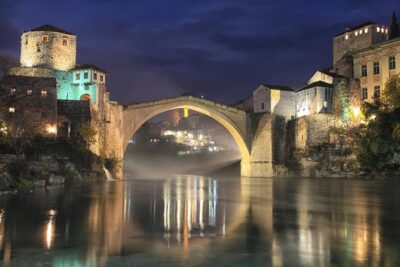
After Blagaj, you reach Mostar, check into a four-star hotel, and take a two-hour walking tour. The focus is the Old Bridge, the Old Bazaar, and the Old Town, with stories about Mostar’s cultural mixture, the bridge’s destruction and rebuilding, the Siege of Mostar, and the origin of the city’s name.
The overnight is the clever part of this tour. Many routes pass through Mostar for a few hours, when the old center is crowded and the visit feels hurried. Staying overnight gives you free time later in the day, when the main flow of day visitors has eased.
Your hotel is listed as Hotel Eden 4 or a similar property, with a twin or double room and breakfast included. Dinner is not included. You can eat independently, or the guide may arrange dinner together with the group, but that should not be treated as part of the base price.
The Mostar walk is not simply a bridge photo stop. The bridge is the visual center, but the guide’s story explains its rise, fall, and rebuilding. You also hear about the people of Mostar and the city’s divided past. A guide named Enis received especially warm praise for his personality, explanations, and ability to make the stops fascinating. Since guides can vary, treat Enis as a helpful detail rather than a guarantee that he will lead your departure.
Mostar is also the point where the schedule may feel generous and rushed at the same time. You get a proper evening, but the day has already included Konjic, the bunker, Jablanica, and Blagaj. Save some energy for the walking tour.
Počitelj, a stone town above the Neretva
Day two begins with Počitelj, a medieval and Ottoman-era town above the Neretva. The walking visit lasts about an hour and includes an easy uphill section.
The main sights include the Hajji Alija Mosque, the Clock Tower, and the Gavrankapetanović Tower. The town is valued for preserving much of its old urban form, with stone buildings and a fortress setting that reflect its strategic role over more than six centuries of written history.
Wear shoes with a good grip. The climb is described as easy, but old stone surfaces and uneven paths can still make the walk awkward. This is not a museum visit with level floors and clear signage. The reward is the view and the sense of a town shaped by defense, trade, and Ottoman rule.
Počitelj is also a place where one hour goes quickly. You will see the key sites and hear the main story, but you will not have time to explore every corner at a slow pace.
Kravice Falls and a summer swim
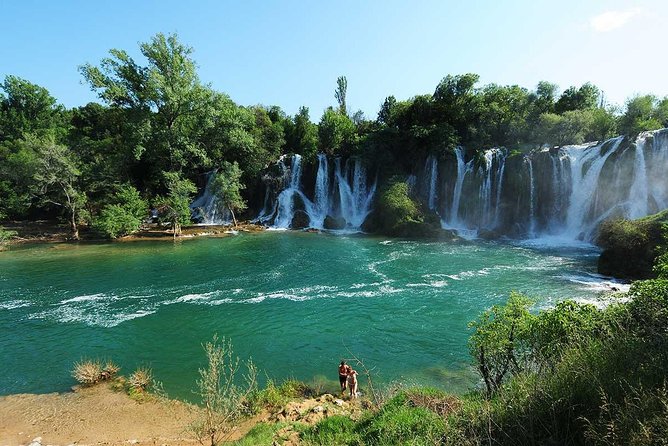
Kravice Falls is the day’s biggest natural attraction. The Trebižat River drops over travertine formations into an amphitheater about 120 metres wide, with falls reaching roughly 26 to 28 metres.
The entrance fee is included, and the planned visit lasts about an hour. From June through September, you can bring a swimsuit and swim, or simply cool your feet near the water. That seasonal option makes this stop especially appealing in hot weather.
Do not expect a full half-day at the falls. One hour lets you take photographs, see the main pool, and possibly get wet, but it leaves little time for a long sit-down. If you want to swim, arrive prepared and use the time well.
Kravice is also the stop most affected by weather and water conditions. The tour description presents it as a year-round attraction, but the swimming appeal is specifically tied to summer. Even outside the warm months, the falls remain a strong visual break in the day.
Herzegovina wine at Brkić cellar
The wine stop introduces a side of Herzegovina that many visitors miss. A local cellar offers four types of authentic wine and snacks, including Blatina, a red wine, and Žilavka, a white wine.
You also learn about biodynamic wine and the region’s winemaking traditions. The visit lasts about an hour, and tasting is included. This is not just a chance to drink between sightseeing stops. It gives you a way to understand the dry western Herzegovina climate and the local grape varieties that do not often appear on international wine lists.
If you do not want wine, a local lunch can be arranged as an alternative. That option is useful, but it is not clear from the provided details if the lunch is included in the tour price, so ask before booking.
The tasting also means this tour is not ideal for anyone who wants a strictly religious or historical route. Wine is one of the central experiences on day two. For many people, that mix of food, drink, and local background is exactly what makes the route feel connected to the region rather than like a string of monuments.
Medjugorje and Radimlja’s medieval tombstones
Medjugorje is a short 45-minute stop. Since 1981, the town has been associated with reported apparitions of the Virgin Mary and has become one of southeastern Europe’s best-known Catholic pilgrimage sites.
The visit is brief, so expect an introduction rather than a detailed religious study. It suits visitors interested in the story and its place in modern Catholic pilgrimage. If you want extended prayer time or a slower look at the pilgrimage center, this schedule may feel too tight.
Radimlja Necropolis near Stolac offers a very different kind of sacred site. The cemetery contains stećci, distinctive medieval tombstones that appeared from the 12th century and reached their peak in the 14th and 15th centuries.
The stones carry carved symbols and raise questions about who was buried there, where the tradition came from, and what the images mean. The visit lasts only about 15 minutes, and admission is included. That is enough for a quick look, but not enough for a long study of the carvings.
Still, Radimlja adds depth to the route. You see religious places from different traditions, then encounter an older Bosnian funerary tradition that does not fit neatly into one modern identity.
Vjetrenica Cave and the final stretch
The final named stop is Vjetrenica Cave, described as one of the world’s most biodiverse caves. The entrance fee is included, and the visit lasts about an hour.
The provided details do not specify the cave’s full tour route, temperature, or final drop-off time. That is worth clarifying if you have a tight onward connection. The itinerary is designed to end in the direction of Dubrovnik, Kotor, or Split, but border crossings and road conditions can affect the day.
Vjetrenica is a fitting final stop because it returns you to Herzegovina’s limestone geology. After rivers, waterfalls, stone towns, and mountain views, the cave shows what lies beneath the ground.
What the $515.63 price really covers
At $515.63 per person, this is not a budget transfer. Its value depends on how much you would otherwise spend arranging the same route yourself.
Included are:
- One night in a four-star Mostar hotel with breakfast
- Tito’s Bunker entrance
- Blagaj Dervish House entrance
- Bosnaseum Museum entrance
- Kravice Falls entrance
- Four-wine tasting with snacks
- Radimlja Necropolis entrance
- Vjetrenica Cave entrance
- Guided sightseeing in Mostar
Meals other than breakfast are not included. You should also allow room in your budget for lunches, dinner, drinks, and any optional arrangements.
The price makes the most sense if you need to move between cities anyway and want a guided route without planning several separate transfers. It is less compelling if you already have transport, want long stays at each stop, or prefer choosing only a few sights.
The included admissions add up, and the small group keeps the experience more personal than a large coach excursion. The tradeoff is a packed schedule. You are paying for coverage and convenience, not a slow, unstructured holiday.
Who should book this two-day route?
I would recommend it to you if you have limited time, want to connect Sarajevo with the Adriatic coast, and prefer your transfer days to include real sightseeing. It is especially good for first-time visitors to Bosnia and Herzegovina who want context for Mostar, Herzegovina’s religious mix, the Yugoslav period, and the region’s food and wine.
It also suits couples and small groups who value a maximum of eight people, pickup, and a hotel night rather than changing buses or organizing local taxis.
I would hesitate if you dislike early starts, long driving days, uphill walking, or frequent changes of subject. The route moves from wartime history to Islamic architecture, from waterfalls to Catholic pilgrimage, and from wine to medieval tombstones. That variety is its strength, but it can also feel like a lot.
Free cancellation is available up to 24 hours before the start time for a full refund. Confirmation is sent within 48 hours, subject to availability. Most people can participate, and service animals are allowed.
Should you book it?
Book this tour if you want the practical job of getting from Sarajevo to the coast combined with a serious introduction to Herzegovina. The overnight in Mostar, included admissions, Tito’s Bunker, Kravice Falls, and the wine tasting make the cost easier to justify.
Skip it if your ideal trip means lingering for half a day at one waterfall, spending a full morning in Mostar, or choosing every meal and stop yourself. For everyone else, this is an efficient, varied, and unusually full route through a part of Bosnia and Herzegovina that deserves more than a view from the car window.
FAQ
How long is the Sarajevo to Dubrovnik tour?
The experience lasts approximately two days and includes one overnight stay in Mostar.
Can I take the tour in the opposite direction?
Yes. You can travel from Sarajevo to Dubrovnik, Kotor, or Split, or take the route in the other direction. The full itinerary is provided regardless of the start and end point.
Is accommodation in Mostar included?
Yes. One night in a four-star hotel, listed as Hotel Eden 4 or similar, is included in a twin or double room. Breakfast is included, but other meals are not.
Are the attraction entrance fees included?
Yes. Included admissions cover Tito’s Bunker, the Dervish House in Blagaj, Kravice Falls, Radimlja Necropolis, and Vjetrenica Cave. The Bosnaseum Museum entrance is also included.
How many people can join the tour?
The tour has a maximum of eight participants.
Can I swim at Kravice Falls?
You can bring a swimsuit and swim or cool your feet during the summer period from June through September. The planned visit lasts about one hour.
Just added in Sarajevo
- Sarajevo Under Siege: A War History Tour★ 5.0 · 10 reviews
- Walking Tour in Sarajevo★ 5.0 · 3 reviews
- Private Full Day Safari Tour★ 5.0 · 8 reviews
- Bosnian Pyramid: The World’s Largest Pyramid (From Sarajevo)★ 5.0 · 1 review
- Ultimate adventure★ 5.0 · 2 reviews
- Mysterious Visoko Pyramids Driving and Walking Tour★ 5.0 · 7 reviews
- Travnik, Jajce, Pliva Lakes & Mills –Medieval & Ottoman Bosnia Full Day Tour★ 5.0 · 3 reviews
- Tour of Herzegovina – From Sarajevo★ 5.0 · 3 reviews
Private Drivers, compared.
Sarajevo to/from Dubrovnik Transfer Tour via Mostar & Herzegovina
Read our review →
Sarajevo to Belgrade: Transfer With East Bosnia Tour
Read our review →
Sarajevo to/from Belgrade UNESCO Transfer Day Tour (Fees Incl.)
Read our review →
Sarajevo to Split (or opposite): Transfer With Herzegovina Tour
Read our review →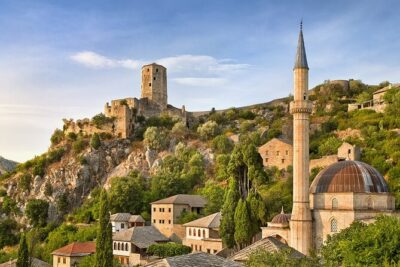
Transfer Mostar to Dubrovnik with Kravice Waterfalls, Blagaj and Počitelj tour
Read our review →
Private Transfer between Trebinje and Dubrovnik
Read our review →
Sarajevo to Dubrovnik: Transfer With Herzegovina Tour
Read our review →Browse the lists this tour appears in