REVIEW · SARAJEVO TOURS
Bosnia Croatia Montenegro – 7 Days Balkan Tour
Three countries, seven busy days. This tour links Sarajevo, Mostar, Split, Dubrovnik, Kotor, and other major sights with transport, breakfasts, hotels, and local guides included. I especially like the strong Sarajevo focus and the use of licensed city guides, which gives important places more meaning than a quick drive-by stop.
I also like the small maximum of 15 people and the mix of famous sights with less obvious stops such as the Olympic bobsleigh track and Trebinje. The main catch is pace: you cover a lot of ground, and several stops allow only 30 minutes to two hours, so this suits you if you prefer seeing many highlights over settling into one town.
In This Review
- Key points before you book
- A seven-day route through the western Balkans
- Day one: Sarajevo, where empires meet
- Day two: Olympic ruins, river springs, and the war tunnel
- Day three: From Konjic to Mostar by way of Herzegovina
- Day four: Split and an overnight on the coast
- Day five: Dubrovnik, then Budva after the border
- Day six: Kotor Bay, Perast, and the return to Sarajevo
- Day seven: A simple Sarajevo departure
- Hotels, vehicle, and group size
- Who will get the most from this tour?
- Should you book the $2,268.95 package?
- FAQ
- Where does the tour begin?
- How long does the tour last?
- Which countries does the tour visit?
- How many nights of accommodation are included?
- Is breakfast included?
- Are lunch and dinner included?
- What transportation is provided?
- What is the maximum group size?
- Are entrance fees included?
- Can I cancel for a full refund?
Key points before you book
- Sarajevo gets two full days: You see the Ottoman old town, Austro-Hungarian center, Olympic sites, and key places tied to the 1990s siege.
- Three countries fit into one route: Bosnia and Herzegovina, Croatia, and Montenegro are connected by private transportation.
- Local guides lead major city walks: Guided visits are planned for Sarajevo, Split, Dubrovnik, and Kotor.
- Four-star hotels and breakfast are included: Six nights of lodging and six breakfasts are covered in the stated price.
- The route includes major UNESCO-linked sights: Mostar’s Old Bridge area, Dubrovnik, Split’s Diocletian’s Palace, and Kotor form the core of the trip.
- The group is capped at 15: That is more manageable than a large coach tour, though the actual group may be smaller.
A seven-day route through the western Balkans
At $2,268.95 per person, this is not a bargain-basement bus trip. The price covers an air-conditioned vehicle, six nights in four-star hotels, six breakfasts, entrance fees and taxes, an English-speaking driver or tour director, and licensed local guides in key cities.
That bundle matters in the Balkans. Borders, winding roads, changing currencies, and scattered sights can make independent planning time-consuming. Here, the transport and hotel moves are arranged for you, leaving you to focus on the towns and monuments.
Still, the value depends on your travel style. You are paying for convenience and coverage, not long stays in each place. Lunch and dinner are extra, and you should expect to buy meals along the way. The route is best for a first look at several countries, not for a slow holiday beside the Adriatic.
A few more options to weigh up in Sarajevo
- Sarajevo: Mostar, Konjic, Blagaj Tekke, Pocitelj & Waterfall
★ 4.9 · 1,335 reviews - Fall of Yugoslavia, Sarajevo War Tour with Tunnel of Hope Museum and Frontlines
★ 5.0 · 1,314 reviews - Sarajevo: Mostar, Konjic, Sufi House, Pocitelj & Kravice Falls
★ 5.0 · 1,179 reviews
Day one: Sarajevo, where empires meet
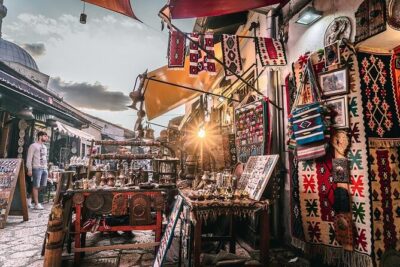
Your Sarajevo introduction begins in Baščaršija, the old Ottoman quarter. The Sebilj fountain on the square is the natural starting point, and the short opening visit helps you get your bearings before the walking continues through the older streets.
The Coppersmith Street stop adds a useful human detail. This is described as Sarajevo’s only fully authentic Ottoman street, and you visit a working coppersmith shop where the craft has passed from father to son. You can watch the basic technique and buy a handmade souvenir, though shopping is optional.
At Gazi Husrev-beg Mosque, you see the center of a large sixteenth-century endowment. The complex once included a mosque, Islamic school, public kitchen, toilet, covered market, caravan hotel, clock tower, and shops. The mosque itself has an admission fee that is not included, so carry some local currency or ask your guide about payment.
The walk then shifts to Sarajevo’s Austro-Hungarian and Jewish heritage. At the Latin Bridge, the guide explains the assassination of Archduke Franz Ferdinand, the event that helped trigger the First World War. The nearby Jewish Museum covers Jewish life in Sarajevo from the sixteenth century to the present, but its admission is also not included.
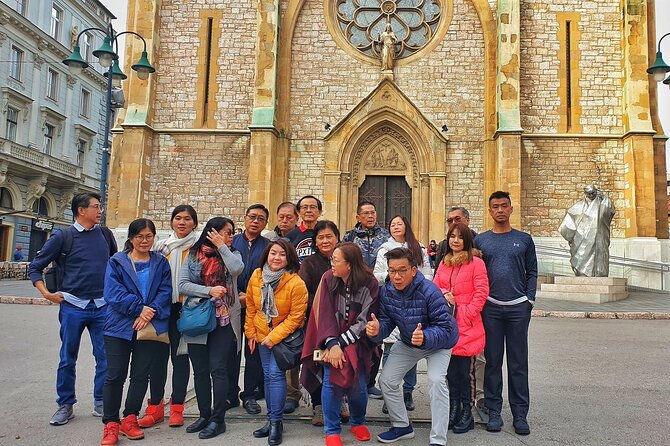
You continue to Cathedral Square and the Sacred Heart Cathedral, then to Markale Market. Here the focus changes from imperial history to the siege of Sarajevo and the market massacre. The Sarajevo roses, marks in the pavement filled with red resin, give a visual reminder of the city’s wartime suffering.
The Serbian Orthodox Cathedral completes the day’s look at Sarajevo’s different religious communities. The stops are short, often 5 to 20 minutes, so do not expect a full museum visit at every site. The strength is the broad introduction: Ottoman, Jewish, Catholic, Orthodox, and twentieth-century Sarajevo all appear in one walk.
Day two: Olympic ruins, river springs, and the war tunnel
The second Sarajevo day starts at the Yellow Fortress, where you get a wide view over the Miljacka River valley. You can see the city’s position among the Olympic mountains and notice how Ottoman, Austro-Hungarian, and modern buildings fill the valley.
Next comes Trebević and the abandoned bobsleigh and luge track from the 1984 Winter Olympics. The visit includes a light forest walk to reach the track. It is a very different experience from the polished monuments in the old town, and it gives the day a strong sense of place.
Allow for practical footwear here. The provided plan calls this a light walk, but an old outdoor track and forest path are not the same as a paved city sidewalk. The admission is free, and the visit lasts about an hour.
At Vrelo Bosne, you visit the springs of the Bosna River below Mount Igman. The river gives Bosnia its name, and the springs were arranged as a park around 140 years ago during Austro-Hungarian rule. This is the calmest stop in the Sarajevo section, with water, trees, and paths replacing city streets.
The final stop is the Sarajevo War Tunnel museum. This one-hour visit explains how the city survived the siege and why the tunnel became essential. Admission is included, which is helpful because the museum is one of the main paid sights on the route.
I consider this second day one of the tour’s strongest sections. You get a view, a walk, nature, and a serious museum without leaving Sarajevo. It also gives you more time in the capital than many fast Balkan circuits allow.
Day three: From Konjic to Mostar by way of Herzegovina
You leave Sarajevo for Konjic, about an hour away. The stop centers on the Ottoman stone bridge from the seventeenth century and the old town around it. With 30 minutes here, you should think of Konjic as a pleasant pause rather than a full visit.
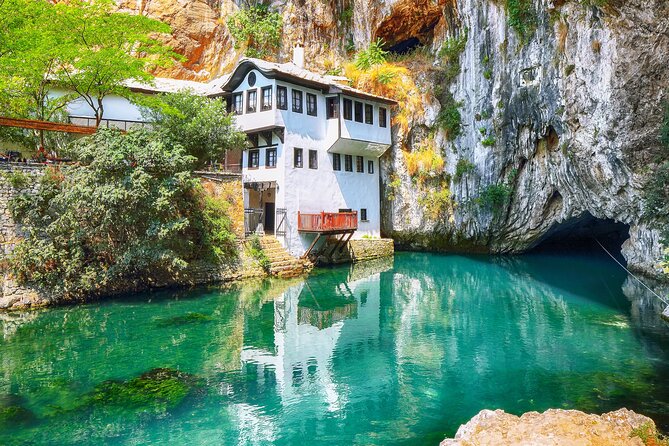
Blagaj brings a more unusual sight. The Buna River emerges from a single cave, a karst spring beside the village. The stop lasts about an hour and is free, giving you time to see the spring area before continuing.
Počitelj is a small medieval stone town on a hill beside the Neretva River. It was first recorded in the fifteenth century and retains traditional buildings and a steep, compact feel. Thirty minutes is enough for a quick look, but not for a leisurely climb or detailed exploration.
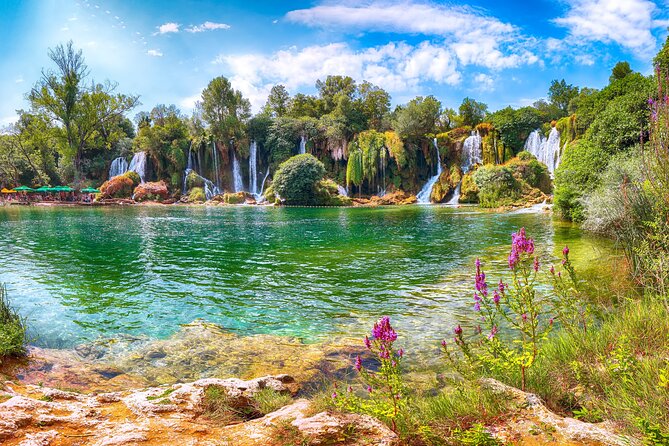
Kravice Falls provides the day’s natural highlight. A 130-meter waterfall amphitheater creates a dramatic setting, and the water is described as ice cold. You have an hour here, with admission included. If you hope to enter the water, remember that the description only confirms the waterfall visit, not swimming arrangements or facilities.
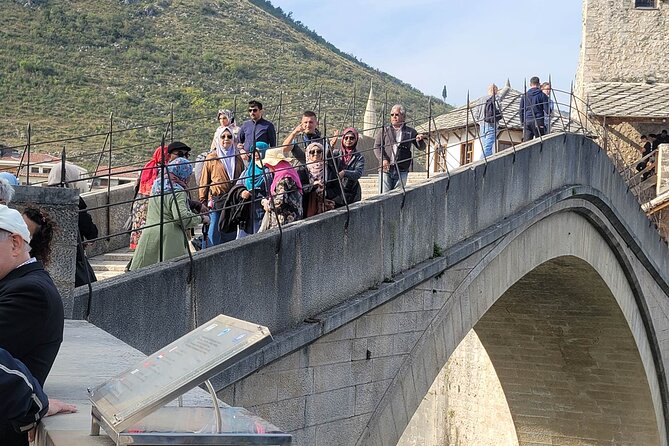
Mostar is the main finish. Before checking into your hotel, you walk through the old town to the Old Bridge, the Crooked Bridge, the bazaar, and the Mehmet Koski Pasha Mosque. The two-hour visit gives you a good first look, but Mostar rewards extra time, so it is worth asking whether part of your evening remains free after check-in.
This is a scenic day, but also a road-heavy one. Five stops in one day means you must watch the clock. The payoff is variety: a bridge town, a cave spring, a hillside settlement, a waterfall, and one of Bosnia and Herzegovina’s best-known cities.
A completely different kind of day:
- ROSES OF SARAJEVO (Official WAR + CITY tour)- Story of a Survivor
★ 5.0 · 770 reviews - Sarajevo: Mostar, Konjic, Počitelj, Sufi House, & Waterfalls
★ 4.9 · 572 reviews - Tunnel Museum: Bosnian & Yugoslav Wars Tour with War Veteran
★ 5.0 · 551 reviews - Sarajevo: 2 Hours Old Town Walking Tour With Local Guide
★ 5.0 · 505 reviews
Day four: Split and an overnight on the coast
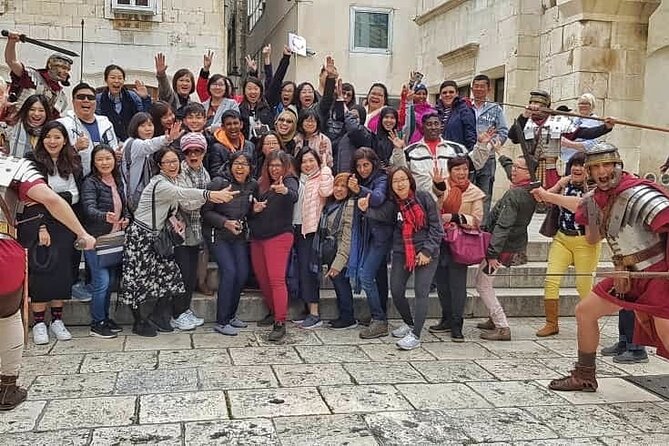
From Mostar, the route crosses into Croatia and reaches Split. A licensed local guide leads the old-town walk, beginning along the waterfront and continuing into Diocletian’s Palace. The palace is not a single isolated building today. It forms the core of the living old town, with streets and daily life woven through the Roman remains.
You have three hours of free time after the guided walk. That is enough to return to a favorite corner, eat lunch, browse the old town, or sit along the waterfront. Since lunch is not included, this is also your main chance to arrange your own midday meal.
The full Split stop lasts about five hours, including the guided portion and free time. Afterward, you continue to Neum for the night. Neum is Bosnia and Herzegovina’s short Adriatic coastline, and the evening there is listed as free and easy.
This overnight keeps the next day’s route practical, but it does mean Split is a half-day visit rather than a full city stay. If Roman architecture is your main interest, you may wish you had longer. If your goal is to see the major palace and continue south, the arrangement works well.
Day five: Dubrovnik, then Budva after the border
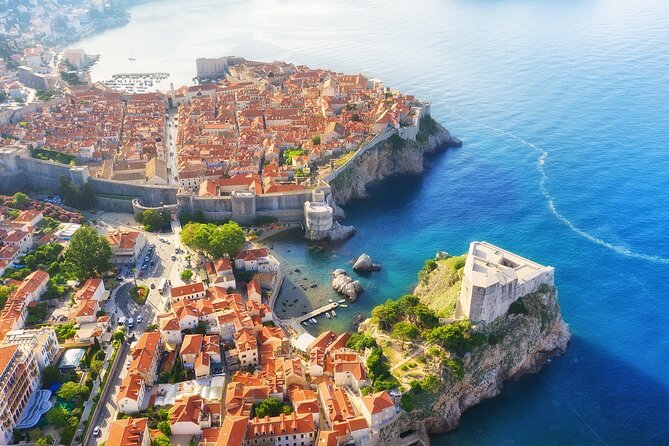
After roughly 80 kilometers from Neum, you reach Dubrovnik. A licensed guide leads you inside the stone walls, then you have three hours to explore independently. That balance is useful because the old town is easy to revisit on foot, and you can choose between more architecture, a meal, or simply time in the narrow streets.
The four-hour Dubrovnik stop is efficient but tight for a city with many paid sights and possible queues. The guided walk is included, but the information provided does not say that the city walls, museums, or cable car are included. Plan around the included walk unless your tour director confirms otherwise.
You then cross into Montenegro and check into a hotel in Budva. The old town visit takes place later, inside Budva’s stone walls. The day combines one of the Adriatic’s best-known historic cities with a second walled center, but border crossings can affect the schedule. Keep your passport accessible and avoid planning fixed evening reservations.
The Budva overnight gives you a chance to see the old town without the pressure of a same-day return drive. The stated eight-hour stop includes hotel time, so it does not mean eight hours of guided sightseeing.
Day six: Kotor Bay, Perast, and the return to Sarajevo
Kotor receives a three-hour guided visit. The local guide handles the walking tour, then you have free time to explore at your own speed. The old town is compact, but the surrounding bay is the larger attraction, so the next stop adds important context.
At Perast, you take a boat ride to Our Lady of the Rocks. The full stop is about two hours, including the short drive from Kotor and the boat trip. The activity is listed without a separate admission charge, but ask your tour director how the boat arrangements are handled because the general inclusions do not spell out every component.
The return journey includes a 30-minute break in Trebinje. You visit the old town and pause before continuing to Sarajevo. This is a brief introduction, but it breaks up a long travel day and gives you one more Bosnian town beyond the main circuit.
You finish back in Sarajevo and check into a hotel for the final night. The plan leaves the evening free, which is handy if you want one last Bosnian meal or a short walk near the old town. It is also a useful buffer before your departure.
Day seven: A simple Sarajevo departure
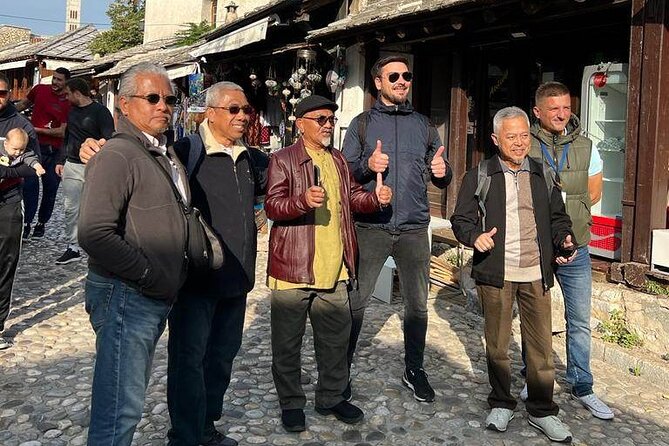
After breakfast and check-out, the tour arranges a transfer to the airport or another location in Sarajevo. The final transfer is listed as taking about two hours, though the exact timing will depend on your departure point and flight.
Six breakfasts are included across the six hotel nights. Lunches and dinners are not, so budget separately for food throughout the week. The tour’s structure makes meals your main daily expense beyond personal purchases and any optional admissions.
Hotels, vehicle, and group size
Six nights in four-star hotels are included, but the supplied details do not name the properties or specify their exact locations. You should ask before booking if being within walking distance of each old town matters to you.
Transportation is by air-conditioned vehicle with an English-speaking driver or tour director. That is a major convenience on a route crossing several borders and linking inland Bosnia with the Croatian and Montenegrin coast.
The maximum group size is 15. That is small enough for easier communication than a large coach, though the experience may feel different if the group is full. One account describes a much smaller departure with only three people, so the group size can vary.
The city walks use licensed local guides in Sarajevo, Split, Dubrovnik, and Kotor. That division of duties makes sense: your driver manages the long route, while local guides explain the places they know best. The booking contact named Elvis is also described as quick to answer questions and helpful with complex trip planning, a useful sign if you need to clarify hotel locations or border-day timing before paying.
Who will get the most from this tour?
I would choose this for a first visit to the western Balkans when you want the major sights without arranging several hotels, transfers, and guides yourself. It is especially suitable if you value Sarajevo’s cultural and wartime context, then want a brisk introduction to Croatia and Montenegro.
It also suits couples, families, and small groups who prefer a planned route. Most people can participate, and the tour is near public transportation, though the itinerary includes walking in old towns, a forest approach to the bobsleigh track, and uneven historic streets.
I would hesitate if you want beach time, long museum visits, or several slow mornings. Split, Dubrovnik, and Kotor each deserve more than a few hours, but this tour deliberately trades depth for range.
The tour offers free cancellation up to 24 hours before the start time for a full refund. Within 24 hours, cancellations and changes are not accepted for a refund, and the departure requires a minimum number of participants. If that minimum is not met, you are offered another date or experience, or a full refund.
Should you book the $2,268.95 package?
Book it if your priority is efficient coverage. You will see Sarajevo in real depth, visit Mostar and Kravice Falls, walk through Split and Dubrovnik, explore Budva and Kotor, take the Perast boat trip, and return to Sarajevo without managing the route yourself.
Think twice if you want a relaxed coastal holiday or need firm control over every hotel and meal. At this price, the package is strongest when you value included transport, four-star lodging, breakfast, and guided city visits more than free time.
My practical advice is to confirm the hotel locations, which admissions are paid locally, the exact airport transfer time, and how the Perast boat ride is handled. If those details suit you, this is a well-organized way to get a broad first taste of three Balkan countries in one week.
FAQ
Where does the tour begin?
The tour begins in Sarajevo, Bosnia and Herzegovina.
How long does the tour last?
The experience lasts approximately seven days.
Which countries does the tour visit?
It visits Bosnia and Herzegovina, Croatia, and Montenegro.
How many nights of accommodation are included?
Six nights of accommodation in four-star hotels are included.
Is breakfast included?
Yes. Six breakfasts are included.
Are lunch and dinner included?
No. Lunch and dinner are not included.
What transportation is provided?
Transportation is provided in an air-conditioned vehicle with an English-speaking driver or tour director.
What is the maximum group size?
The maximum group size is 15 people.
Are entrance fees included?
Some entrance fees are included, including Vrelo Bosne, the Sarajevo War Tunnel, and Kravice Falls. Admission to Gazi Husrev-beg Mosque and the Jewish Museum is not included.
Can I cancel for a full refund?
Yes. You can cancel at least 24 hours before the experience start time for a full refund. Cancellations within 24 hours are not refunded.
Just added in Sarajevo
- Sarajevo Under Siege: A War History Tour★ 5.0 · 10 reviews
- Walking Tour in Sarajevo★ 5.0 · 3 reviews
- Private Full Day Safari Tour★ 5.0 · 8 reviews
- Bosnian Pyramid: The World’s Largest Pyramid (From Sarajevo)★ 5.0 · 1 review
- Mysterious Visoko Pyramids Driving and Walking Tour★ 5.0 · 7 reviews
- Ultimate adventure★ 5.0 · 2 reviews
- Travnik, Jajce, Pliva Lakes & Mills –Medieval & Ottoman Bosnia Full Day Tour★ 5.0 · 3 reviews
- Sarajevo to/from Zagreb Transfer Day Tour (North-central Bosnia)★ 5.0 · 4 reviews
Sarajevo Tours, compared.
Sarajevo: Mostar, Konjic, Blagaj Tekke, Pocitelj & Waterfall
Read our review →
Sarajevo: Mostar, Konjic, Sufi House, Pocitelj & Kravice Falls
Read our review →
Sarajevo: 2 Hours Old Town Walking Tour With Local Guide
Read our review →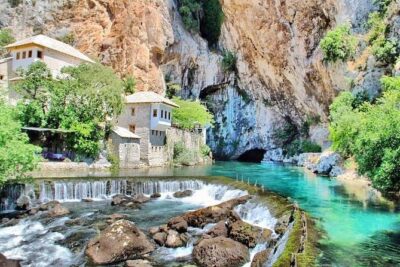
Sarajevo: Mostar, Konjic, Dervish House, Pocitelj & Kravica Falls
Read our review →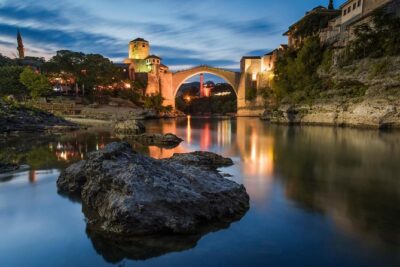
Mostar,Kravica Waterfall,Blagaj,Počitelj – Day Tour from Sarajevo
Read our review →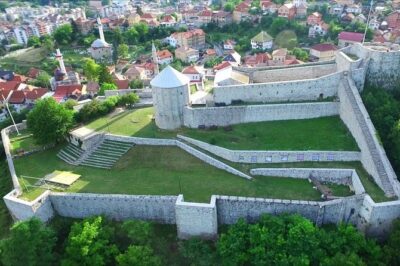
Jajce, Travnik and Pliva watermills – Day Tour from Sarajevo
Read our review →