REVIEW · SARAJEVO TOURS
Jewish Tour
Sarajevo’s Jewish story is woven into its streets. This four-hour tour links the Sephardic community that arrived after the expulsion from Spain and Portugal with the later Ashkenazi community, then places both stories inside Sarajevo’s old town and religious past. I like the clear focus on Jewish heritage and the small group size, limited to 10 people.
I also like that the route includes both the Jewish Museum and Ashkenazi Synagogue, not just a passing look from outside. Guide Fariz earned high praise for explaining Jewish history, Sarajevo’s religious traditions, and modern Bosnian life with care. The main consideration is time: five stops in about four hours means some visits are brief, especially the 10-minute stop at the Bosnian Cultural Center.
In This Review
- Key points to know before booking
- Why Sarajevo’s Jewish story matters
- Starting at the Jewish Museum of Bosnia and Herzegovina
- The Bosnian Cultural Center and an unrealized synagogue
- Baščaršija, Sarajevo’s old trading heart
- Inside the Ashkenazi Synagogue
- The Jewish Cemetery and Sarajevo’s harder memories
- What the guide adds to the experience
- Is $29.91 a fair price?
- Timing, meeting point, and practical details
- Who will get the most from this tour?
- Should you book the Jewish Tour?
- FAQ
- How long does the Jewish Tour last?
- What time does the tour start?
- Where does the tour begin?
- Where does the tour end?
- What is included in the price?
- Is the tour suitable for most people?
- What is the cancellation policy?
Key points to know before booking
- Sephardic roots in Sarajevo: Learn how Jews expelled from Spain and Portugal found a new home in Sarajevo during the 16th century.
- Two Jewish traditions: The tour explains both Sephardic and Ashkenazi life, including language, customs, suffering, and survival.
- Five stops in four hours: You visit the Jewish Museum, Bosnian Cultural Center, Baščaršija, Ashkenazi Synagogue, and Jewish Cemetery.
- A small group setting: The experience is limited to 10 people, allowing more room for questions than a large coach tour.
- Transport included: An air-conditioned vehicle connects the sites, useful for a cemetery visit beyond the old town core.
- Good value at $29.91: Museum and synagogue admission are included, while tips are not.
Why Sarajevo’s Jewish story matters
Sarajevo is often introduced through its Ottoman bazaars, Austro-Hungarian buildings, and mixture of religious traditions. This tour adds another essential strand: the Jewish communities that helped shape the city for centuries.
The story begins in the late 15th century, when the fall of Granada in 1492 brought persecution and expulsion for Jews in Spain and Portugal. Many Sephardic Jews moved across the Mediterranean and into the Ottoman world. In the 16th century, Sarajevo became home to new Jewish neighbors, who settled in what became known as Sijavus Pasha’s Quarter.
You are not simply shown a synagogue and sent on your way. The tour aims to explain how people lived. That includes their work, songs, food, language, moments of happiness, and periods of fear and loss. The attention to Ladino, the language associated with Sephardic Jews, gives the story a personal and cultural edge.
I find this useful because Jewish history in Sarajevo is not presented as an isolated subject. It is tied to the city’s wider religious and social life. You learn about Sephardim and Ashkenazim, then see where their communities worshipped, traded, lived, and were buried.
A few more options to weigh up in Sarajevo
- Sarajevo: Mostar, Konjic, Blagaj Tekke, Pocitelj & Waterfall
★ 4.9 · 1,335 reviews - Fall of Yugoslavia, Sarajevo War Tour with Tunnel of Hope Museum and Frontlines
★ 5.0 · 1,314 reviews - Sarajevo: Mostar, Konjic, Sufi House, Pocitelj & Kravice Falls
★ 5.0 · 1,179 reviews
Starting at the Jewish Museum of Bosnia and Herzegovina
The Jewish Museum is the strongest historical anchor on the route. You have about 30 minutes here, with admission included, to learn about the Sephardic Jewish community in Sarajevo.
That half hour is important because the museum gives shape to the stories introduced by the guide. Rather than hearing only dates and names, you can connect the wider migration from Spain and Portugal to the particular community that took root in Sarajevo.
Expect the focus to include the development of Jewish life in the city, the Sephardic community, and the cultural details that made it distinct. Ladino is part of that picture. So are songs, food, daily work, and religious customs.
The museum visit is also a useful reminder that this was a living community, not only a subject of persecution. The tour description makes room for both ordinary life and painful chapters. That balance matters. A good heritage tour should show what people built before explaining what was later taken from them.
The limitation is the scheduled time. Thirty minutes can introduce the collection and its story, but it is not enough for a slow museum visit. If you are the sort of person who reads every label, you may want to return independently if that is possible during your stay.
The Bosnian Cultural Center and an unrealized synagogue
The next stop lasts about 10 minutes and is free to enter. The Bosnian Cultural Center occupies a site built with the idea of creating the largest Jewish temple in the Balkans.
That detail gives the building unusual importance. You are looking at a place connected to Jewish ambition and community life, even though its present function is cultural rather than religious. The short visit works best as a visual pause and a chance to understand the scale of what Sarajevo’s Jewish community once hoped to create.
Do not expect a long indoor visit here. Ten minutes is enough for an explanation and a look at the site, but not a full cultural program. Its value comes from the story attached to the building, especially when paired with the museum and the later synagogue stop.
This is one reason the tour works better as a connected route than as five unrelated attractions. Each place adds a different piece. The museum covers history and identity. The cultural center points to communal plans. The synagogue shows a later chapter in Jewish life.
Baščaršija, Sarajevo’s old trading heart
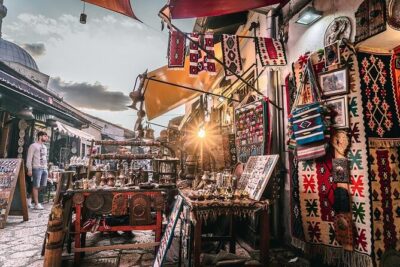
Baščaršija is the most general stop on the tour, but it helps place Jewish life inside Sarajevo itself. You spend about 15 minutes in the old town, once the city’s economic center and a major trading hub in the Balkans.
The stop is free and brief. You can expect a look at the old town’s character and an explanation of its role in Sarajevo’s commercial life. The tour’s Jewish focus becomes more grounded here because trade and neighborhood life were part of the city’s shared story.
I like the inclusion of Baščaršija because it prevents the tour from becoming too narrow. You get a sense of the setting in which different communities met and worked. The old town also gives you a break from museum interiors and formal religious sites.
At the same time, 15 minutes is not enough to explore Baščaršija properly. Treat this as an introduction, not a full old-town tour. You may want to return later for more time among the streets, shops, and historic surroundings.
The stop also helps you understand the tour’s pace. This is a guided overview, not a day of long visits at each site. You will cover a lot, but you should expect the guide’s explanations to do much of the work.
A completely different kind of day:
- ROSES OF SARAJEVO (Official WAR + CITY tour)- Story of a Survivor
★ 5.0 · 770 reviews - Sarajevo: Mostar, Konjic, Počitelj, Sufi House, & Waterfalls
★ 4.9 · 572 reviews - Tunnel Museum: Bosnian & Yugoslav Wars Tour with War Veteran
★ 5.0 · 551 reviews - Sarajevo: 2 Hours Old Town Walking Tour With Local Guide
★ 5.0 · 505 reviews
Inside the Ashkenazi Synagogue
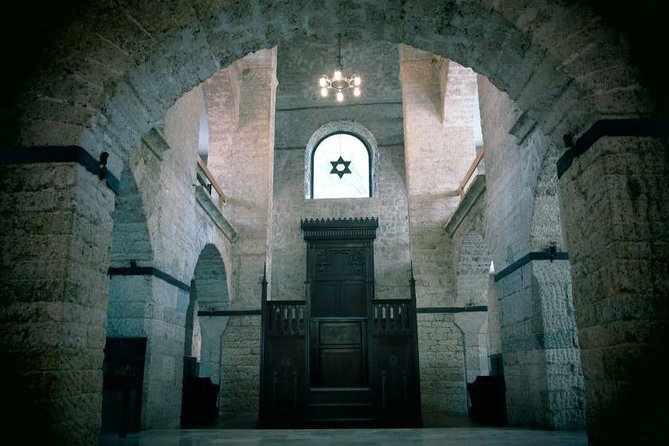
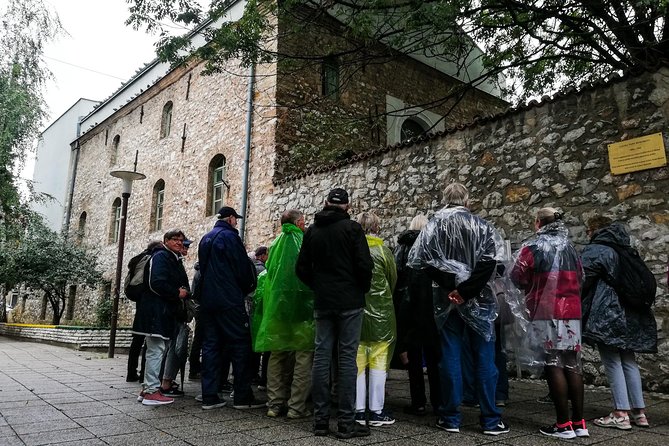
The Ashkenazi Synagogue, also called the Sarajevo Synagogue, was built in 1902 for Jews arriving in larger numbers during the Austro-Hungarian occupation of Bosnia and Herzegovina.
You have about 30 minutes here, and admission is included. This is the second major interior visit after the Jewish Museum, and it gives the tour a clear contrast between Sephardic and Ashkenazi chapters of Sarajevo’s Jewish life.
The synagogue is valuable because it represents a later period than the Sephardic settlement described at the beginning. You are not seeing one single, unchanging Jewish community. You are following different groups, arrivals, customs, and institutions across time.
The half-hour visit should give you enough space to see the building and hear its place in Sarajevo’s story. It is also a good point to ask questions about the distinction between Sephardic and Ashkenazi traditions, especially if those terms are new to you.
The tour’s religious context is one of its strongest features. Fariz, one guide associated with the experience, was praised for explaining Sarajevo’s religious history while also discussing life in Bosnia today. His own Muslim background, combined with serious study of Jewish history, was noted as a helpful part of the conversation. That kind of perspective can make the tour feel connected to Sarajevo’s present, not trapped in the past.
The Jewish Cemetery and Sarajevo’s harder memories
The final major stop is the Jewish Cemetery, described as the second-largest Jewish cemetery in Europe. You have about 30 minutes there, and admission is free.
A cemetery can tell you things a museum cannot. Names, dates, family groupings, and the scale of the grounds can make a community’s presence feel concrete. This is a place for the quieter part of the tour, when the focus shifts from institutions and streets to memory, death, and endurance.
The description of the experience also connects the cemetery with persecution and the struggle against death and suffering. That means the visit may carry emotional weight. You should allow yourself time to take in the setting rather than treating it as another quick photo stop.
The air-conditioned vehicle is especially useful here. The tour includes transport, and the cemetery is not simply folded into a short walk through Baščaršija. You can move between the city’s central sites and this important place without arranging separate transport.
The cemetery visit may be the most meaningful stop for people interested in the human cost of Sarajevo’s history. It may be less comfortable for anyone hoping for a light sightseeing morning. This is a serious subject, and the tour does not avoid that fact.
What the guide adds to the experience
A Jewish heritage tour depends heavily on the guide. Buildings can be visited alone, but their meaning is easier to grasp when someone explains how they fit together.
Fariz received especially strong praise for his command of Sarajevo’s religious history and for his ability to discuss Jewish culture alongside present-day Bosnian life. The important point is not only that he knows the subject. It is that he can connect Jewish history to the city around you.
You may hear about what Sephardic Jews did for work, which songs they sang, what foods they prepared, and how Ladino shaped community identity. You will also hear about Ashkenazi Jews, their arrival during the Austro-Hungarian period, and the differences between the two traditions.
Because the group is capped at 10 people, you should have a better chance to ask questions than on a large bus excursion. That matters on a subject with unfamiliar names, religious terms, and several historical periods.
The experience has a rating of 5 from the available feedback, but the sample is very small. I would treat the praise for Fariz as useful evidence about the guide’s approach, not as a guarantee that every departure will feel identical. The exact guide may vary.
Is $29.91 a fair price?
At $29.91 per person, this tour offers solid value if you want an organized introduction to Jewish Sarajevo.
The price includes an air-conditioned vehicle, a guide, and admission to the Jewish Museum and Ashkenazi Synagogue. The Bosnian Cultural Center and Jewish Cemetery are listed with no admission charge. Tips are not included, so budget separately if you want to thank the guide.
You are also paying for the way the sites are linked. Visiting the museum, synagogue, cemetery, and old town on your own would require research and transport planning. The tour gives you one historical thread and places the stops in an order that makes sense.
The value is less clear if you already know Sarajevo well or want long, unhurried visits. The route covers five stops in about four hours, so some places receive only a short introduction. For a first visit, though, that compact format is useful. You can learn the outline, identify the places worth revisiting, and ask questions as you go.
Timing, meeting point, and practical details
The tour starts at 10:00 a.m. from Sarajevo Insider, at Zelenih beretki 30 in Sarajevo. It ends back at the same meeting point, which makes planning the rest of your day easier.
Confirmation is provided when you book. The meeting point is near public transportation, and most people can participate. The group maximum is 10 people, a practical size for a history-focused outing.
The four-hour duration is long enough to provide real context but short enough to fit into a busy Sarajevo schedule. You might book it early in your stay, since the old town stop and the guide’s orientation can help you understand the city better during later independent walks.
Free cancellation is available if you cancel at least 24 hours before the local start time. Cancellations or changes made inside that window are not refunded or accepted. The experience also requires a minimum number of participants, so an operator cancellation would result in another date or experience, or a full refund.
Who will get the most from this tour?
I would choose this tour if you want Jewish history explained as part of Sarajevo’s wider religious and urban story. It suits anyone curious about Sephardic migration, Ashkenazi life, Ladino, Sarajevo’s old town, and the city’s places of remembrance.
It is also a good fit if you prefer a guide-led visit to reading up on each location yourself. The small group and air-conditioned vehicle add comfort without turning the experience into a large sightseeing operation.
You should think twice if you want a relaxed museum morning with plenty of time at every stop. The schedule is focused and fairly tight. Baščaršija receives only 15 minutes, and the Bosnian Cultural Center just 10 minutes.
I would also consider the emotional tone. The tour includes persecution, suffering, cemeteries, and the loss of communities. That seriousness is part of its value, but it may not suit someone looking only for cheerful old-town sightseeing.
Should you book the Jewish Tour?
Yes, if you want a focused, affordable introduction to Jewish Sarajevo and the people behind its buildings, language, food, and memories.
The strongest reasons to book are the combination of the Jewish Museum, Ashkenazi Synagogue, and Jewish Cemetery, plus the chance to hear the story from a guide who can relate it to Sarajevo’s Muslim, Christian, and modern Bosnian setting. Fariz’s praised approach is a particularly good sign, though guide assignments can change.
Book it early in your Sarajevo stay if you want historical context for the rest of the city. Skip it only if you need slow, extended time at each site or prefer to explore without a fixed schedule.
FAQ
How long does the Jewish Tour last?
The tour lasts approximately four hours.
What time does the tour start?
It starts at 10:00 a.m.
Where does the tour begin?
It begins at Sarajevo Insider, Zelenih beretki 30, Sarajevo 71000, Bosnia and Herzegovina.
Where does the tour end?
The activity ends back at the starting meeting point.
What is included in the price?
The price includes an air-conditioned vehicle, admission to the Jewish Museum of Bosnia and Herzegovina, and admission to the Ashkenazi Synagogue.
Is the tour suitable for most people?
Yes. The provided information says most people can participate, and the meeting point is near public transportation.
What is the cancellation policy?
You can cancel for a full refund up to 24 hours before the experience starts. Cancellations or changes made less than 24 hours before the start time are not refunded or accepted.
Just added in Sarajevo
- Sarajevo Under Siege: A War History Tour★ 5.0 · 10 reviews
- Walking Tour in Sarajevo★ 5.0 · 3 reviews
- Private Full Day Safari Tour★ 5.0 · 8 reviews
- Bosnian Pyramid: The World’s Largest Pyramid (From Sarajevo)★ 5.0 · 1 review
- Mysterious Visoko Pyramids Driving and Walking Tour★ 5.0 · 7 reviews
- Ultimate adventure★ 5.0 · 2 reviews
- Travnik, Jajce, Pliva Lakes & Mills –Medieval & Ottoman Bosnia Full Day Tour★ 5.0 · 3 reviews
- Sarajevo to/from Zagreb Transfer Day Tour (North-central Bosnia)★ 5.0 · 4 reviews
Sarajevo Tours, compared.
Sarajevo: Mostar, Konjic, Blagaj Tekke, Pocitelj & Waterfall
Read our review →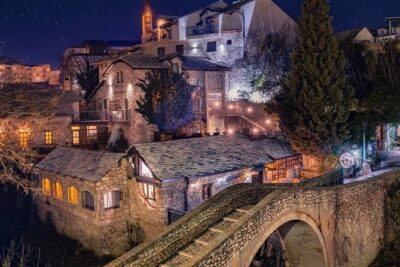
Sarajevo: Mostar, Konjic, Sufi House, Pocitelj & Kravice Falls
Read our review →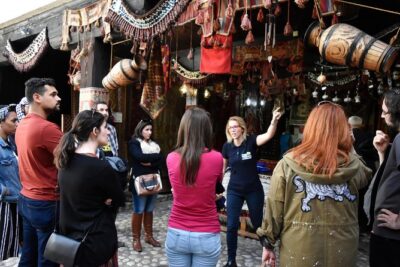
Sarajevo: 2 Hours Old Town Walking Tour With Local Guide
Read our review →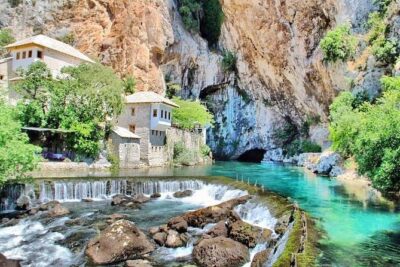
Sarajevo: Mostar, Konjic, Dervish House, Pocitelj & Kravica Falls
Read our review →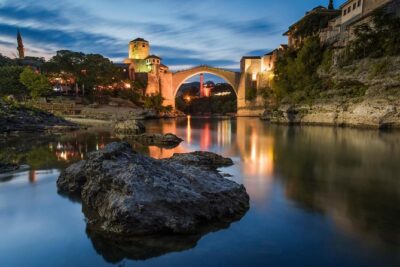
Mostar,Kravica Waterfall,Blagaj,Počitelj – Day Tour from Sarajevo
Read our review →
Jajce, Travnik and Pliva watermills – Day Tour from Sarajevo
Read our review →