REVIEW · SARAJEVO TOURS
Sarajevo for beginners
Sarajevo’s story unfolds in a few walkable streets. I like this tour because it links the city’s Ottoman, Austro-Hungarian, Orthodox, Catholic, Muslim, and Jewish landmarks in one clear route. I also like the personal touch: guides such as Samra have been praised for sharp storytelling, perfect English, humor, and useful advice for the rest of your stay. The main limitation is time. Two hours is enough for a strong introduction, but not enough for long museum visits or a slow look inside every building.
At $34.92 per person, this is a sensible first-day purchase if you want the city to make sense quickly. You’ll cover many major sights on foot, stop for Bosnian coffee or tea, and hear the local meaning behind places that are easy to pass without noticing. Admission fees are not included, and the group can reach 18 people, so this is not a private, quiet tour.
In This Review
- Key points at a glance
- Starting at Sarajevo’s Catholic cathedral
- Hotel Europe and the remains of Tašlihan
- Gazi-Husrev Beg’s Bezistan and the market streets
- The assassination site and Latin Bridge
- Ottoman Sarajevo by the Emperor’s Mosque
- Two bridges and Sarajevo City Hall
- Kazandžiluk and the craft of old Sarajevo
- Sebilj, Baščaršija, and a cup of Bosnian coffee
- Morića Han and the Gazi Husrev-beg Mosque
- The Jewish Museum and Sarajevo’s many communities
- Guide quality and the human side of the walk
- Price, pace, and group size
- Who should book Sarajevo for beginners
- Should you book it?
- FAQ
- Where does the Sarajevo for beginners tour start?
- What time does the tour begin?
- How long does the experience last?
- What is included in the price?
- What language is the tour offered in?
- How many people can join the tour?
Key points at a glance
- Seventeen named stops in about two hours: The route covers Sarajevo’s central religious buildings, bridges, markets, squares, and historic streets at a brisk pace.
- A meeting point at the Cathedral: Start at Trg fra Grge Martića at 9:00 a.m., a useful central location for beginning your orientation.
- Four faith traditions in one walk: Catholic, Orthodox, Muslim, and Jewish landmarks all feature in the route.
- The assassination site gets proper context: The stop includes the location tied to the event that changed world history, along with the nearby Latin Bridge.
- Bosnian coffee is part of the experience: Coffee or tea is included, and one guide specifically helped a guest learn how to drink Bosnian coffee.
- Small enough to feel manageable: A maximum of 18 people keeps the group more practical than a large coach tour, though it may still feel busy at popular stops.
Starting at Sarajevo’s Catholic cathedral
The tour begins at the Cathedral of the Sacred Heart of Jesus, known locally as Katedrala Srca Isusova. You get about 10 minutes here, enough to admire its simple beauty and place Sarajevo’s Catholic community within the wider city story.
This is a good starting point because the route does not treat Sarajevo as an Ottoman-only city. The cathedral helps establish the layered character of the center from the first few minutes. You’ll want to listen closely rather than expect a long interior visit, since admission is not included and the schedule moves quickly.
From there, the group reaches the Orthodox Church of the Nativity of the Theotokos. Again, the planned stop is around 10 minutes, with entry not included. The value here is the contrast between the Catholic cathedral and Serbian Orthodox church, both located within the central area.
I like this early pairing. It gives you a useful frame for understanding Sarajevo as a city shaped by several religious and cultural communities. If you want extended time inside either building, plan to return independently.
A few more options to weigh up in Sarajevo
- Sarajevo: Mostar, Konjic, Blagaj Tekke, Pocitelj & Waterfall
★ 4.9 · 1,335 reviews - Fall of Yugoslavia, Sarajevo War Tour with Tunnel of Hope Museum and Frontlines
★ 5.0 · 1,314 reviews - Sarajevo: Mostar, Konjic, Sufi House, Pocitelj & Kravice Falls
★ 5.0 · 1,179 reviews
Hotel Europe and the remains of Tašlihan
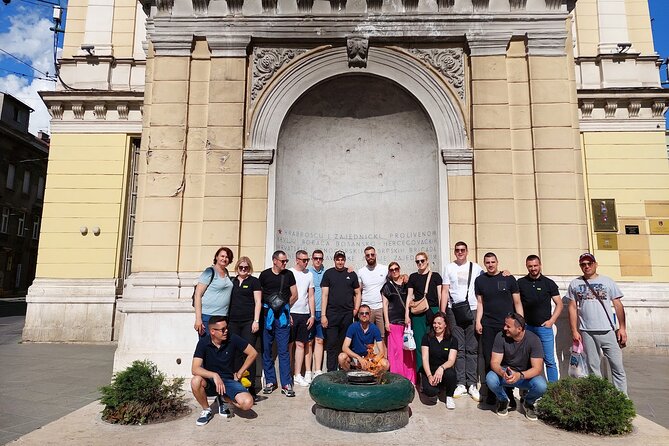
Hotel Europe receives a short five-minute stop. It is described as Sarajevo’s first hotel and the oldest in Southeast Europe, making it more than a grand facade. The guide’s job here is to connect the building with the city’s changing urban life and Austro-Hungarian period.
The next stop, Tašlihan, is also brief. You’ll see the remains of a former inn, a reminder that Sarajevo once served as an important stopping place for merchants and people moving through the region. Five minutes may sound short, but the close spacing of these sites makes the route efficient.
The drawback is that this section can feel compressed. You are seeing several layers of Sarajevo in quick succession, so take mental notes. If a particular building catches your interest, mark it on your phone and return later.
Gazi-Husrev Beg’s Bezistan and the market streets
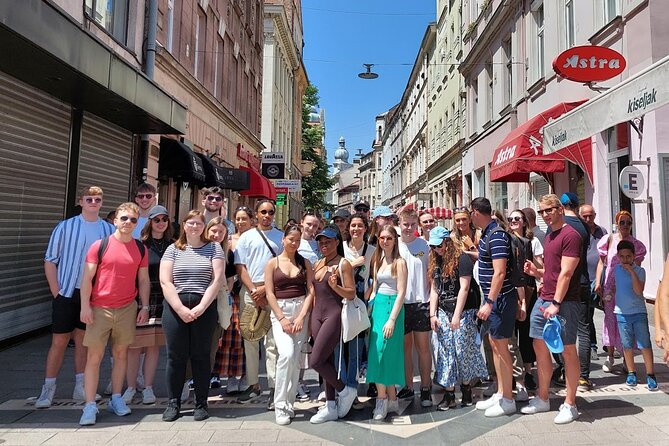
Gazi-Husrev Beg’s Bezistan is presented as the original shopping mall of Sarajevo. That comparison makes the site easy to understand: this was a purpose-built commercial space, not simply an open street market.
The stop lasts around five minutes, so expect an explanation and a quick look rather than a leisurely shopping break. Still, it gives you a better sense of how trade shaped the old center.
The route then moves toward the Sarajevo Assassination location, but it also includes the story of Bravadžiluk Street. This is one of the useful features of the walk. You are not only collecting monuments. You are hearing how ordinary streets developed and how different periods left their mark on the same compact center.
The assassination site and Latin Bridge
The location of the Sarajevo assassination receives 15 minutes, one of the longest stops on the route. That extra time matters. The subject is often reduced to a single sentence about 1914, but the place deserves more care than a quick photograph.
The nearby Latin Bridge is given another 10 minutes. It is known as the bridge with three names, a detail that shows how names, languages, and political periods overlap in Sarajevo. Together, these stops let you connect a famous world event with a real street corner and a nearby bridge.
I would pay close attention here. The location may look modest, yet the consequences tied to it were enormous. A local guide can help keep the explanation grounded in Sarajevo rather than turning it into a dry European history lecture.
A completely different kind of day:
- ROSES OF SARAJEVO (Official WAR + CITY tour)- Story of a Survivor
★ 5.0 · 770 reviews - Sarajevo: Mostar, Konjic, Počitelj, Sufi House, & Waterfalls
★ 4.9 · 572 reviews - Tunnel Museum: Bosnian & Yugoslav Wars Tour with War Veteran
★ 5.0 · 551 reviews - Sarajevo: 2 Hours Old Town Walking Tour With Local Guide
★ 5.0 · 505 reviews
Ottoman Sarajevo by the Emperor’s Mosque
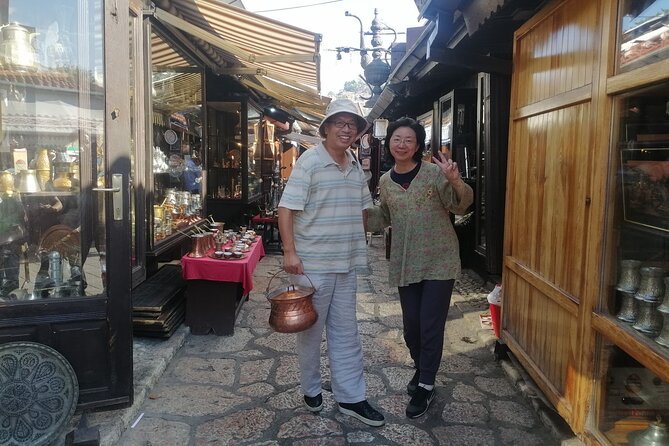
The Emperor’s Mosque is described as the oldest mosque in Sarajevo, with about 10 minutes allocated to the stop. This brings the route firmly into the city’s Ottoman chapter.
The tour does not list admission as included, so you should not expect a formal mosque visit to be part of the price. The guide can still explain why the mosque matters and how it fits into the surrounding area. Dress and entry rules can vary at religious sites, so treat this as a place for respectful observation and follow any instructions given locally.
Next comes Inat kuća, or the House of Spite. The point of this stop is built around the meaning of inat, a stubborn refusal to give in. Ten minutes at the Emperor’s Mosque followed by five minutes at Inat kuća creates a nice shift from major monument to memorable local character.
That balance is one of the tour’s strengths. Sarajevo is not only grand buildings and turning points. It is also stories about pride, argument, endurance, and people insisting on having their say.
Two bridges and Sarajevo City Hall
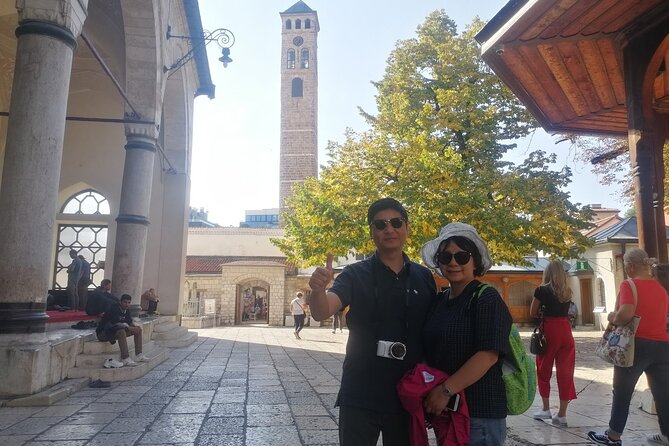
Seher Cehaja’s Bridge receives five minutes. It is described as the oldest bridge in Sarajevo, and also the second one built, which gives the guide another chance to explain the city through its crossings and waterways.
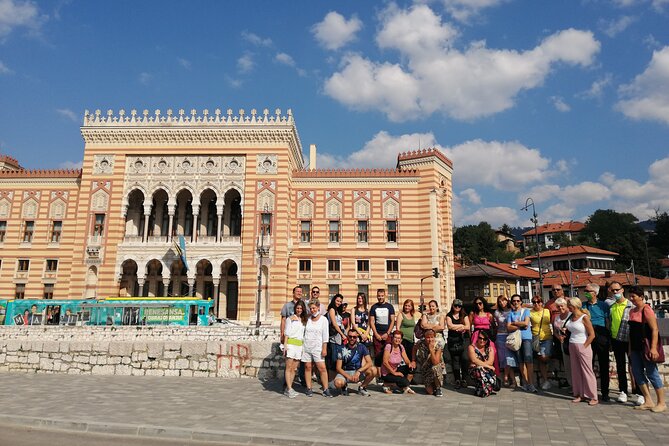
The largest time allotment in this section goes to Sarajevo City Hall, with 15 minutes. Built during the Austro-Hungarian period in the middle of the old part of town, the building is especially interesting because its style fits beside Ottoman architecture rather than replacing it entirely.
That contrast is central to Sarajevo’s appeal. You can move through a small area and see Islamic, Austro-Hungarian, Catholic, Orthodox, and Jewish influences close together. The city’s character comes from that overlap.
Admission is not included, so the tour focuses on the outside and the explanation. If the building becomes a priority for you, ask the guide for advice about visiting it separately. The short stop is enough to appreciate the setting, but not enough for a full interior examination.
Kazandžiluk and the craft of old Sarajevo
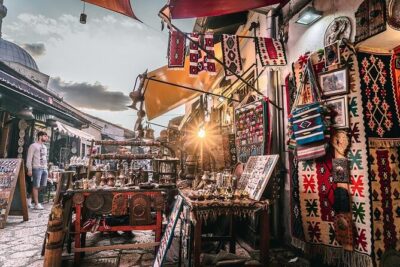
The story of Bravadžiluk Street leads into Kazandžiluk, one of the most authentic streets in Sarajevo. This is where the walk should feel less like a checklist and more like a lesson in daily life.
Kazandžiluk is associated with traditional coppersmithing, and the street gives you a chance to notice the craft atmosphere of the old market quarter. The scheduled 10 minutes will not allow a long shopping session, but it is enough to understand why the street matters and to decide if you want to return.
I would save a little energy for this section. The best way to use a short stop is to look closely at the shops and street details rather than rush for photographs. If you buy anything, remember that this walk is not designed as a dedicated shopping tour.
Sebilj, Baščaršija, and a cup of Bosnian coffee
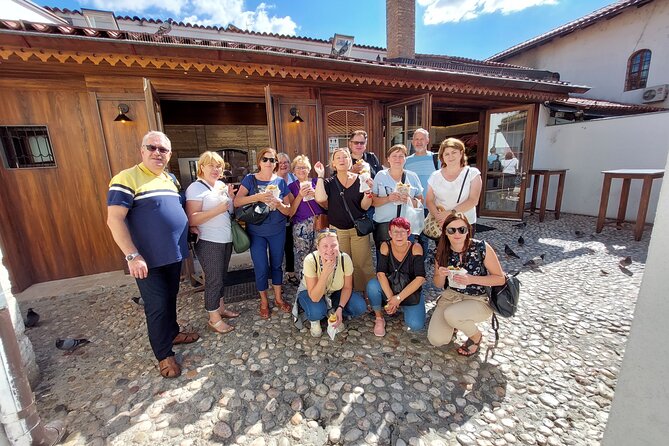
Sebilj is a five-minute stop and a natural meeting point in the old market area. It is one of those places that helps you get your bearings. Baščaršija, Sarajevo’s main square, follows with about 10 minutes.
These places can be busy, especially around the center of the market quarter, so a guide is useful. You’ll learn what you are looking at instead of simply seeing a fountain, a square, and a crowd.
Coffee or tea is included, adding a welcome pause to a fast-paced walk. One particularly helpful detail from the guide’s service is instruction in how to drink Bosnian coffee. That makes the refreshment more than a free beverage. It gives you a small piece of local routine to carry into the rest of your stay.
Do not expect a long café session. With 17 stops on the schedule, the drink is likely to be a brief cultural break rather than a slow morning over several cups.
Morića Han and the Gazi Husrev-beg Mosque
Fotokopirnica Morića Han is described as probably the coolest place in Sarajevo, and it receives 10 minutes. The unusual name alone makes it worth asking questions. It points toward one of the old caravanserai spaces associated with Sarajevo’s commercial past.
The route then reaches the Gazi Husrev-beg Mosque, the central mosque in Sarajevo, with another 10-minute stop. Together, these places show how commerce, lodging, worship, and public life once worked together in the old town.
Again, admission is not included. Use the guide’s explanation to decide which sites deserve a return visit. This is a good approach for a first orientation tour: you get enough information to plan your own second look instead of spending the entire morning inside one attraction.
A short note in the route, Different time, different story, signals the change in period and perspective. That kind of transition helps keep the walk from becoming a string of disconnected dates.
The Jewish Museum and Sarajevo’s many communities
The final named stop is the Jewish Museum of Bosnia and Herzegovina, with about 15 minutes. The group sees the square and hears about the Jewish community in Bosnia and Herzegovina.
This is an important closing stop because it completes the religious and cultural picture introduced at the cathedral and Orthodox church. The tour makes room for Muslim, Catholic, Orthodox, and Jewish stories within one central walk.
Museum admission is not included, so think of this as an orientation to the site rather than a full museum visit. If the subject interests you, you can return with more time. The route ends back at the original meeting point, which makes it easy to continue exploring from a familiar location.
Guide quality and the human side of the walk
The strongest praise has focused on the guides, especially Samra. She has been described as warm, funny, open, historically accurate, and able to answer detailed questions in excellent English. Her personal perspective appears to be a major part of the experience, especially when discussing Bosnia’s difficult past and modern identity.
I also find it useful that Irfan is named as another guide connected with the same company. You should not assume a specific guide unless your booking confirms it, but the repeated emphasis on friendly, clear guiding suggests that the company’s main value is its people rather than flashy production.
Samra has also helped with restaurant suggestions, museum entries, accommodation, and wider Bosnia planning in other tour settings. Those services are not listed as part of this two-hour experience, so do not count on them being included here. Still, it is sensible to ask your guide for practical ideas for the rest of your Sarajevo visit.
Price, pace, and group size
At $34.92 per person, the tour offers solid value if you are new to Sarajevo. You receive about two hours of guiding, a broad route through the central sights, and coffee or tea. The real value lies in the connections between places: the route explains how Ottoman, Austro-Hungarian, religious, commercial, and political stories share the same streets.
The price is less attractive if you prefer long interior visits. Most stops last five or 10 minutes, and admission is not included. You are paying for orientation and interpretation, not a package of entrance tickets.
The maximum group size is 18 people. That is manageable for a walking tour, though you may need to stay close to the guide at busy points. The 9:00 a.m. start is helpful for making the most of the day, especially if you want to return to the Bezistan, City Hall, museum, mosque, or market streets later.
Wear comfortable shoes. The distance is not given, but the route includes many stops across the old center and runs for roughly two hours.
Who should book Sarajevo for beginners
I recommend this walk most strongly for a first visit, a short stay, or anyone who wants the city explained before exploring alone. It suits curious adults, couples, small groups, and solo visitors who value local stories more than a formal lecture.
It is also a good choice if you want to understand Sarajevo’s religious mix and complicated past without spending a full day on a large sightseeing program. The route gives you enough landmarks to build a mental map quickly.
You may want another option if you already know central Sarajevo well, need extensive museum time, or dislike brisk walking between short stops. Families and people with limited stamina should also consider the pace, though most participants can take part and service animals are allowed.
Booking is available in English with a mobile ticket. The tour is often reserved well ahead, with an average booking lead time of 38 days, so early planning is sensible if your dates are fixed. Free cancellation is available up to 24 hours before the start time. A minimum number is required, and if that number is not reached, you are offered another date or experience, or a full refund.
Should you book it?
Book it if you want a clear, human introduction to Sarajevo rather than a long list of entry tickets. The route is packed, the price is fair, and the guide’s storytelling appears to be the main reason this experience works so well.
The best plan is to take it near the start of your stay, then return to the places that catch your attention. Set aside extra time for Sarajevo City Hall, the Jewish Museum, the mosques, and the market streets if you want to go inside or shop.
Skip it only if you already have a strong sense of the old center or prefer to explore at a very slow pace. For most first-time visitors, this is a practical way to begin, with enough history, local character, and coffee culture to make the city easier to read.
FAQ
Where does the Sarajevo for beginners tour start?
It starts at Trg fra Grge Martića, Trg Fra Grge Martića, 71000 Sarajevo, Bosnia and Herzegovina.
What time does the tour begin?
The tour starts at 9:00 a.m.
How long does the experience last?
It lasts approximately two hours.
What is included in the price?
Coffee and/or tea are included. Admission tickets to the listed sights are not included.
What language is the tour offered in?
The tour is offered in English.
How many people can join the tour?
The maximum group size is 18 people. Most people can participate, and service animals are allowed.
Just added in Sarajevo
- Sarajevo Under Siege: A War History Tour★ 5.0 · 10 reviews
- Walking Tour in Sarajevo★ 5.0 · 3 reviews
- Private Full Day Safari Tour★ 5.0 · 8 reviews
- Bosnian Pyramid: The World’s Largest Pyramid (From Sarajevo)★ 5.0 · 1 review
- Ultimate adventure★ 5.0 · 2 reviews
- Mysterious Visoko Pyramids Driving and Walking Tour★ 5.0 · 7 reviews
- Travnik, Jajce, Pliva Lakes & Mills –Medieval & Ottoman Bosnia Full Day Tour★ 5.0 · 3 reviews
- Sarajevo to/from Zagreb Transfer Day Tour (North-central Bosnia)★ 5.0 · 4 reviews
Sarajevo Tours, compared.
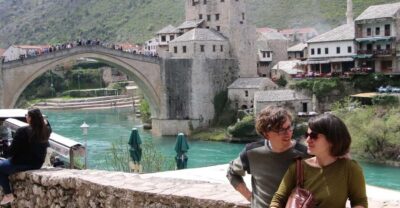
Sarajevo: Mostar, Konjic, Blagaj Tekke, Pocitelj & Waterfall
Read our review →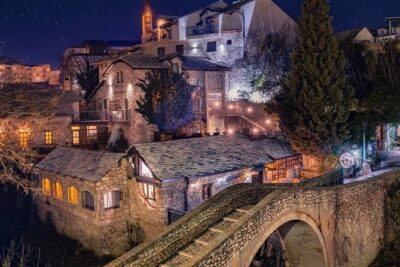
Sarajevo: Mostar, Konjic, Sufi House, Pocitelj & Kravice Falls
Read our review →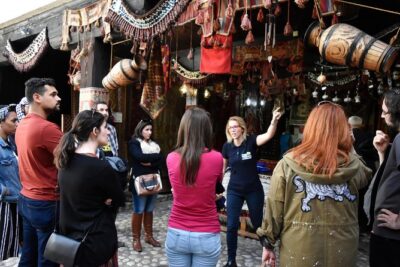
Sarajevo: 2 Hours Old Town Walking Tour With Local Guide
Read our review →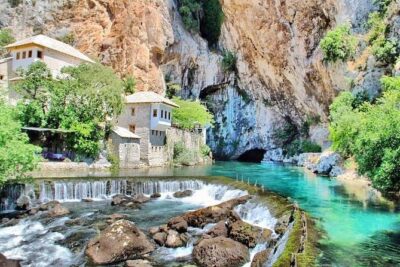
Sarajevo: Mostar, Konjic, Dervish House, Pocitelj & Kravica Falls
Read our review →
Mostar,Kravica Waterfall,Blagaj,Počitelj – Day Tour from Sarajevo
Read our review →
Jajce, Travnik and Pliva watermills – Day Tour from Sarajevo
Read our review →