REVIEW · SARAJEVO TOURS
Sarajevo: Islamic Traditions and Daily Life Tour
Sarajevo’s story is written in its mosques. This two-hour walking tour connects Islamic faith, Ottoman architecture, and everyday life across the city center, from the site of Sarajevo’s founding to its old market streets. I like the strong focus on local culture, and I like that the tour includes both major monuments and smaller places such as Jedileri Sanctuary and Alifakovac Cemetery.
The guide makes the difference here. Suad and Fuad are praised for being warm, thoughtful, and well-informed, with one guide even spending extra time suggesting places to eat. The main consideration is pace: you cover a lot in two hours, and part of the route includes an uphill walk, so comfortable shoes are essential. A few admission fees also sit outside the $30.04 tour price.
In This Review
- Key points to know before you book
- Why this tour gives Sarajevo more meaning
- Starting at Mejdan Park and Jedileri Sanctuary
- The Emperor’s Mosque and Sarajevo’s Islamic beginnings
- Gazi Husrev-beg Mosque, the heart of the route
- Sarajevo’s lunar Clock Tower
- Gazi Husrev Begova Medresa and the value of education
- Svrzo’s House reveals ordinary Ottoman life
- The Faculty of Islamic Studies and modern Sarajevo
- Baščaršija, Sebilj, and Bravadžiluk Street
- Alifakovac Cemetery and Morica Han
- What the $30.04 price includes
- Who should book this walking tour?
- Should you book the Sarajevo Islamic Traditions and Daily Life Tour?
- FAQ
- How long does the Sarajevo Islamic Traditions and Daily Life Tour last?
- Where does the tour start?
- Is the tour offered in English?
- Are entrance fees included?
- How large can the group be?
- Can I cancel for a full refund?
Key points to know before you book
- A focused look at Sarajevo’s Muslim heritage: The route explains how Islam shaped the city’s buildings, customs, education, food, and public life.
- Several important sites in one short walk: You visit the Emperor’s Mosque, Gazi Husrev-beg Mosque, Baščaršija, Morica Han, and more.
- The 18th-century Svrzo’s House adds daily-life detail: This preserved Ottoman home helps you picture how a Muslim family lived in Sarajevo.
- The lunar clock is a memorable stop: Sarajevo’s historic Clock Tower uses the Islamic lunar calendar, an unusual detail that links timekeeping with religious tradition.
- The route is not entirely flat: The walk includes an uphill section, and the compact schedule means you should expect a brisk pace.
- Extra costs are modest but real: Svrzo’s House costs 5 BAM, while the Gazi Husrev Bey Mosque and Museum costs 8 BAM.
Why this tour gives Sarajevo more meaning
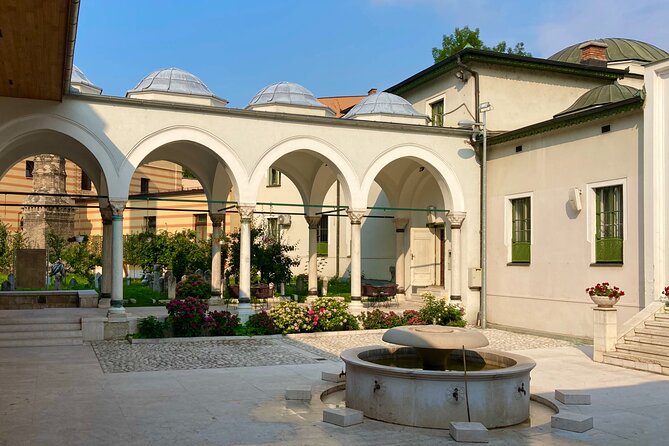
Sarajevo can look like a pleasant old European city at first glance, with cobbled lanes, market stalls, fountains, and handsome religious buildings. This tour helps you read the details. You learn why certain buildings were placed where they are, how religious institutions supported education, and how Muslim customs became part of ordinary city life.
I especially like the way the route moves between grand monuments and human-scale places. The Gazi Husrev-beg Mosque is important, but so is Svrzo’s House, where you can see how rooms, furnishings, and household arrangements reflected family life in the 18th century. That mix keeps the tour from becoming a procession of façades.
The experience is also useful if you are unfamiliar with Bosnia and Herzegovina’s place in Europe. Sarajevo is one of Europe’s few Muslim-majority cities, and its Islamic identity is not separate from its wider culture. It is woven into architecture, food, schooling, commerce, burial customs, and the rhythm of the historic center.
The group can include up to 25 people, though the size on a particular day may be smaller. One booking resulted in a private experience, which allowed the guide to answer questions at length and suggest places to eat. You should not count on a private tour, but the small-group format can make the walk feel personal when numbers are low.
A few more options to weigh up in Sarajevo
- Sarajevo: Mostar, Konjic, Blagaj Tekke, Pocitelj & Waterfall
★ 4.9 · 1,335 reviews - Fall of Yugoslavia, Sarajevo War Tour with Tunnel of Hope Museum and Frontlines
★ 5.0 · 1,314 reviews - Sarajevo: Mostar, Konjic, Sufi House, Pocitelj & Kravice Falls
★ 5.0 · 1,179 reviews
Starting at Mejdan Park and Jedileri Sanctuary
The meeting point is Sarajevo Insider at Zelenih beretki 30. The tour begins at 10:00 a.m. and ends back at the same location, which makes planning the rest of your day fairly easy.
The first stop is Mejdan Park, a historic site connected with the official establishment of Sarajevo. It was also a place where people gathered for social activities. You spend only about five minutes here, but the stop sets up an important idea: Sarajevo developed as a community as much as a collection of buildings.
From there, the walk reaches Turbe sedam braće, also called Jedileri Sanctuary. This sacred site is linked to Muslim spiritual life in Bosnia. The stop is brief, about five minutes, so the value comes from the guide’s explanation rather than a long visit inside.
I would pay attention to the customs and beliefs discussed here, even if you are not Muslim. The point is not simply to identify a religious monument. It is to understand how sacred places function in the life of a city and why people continue to visit them.
The Emperor’s Mosque and Sarajevo’s Islamic beginnings
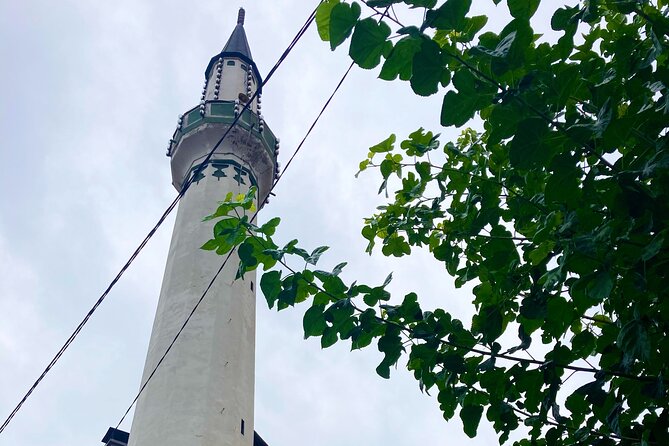
The Emperor’s Mosque is described as Sarajevo’s oldest mosque. You spend only a few minutes here, but it carries major historical weight. The guide also explains how the city’s Islamic heritage shaped its name, giving you a direct connection between language, place, and religion.
This is a quick orientation stop rather than a long architectural visit. If you want extensive time for photographs or quiet reflection, two hours does not leave much room. Still, the mosque works well early in the route because it gives context before you reach the larger religious complex of Gazi Husrev-beg.
The walk is most useful when you listen for connections. Sarajevo’s Islamic identity did not come from one building alone. It developed through mosques, schools, markets, charitable foundations, inns, fountains, and homes. The tour keeps returning to that wider picture.
Gazi Husrev-beg Mosque, the heart of the route
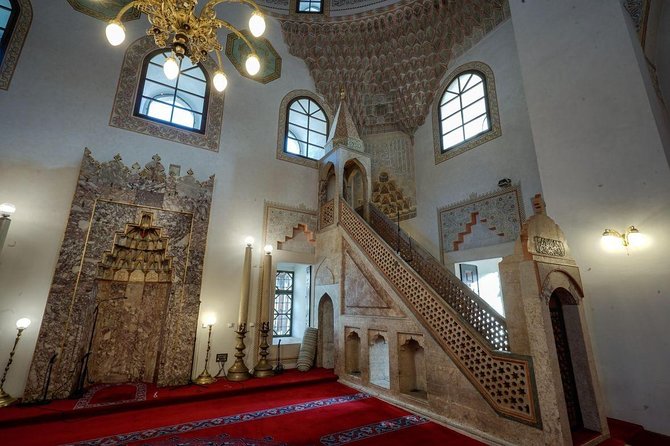
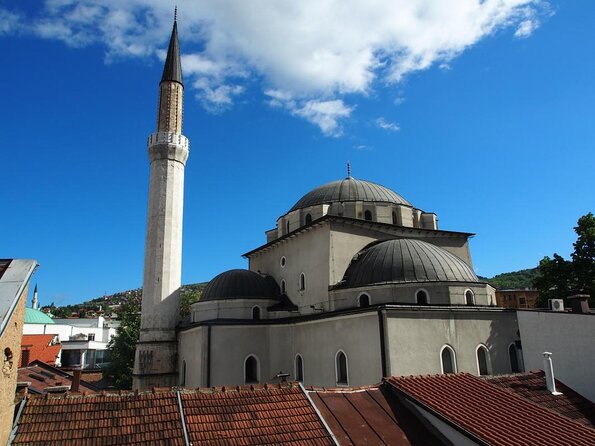
The Gazi Husrev-beg Mosque receives the longest stop, about 30 minutes, and for good reason. It is a major spiritual and cultural center in Sarajevo and one of the city’s best-known examples of Islamic architecture.
Here, the guide can explain the mosque’s role beyond worship. Religious buildings in Sarajevo were part of a larger network that included education, public services, commerce, and charitable work. That wider role helps you understand why the surrounding quarter became such an important center of city life.
Admission to the mosque and museum is not included. The listed price is 8 BAM, or about €4.50 per person. At $30.04 for the full tour, I consider this reasonable, especially because a certified guide and city map are included, but you should carry extra cash for the two paid sites.
Dress and conduct matter at a mosque. The tour information does not specify a dress code, so you should be prepared to follow the site’s local requirements. Your guide can help you understand what is appropriate when you arrive.
A completely different kind of day:
- ROSES OF SARAJEVO (Official WAR + CITY tour)- Story of a Survivor
★ 5.0 · 770 reviews - Sarajevo: Mostar, Konjic, Počitelj, Sufi House, & Waterfalls
★ 4.9 · 572 reviews - Tunnel Museum: Bosnian & Yugoslav Wars Tour with War Veteran
★ 5.0 · 551 reviews - Sarajevo: 2 Hours Old Town Walking Tour With Local Guide
★ 5.0 · 505 reviews
Sarajevo’s lunar Clock Tower
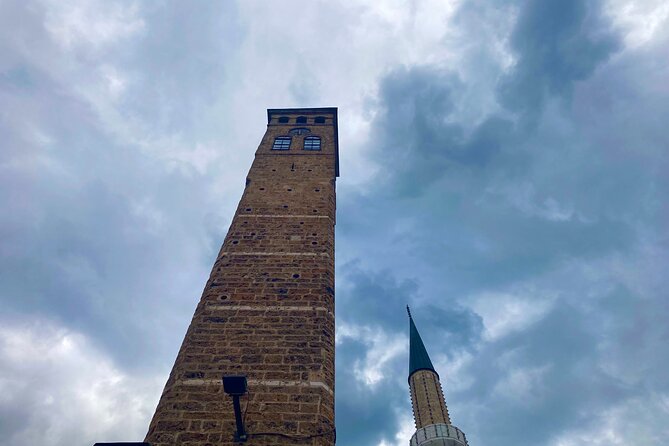
A short stop at Sarajevo’s historic Clock Tower brings an unusual detail into the tour. This is a rare lunar clock, designed to mark time according to the Islamic lunar calendar rather than the standard clock system most of us use.
That small difference opens up a larger discussion about how religious practice shaped daily schedules. Time in a Muslim city was not only a matter of work and appointments. It was also connected to prayer and the lunar calendar.
The Clock Tower is easy to appreciate because it is both practical and distinctive. You do not need a long lecture to remember it. Once you understand what makes it unusual, the tower becomes one of those details you will notice again as you walk through Sarajevo.
Gazi Husrev Begova Medresa and the value of education
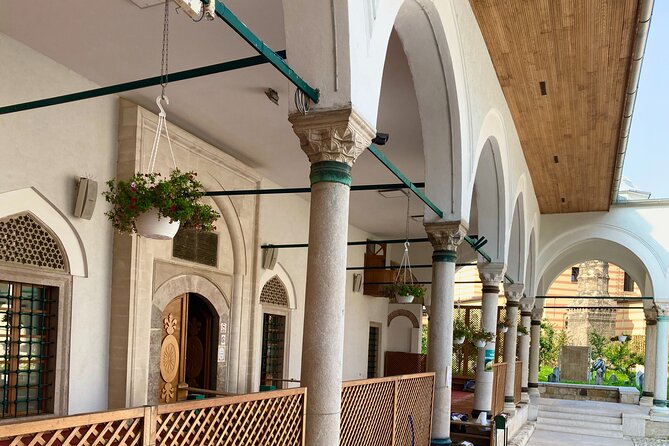
The Gazi Husrev Begova Medresa was Sarajevo’s first Islamic high school, founded in 1537. You spend around ten minutes here, learning about the educational legacy of one of the city’s major benefactors.
This stop broadens the tour beyond worship. Islamic institutions helped provide learning as well as religious instruction, and the madrasa is a clear example of that role. It also shows how education was part of the city’s development centuries ago.
The building is meaningful even if you are more interested in architecture than theology. Its place in the route helps explain why Gazi Husrev-beg is remembered not only for a mosque, but also for supporting institutions that shaped Sarajevo’s public life.
Svrzo’s House reveals ordinary Ottoman life
Svrzo’s House is one of the strongest parts of the experience. This well-preserved Ottoman home shows how Muslim families in Bosnia lived during the 18th century. You have about 20 minutes here, making it the second-longest stop after the Gazi Husrev-beg Mosque.
I like this kind of museum because it gives you something a large monument cannot. A mosque tells you about public faith and community life. A house shows how people organized private life, family space, and daily routines.
The entrance fee is 5 BAM, listed as about €3 per person. That is a small additional cost for one of the tour’s most useful visits. A previous guide, Fuad, was praised for making the madrasa and restored Ottoman home especially memorable, and his friendly approach helped visitors feel comfortable asking questions.
The uphill walking becomes more noticeable around parts of the route, so take your time on the approach. You are not racing through a giant museum, but the schedule is compact. If historic homes interest you, this is a place where you may wish for a few extra minutes.
The Faculty of Islamic Studies and modern Sarajevo
The Faculty of Islamic Studies at the University of Sarajevo receives only a brief stop, about one minute. That sounds short, but the building earns its place because it blends Neo-Moorish-inspired design with modern elements.
This is a quick architectural glance rather than a full visit. You will not have time to explore the institution in detail, but the stop makes an important point: Islamic design in Sarajevo is not limited to Ottoman-era buildings. It continues into modern academic and cultural life.
The building also adds variety to the walk. Without it, the route could feel focused only on the past. With it, you see how Sarajevo continues to express its Islamic identity through present-day education.
Baščaršija, Sebilj, and Bravadžiluk Street
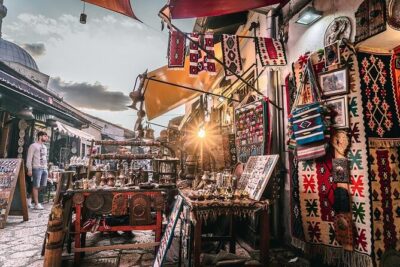
Baščaršija is Sarajevo’s old bazaar and one of the most atmospheric parts of the tour. You spend about 20 minutes walking through the market quarter, where Ottoman-era trade and craft traditions remain visible in the streets and workshops.
This is where the tour’s themes become easy to see. Religion, trade, food, and public life were closely linked in the old city. The guide can help you make sense of the layout instead of leaving you to see it as a pretty shopping area.
At Sebilj Fountain, you pause for only a minute. The fountain is a familiar symbol of Sarajevo and has a place in Muslim traditions. The short stop is enough to explain its role, though you will likely want to take a quick photograph.
Bravadžiluk Street gives the tour a food angle. You explore Muslim culinary traditions and local crafts, and this is a good place to ask your guide what to try later. One guide spent additional time recommending places to eat, a useful bonus when you are still learning how Sarajevo’s food culture works.
I would not treat this part as a full food tour. The emphasis is on context and observation, not a series of included tastings. Still, it can help you choose where to return for a meal after the walk.
Alifakovac Cemetery and Morica Han
Alifakovac Cemetery is optional and receives only about two minutes. This quiet resting place is associated with notable Muslims in Bosnia and offers a moment to reflect on Sarajevo’s religious past.
The stop is short, but cemeteries can reveal much about a city. Tombstones, burial grounds, and the way a cemetery sits within an urban neighborhood all show how the past remains part of daily surroundings. If you prefer to keep moving, you can treat this as a brief pause rather than a major attraction.
Morica Han is the final listed stop. It is Sarajevo’s best-preserved Ottoman inn and once served Muslim travelers moving through Bosnia. You spend about three minutes here, so the guide’s explanation matters more than a long interior visit.
The han helps complete the story. Mosques served worshippers, madrasas supported education, markets supported trade, and inns gave travelers a place to stay. Together, these sites show how a city worked as a connected social system.
What the $30.04 price includes
At $30.04 per person, this is a fairly priced introduction to Sarajevo’s Islamic traditions. You receive a certified guide and a city map, and the tour gathers many important sites into one organized walk. If you tried to build the same route alone, you could see the buildings, but you would miss much of the connection between them.
The two extra entrance fees add 13 BAM in total if you visit both paid sites. That brings the cultural cost to a modest level, especially for a two-hour guided experience. The paid visits are not hidden in the fine print, but you should know about them before arriving.
The tour is offered in English and uses a mobile ticket. Confirmation arrives at booking, and the meeting point is near public transportation. Most people can participate, but the uphill section is worth taking seriously if walking is difficult for you.
The tour is usually booked about 14 days ahead. That does not guarantee it will sell out, but I would reserve in advance if the 10:00 a.m. start fits your plans.
Who should book this walking tour?
I would choose this experience if you want a clear introduction to Sarajevo’s Muslim culture and do not want to study the city’s religious sites alone. It suits anyone interested in Ottoman architecture, Bosnia’s complex past, Islamic education, traditional food, or the connection between faith and daily life.
It is also a good first-day activity. The guide gives you a map, points out useful areas, and can help you decide where to eat afterward. One particularly warm experience included extra time in the city and restaurant suggestions, though you should see that as a welcome possibility rather than a guaranteed part of the schedule.
You may want a different tour if you prefer a slow photography walk, a long museum visit, or a detailed architectural survey. The two-hour format is efficient, but it requires steady movement. The route includes many short stops, and some sites receive only a minute or a few minutes.
The experience has a five-star rating from seven published ratings, with praise focused on the guides’ kindness, insight, and ability to explain Islam in Bosnia to both Muslim and non-Muslim participants. That emphasis matters. This is not presented as a religious lesson only for believers. It is a cultural tour designed to help you understand Sarajevo.
Should you book the Sarajevo Islamic Traditions and Daily Life Tour?
Yes, if you want Sarajevo explained through its mosques, schools, homes, markets, and customs. I especially recommend it for a first visit, when the old city’s many layers can otherwise blur together.
Book it knowing that the walk is brisk, the route includes an uphill section, and 13 BAM in additional admission fees may apply. Wear good shoes, arrive ready for a respectful visit to religious sites, and bring questions for the guide.
For $30.04, the tour offers strong value because it gives you a connected story rather than a list of monuments. If Suad or Fuad leads your walk, you can expect the kind of friendly, personal conversation that made this experience particularly well regarded.
FAQ
How long does the Sarajevo Islamic Traditions and Daily Life Tour last?
The tour lasts approximately two hours. It begins at 10:00 a.m. and ends back at the Sarajevo Insider meeting point.
Where does the tour start?
The meeting point is Sarajevo Insider, at Zelenih beretki 30, Sarajevo 71000, Bosnia and Herzegovina.
Is the tour offered in English?
Yes. The experience is offered in English and includes a mobile ticket.
Are entrance fees included?
No. Svrzo’s House costs 5 BAM per person, and the Gazi Husrev Bey Mosque and Museum costs 8 BAM per person. The tour price includes a certified guide and city map.
How large can the group be?
The maximum group size is 25 people. Most people can participate, and the meeting point is near public transportation.
Can I cancel for a full refund?
Yes, if you cancel at least 24 hours before the local start time. Cancellations made less than 24 hours before the start are not refunded. Poor weather or failure to meet the minimum number of participants may lead to a rescheduled experience or a full refund.
Just added in Sarajevo
- Sarajevo Under Siege: A War History Tour★ 5.0 · 10 reviews
- Walking Tour in Sarajevo★ 5.0 · 3 reviews
- Private Full Day Safari Tour★ 5.0 · 8 reviews
- Bosnian Pyramid: The World’s Largest Pyramid (From Sarajevo)★ 5.0 · 1 review
- Mysterious Visoko Pyramids Driving and Walking Tour★ 5.0 · 7 reviews
- Ultimate adventure★ 5.0 · 2 reviews
- Travnik, Jajce, Pliva Lakes & Mills –Medieval & Ottoman Bosnia Full Day Tour★ 5.0 · 3 reviews
- Sarajevo to/from Zagreb Transfer Day Tour (North-central Bosnia)★ 5.0 · 4 reviews
Sarajevo Tours, compared.
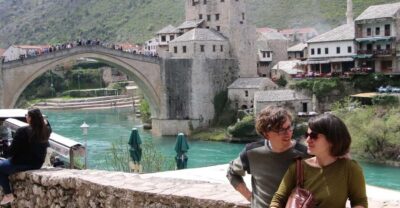
Sarajevo: Mostar, Konjic, Blagaj Tekke, Pocitelj & Waterfall
Read our review →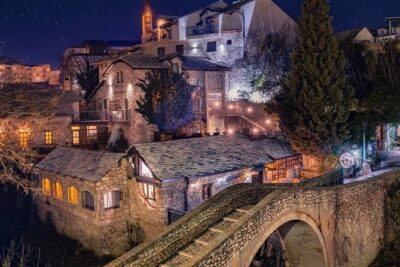
Sarajevo: Mostar, Konjic, Sufi House, Pocitelj & Kravice Falls
Read our review →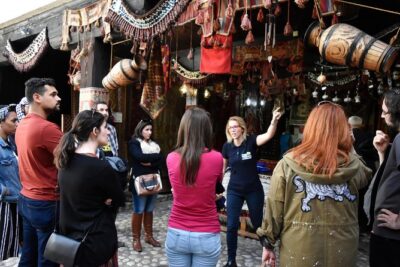
Sarajevo: 2 Hours Old Town Walking Tour With Local Guide
Read our review →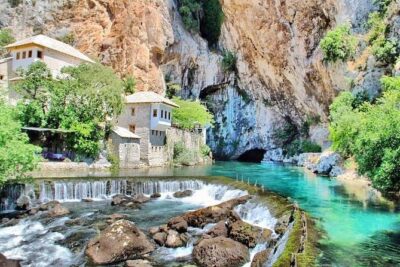
Sarajevo: Mostar, Konjic, Dervish House, Pocitelj & Kravica Falls
Read our review →
Mostar,Kravica Waterfall,Blagaj,Počitelj – Day Tour from Sarajevo
Read our review →
Jajce, Travnik and Pliva watermills – Day Tour from Sarajevo
Read our review →