
REVIEW · SARAJEVO OLYMPIC MOUNTAINS
Sarajevo Full Day Tour: History, Culture, Nature, War & Olympics
Sarajevo tells many stories in one day. This tour links the Bosna River Springs, the 1984 Olympic bobsleigh track, the Tunnel Museum, and the layered streets of the Old Town into one well-planned introduction to the city. I especially like the personal war stories from guides such as Enes, Ahmed, Edis, and Elvis, and I like that hotel pickup, lunch, water, coffee, and several entrance fees are included. The main consideration is pace: you cover a lot of ground, with some walking and many short stops.
The tour also gives you the rare chance to see Sarajevo from several angles, from the peaceful springs to the former front line on Trebević mountain. I love the mix of nature, Ottoman, Austro-Hungarian, Jewish, Catholic, and Orthodox heritage. Just confirm the lunch timing when you book, since an earlier version of the experience left one group hungry by midafternoon, though lunch is now included.
In This Review
- Key points to know before booking
- A full day that explains Sarajevo from several angles
- Vrelo Bosne: Sarajevo’s calm beginning
- The Tunnel Museum and the Siege of Sarajevo
- The Olympic bobsleigh track on Trebević
- Yellow Fortress and Sarajevo’s wartime viewpoints
- Sniper Alley and the city’s modern history
- Sarajevo City Hall and the Austro-Hungarian chapter
- Walking through Baščaršija and the Ottoman Old Town
- Four faiths and one street corner
- What the $114.45 price really covers
- Who should book this Sarajevo day tour?
- FAQ
- What time does the Sarajevo full-day tour start?
- Where is pickup available?
- How long does the tour last?
- What is included in the price?
- Are all entrance fees included?
- How many people can join the tour?
- Should you book it?
Key points to know before booking
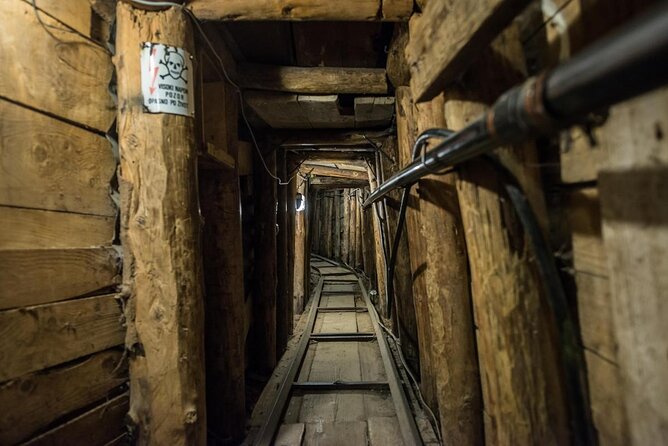
- The Tunnel Museum gives Sarajevo’s wartime story a human face, especially when your guide explains the siege through personal family memories.
- Vrelo Bosne brings a welcome green pause before the heavier history begins.
- The Olympic bobsleigh track is an unusual stop, combining sports history, mountain scenery, and wartime damage.
- Old Town packs East and West into a short walk, with mosques, cathedrals, markets, coffee houses, and the Sarajevo Meeting of Culture.
- Hotel pickup and a small group of up to 15 people make a busy day easier to manage.
- The $114.45 price includes meaningful extras, including lunch, bottled water, Bosnian coffee, vehicle transport, and two entrance fees.
A full day that explains Sarajevo from several angles
This is not just a city sightseeing ride. It is a city-and-surroundings tour that tries to answer a larger question: how did Sarajevo become a meeting place of religions, empires, cultures, and painful modern history?
You start at 9 a.m. with pickup from your hotel lobby or another location in Sarajevo. An air-conditioned vehicle carries you to the outlying sights, while the central Old Town section is explored on foot. The advertised length is six to seven hours, although the number of stops means the day feels full.
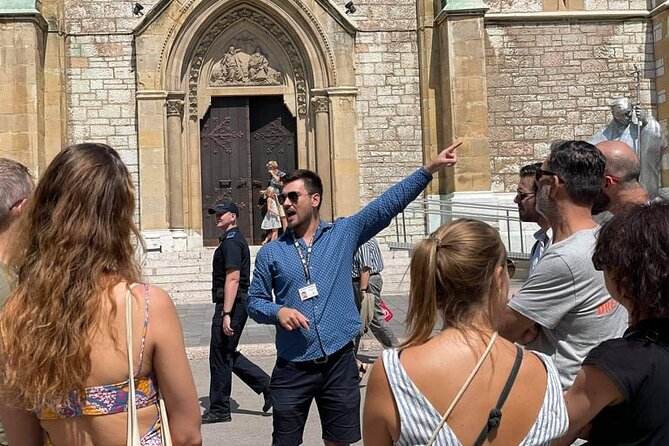
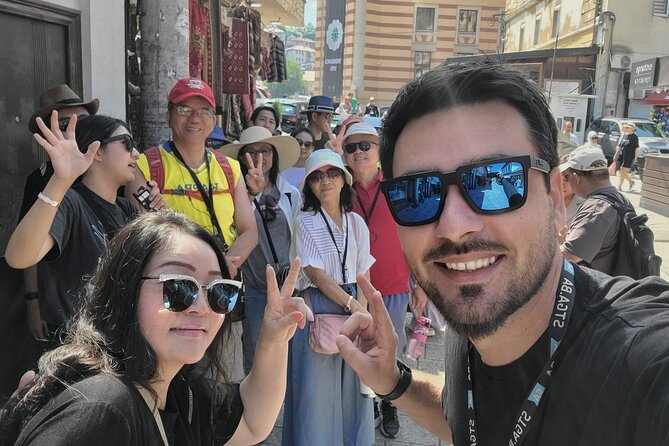
The maximum group size is 15. That is large enough to keep the price reasonable but small enough for you to ask questions. The strongest part of the experience depends on the guide. Enes is praised for his humor, clear explanations, photography help, and 15 years in tourism. Ahmed is noted for his strong grasp of history and firsthand childhood memories of the siege. Edis and Elvis are also described as friendly, clear, and attentive.
That personal connection matters in Sarajevo. Dates and political agreements are important, but the city’s recent past is easier to understand when your guide explains how ordinary families lived through it.
Other tours covering the siege of Sarajevo:
- Fall of Yugoslavia, Sarajevo War Tour with Tunnel of Hope Museum and Frontlines
★ 5.0 · 1,314 reviews - ROSES OF SARAJEVO (Official WAR + CITY tour)- Story of a Survivor
★ 5.0 · 770 reviews - Tunnel Museum: Bosnian & Yugoslav Wars Tour with War Veteran
★ 5.0 · 551 reviews
Vrelo Bosne: Sarajevo’s calm beginning
The first stop is Vrelo Bosne, the springs of the Bosna River. You spend about 40 minutes here, and admission is included.
This is a smart way to begin. The springs offer a quiet setting and introduce the natural side of Bosnia and Herzegovina before the tour turns toward war and urban history. The river’s name is tied to the country’s name, so the stop carries more meaning than a simple park visit.
You should treat this as a scenic pause rather than a long nature walk. Forty minutes gives you time to see the springs and take photographs, but not to explore the full area at leisure. If you prefer a slow morning with plenty of time outdoors, this part may feel brief. Still, after hotel pickup, a peaceful first stop helps you settle into the day.
The Tunnel Museum and the Siege of Sarajevo
The Sarajevo War Tunnel, often called the Tunnel of Hope, is one of the day’s most important stops. The entrance fee is included, and you spend around 40 minutes at the museum.
The tunnel was built during the siege of Sarajevo to connect the city with the outside world. The visit helps explain how food, medicine, supplies, and people moved through a narrow underground route while the city was surrounded. It is a compact museum, but its subject is enormous.
This is where a good guide makes a real difference. Enes, Ahmed, Edis, and other guides have explained the war with both political context and family memories. One guide shared photographs from the period and described his own experience as a child, which gave the visit a direct human focus.
Expect serious material. The tour does not treat the siege as a distant chapter in European history. It connects the conflict to the city you are seeing today, including the effects of the Dayton Agreement and the way the war still shapes public memory.
If you want only light sightseeing, this stop may be emotionally demanding. I think it is essential for anyone trying to understand Sarajevo beyond its cafés and attractive Old Town streets.
The Olympic bobsleigh track on Trebević
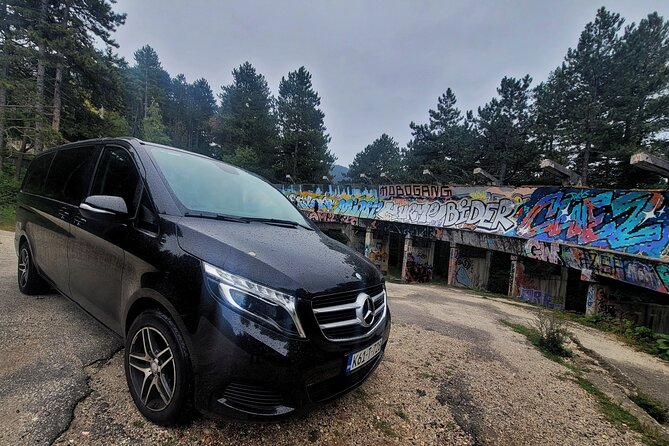
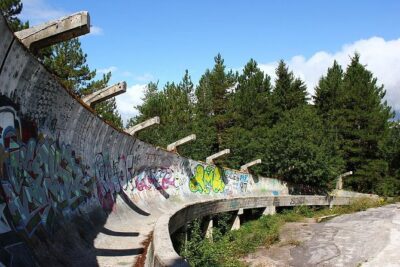
The next stop lasts about 40 minutes and has no additional entrance fee. The Sarajevo Olympic bobsleigh and luge track was built for the 1984 Winter Olympics. It was later abandoned and used as part of the front line during the war.
That contrast is what makes the site so striking. The track recalls a moment when Sarajevo welcomed the world for sport. Its damaged and abandoned condition then points to the city’s later destruction. You are not simply looking at an old sports facility. You are seeing two very different chapters of Sarajevo’s recent past in the same place.
The mountain setting also gives the day a change of mood. After the Tunnel Museum, the open air and higher viewpoint feel refreshing. Several visitors considered the Olympic track and Bosna Springs the best parts of the day, especially because they are harder to fit into an ordinary Old Town walk.
The stop is brief, so you should not expect a long mountain outing. It works best as a focused visit with a guide who can connect the Olympic story to the war.
More of the Olympic mountains:
- Sarajevo Grand Tour: Old Town, War Tunnel, Olympic Sites & More
★ 5.0 · 73 reviews - Sarajevo: Olympic Mountains and Spring of Bosna River Tour
★ 5.0 · 25 reviews - Cable Car Olympic Tour With Museum
★ 5.0 · 17 reviews - Trebevic Mountain Biking Tour from Sarajevo – Bobsleigh Track
★ 5.0 · 16 reviews
Yellow Fortress and Sarajevo’s wartime viewpoints
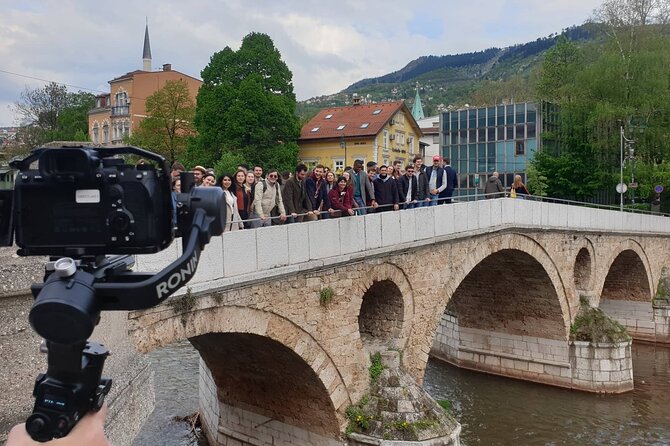
Yellow Fortress takes about 30 minutes and is free to visit. It is one of the main panoramic points above the city, with a view across Sarajevo’s valley and rooftops.
Your guide can help you read the city from above. The view is not just a photo opportunity. It shows how tightly the urban area sits between hills, a fact that helps explain the military importance of the surrounding heights during the siege.
The Jewish Cemetery follows, with about 30 minutes at the site. It offers another viewpoint over Sarajevo and carries a difficult wartime connection because parts of the area were used as sniper positions. The cemetery also introduces Jewish heritage, which is one of the many strands in Sarajevo’s story.
These two stops work well together. Yellow Fortress gives you the classic city photograph, while the cemetery adds a more serious layer. You should be prepared for uneven walking and time outdoors, though the tour data does not specify the exact surfaces or accessibility arrangements.
Sniper Alley and the city’s modern history
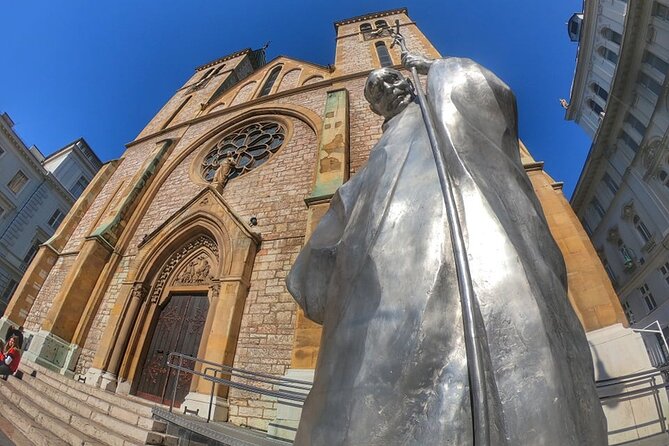
The Sniper Alley section lasts about an hour and is one of the longest parts of the tour. Here you see and discuss the former war hotel, the Bosnian Rome and Juliette Bridge, the role of United Nations forces, journalists, and international supporters during the siege.
The name Sniper Alley refers to a central route where crossing the road could be dangerous during the war. Your guide explains how the city functioned under fire and how residents tried to maintain daily life. This is more useful than viewing isolated war markers because the story is tied to actual streets and buildings.
You may find this portion less polished than the Old Town sightseeing that follows. That is part of its value. Sarajevo’s wartime story is not confined to one museum. It remains connected to ordinary roads, apartment blocks, bridges, and hotels.
The hour also gives you time to ask questions. If you want to understand the role of the UN, foreign journalists, or the outside help that reached Sarajevo, this is a good place to do it. Guides have been praised for explaining the war clearly without turning the conversation into a dry political lecture.
Sarajevo City Hall and the Austro-Hungarian chapter
At Sarajevo City Hall, you spend about 30 minutes inside. Admission is not included, so check the extra cost before you go.
The building is one of Sarajevo’s most recognizable examples of Austro-Hungarian design. Inside, the architecture shifts the focus from Ottoman-era streets to the later imperial period. Its history also connects to the city’s cultural life and to the wider political tensions that shaped Bosnia before World War I.
Because the stop is short, you will get an introduction rather than an extended museum visit. If the interior is especially important to you, ask your guide how much independent viewing time you will have.
Walking through Baščaršija and the Ottoman Old Town
The central walking section begins with Kazandžiluk, the copper-smith street. You spend about 10 minutes here, enough to see the traditional craft street and understand how the Old Town’s commercial character developed.
From there, you reach Baščaršija Square and Sebilj, the famous wooden fountain. This is the heart of the Old Town, once and still a place for trade, meeting, and orientation. The stop is also short, about 10 minutes, so think of it as a starting point for the surrounding streets rather than a full market visit.
Morica Han is a more relaxed pause. This former Ottoman caravanserai once provided lodging for merchants. Today, the tour includes Bosnian coffee here, with about 20 minutes to sit and experience a quieter corner of the Old Town.
Bosnian coffee is prepared and served differently from the familiar filtered coffee many people know. The point is not to rush through a cup while walking. Morica Han gives you a chance to stop, talk, and let the city’s older commercial world take shape.
Lunch is included in the current tour, along with bottled water. Food was a concern for one earlier group, which felt rushed and hungry by 3 p.m., so it is sensible to ask the guide at the start when lunch will happen. One guide also introduced a group to delicious burek and offered restaurant suggestions, a useful bonus if you are staying longer in Sarajevo.
Four faiths and one street corner
The Old Town portion moves quickly, but the sequence of religious and cultural sites is one of the tour’s strongest features.
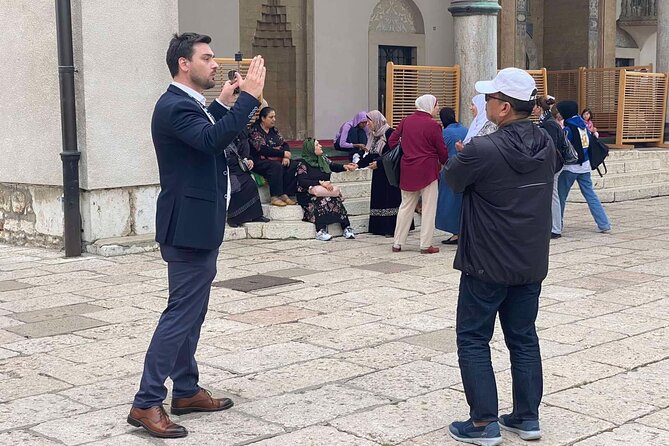
Gazi Husrev-beg Mosque receives about 10 minutes of attention, with admission not included. It is the largest mosque in the Old Town and is linked to Gazi Husrev-beg, a major Ottoman benefactor who invested heavily in Sarajevo.
The nearby Old Sarajevo Clock Tower takes only five minutes. Its lunar time system is a small but memorable detail. The clock once served a religious purpose, marking time according to the lunar day rather than the standard modern clock.
At Latin Bridge, you spend around 15 minutes. This is the site associated with the assassination that triggered World War I. The bridge is modest, but the event connected to it changed Europe and eventually affected much of the world.
Gazi-Husrev Beg’s Bezistan, a covered Ottoman market, takes about 10 minutes. Its sheltered passage gives you another glimpse of the old trading city. Then comes the Sarajevo Meeting of Culture, marked by the point where the Ottoman-influenced East meets the Austro-Hungarian-influenced West.
The tour continues to the Jewish Museum of Bosnia and Herzegovina for about 15 minutes. Admission is not included. The museum covers Jewish life in Bosnia from the 16th century to the present, adding context to the Jewish Cemetery stop.
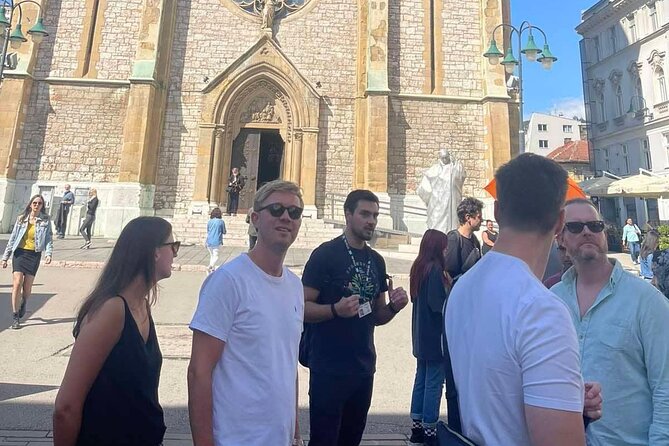
The final religious stops are Katedrala Srca Isusova, the Catholic Cathedral, and the Serbian Orthodox Cathedral. You get about 10 minutes at each. Seeing a mosque, Catholic cathedral, Orthodox cathedral, and Jewish heritage site within one compact city center makes Sarajevo’s identity unusually clear.
The short timings are both helpful and limiting. You see a great deal, but you will not have long independent visits at each site. I would choose this tour for orientation and context, then return on another day to the places that catch your interest.
What the $114.45 price really covers
At $114.45 per person, this is not the cheapest way to see Sarajevo. The value comes from the number of separate pieces bundled into one day.
The price includes:
- Hotel pickup in Sarajevo
- Air-conditioned transportation
- A tour guide
- Bottled water
- Lunch
- Bosnian coffee
- Admission to the Tunnel Museum
- Admission to Vrelo Bosne
You also avoid arranging separate transport to the springs, tunnel, Olympic track, cemetery, and hilltop viewpoints. That matters because these sites are spread beyond the Old Town and are not naturally joined into one easy walking route.
Three museum or religious admissions are not included: Sarajevo City Hall, Gazi Husrev-beg Mosque, and the Jewish Museum. Tips are also extra. The tour’s 4.9 out of 5 rating, based on 27 ratings, and full recommendation rate point to a strong overall experience, but the small sample means you should still judge the fast pace and serious subject matter for yourself.
Who should book this Sarajevo day tour?
I would choose this experience if you have one or two full days in Sarajevo and want a useful first look at the city and its surroundings. It is especially suited to people who want history explained clearly rather than simply photographed.
It is also a good choice for solo visitors or couples who would rather not arrange several taxis and admissions. The included transport, lunch, coffee, and two key entrance fees make the price easier to justify.
You may prefer a slower private tour if you want long museum visits, extended meals, or time to browse every shop in Baščaršija. The day is packed, and the Old Town stops are often measured in minutes. You should also be comfortable with a serious discussion of the war and with some walking between sights.
Free cancellation is available until 24 hours before the 9 a.m. start time. Poor weather or failure to meet the minimum group size can lead to a new date, another experience, or a full refund.
FAQ
What time does the Sarajevo full-day tour start?
The tour starts at 9:00 a.m.
Where is pickup available?
Pickup is offered from the lobby of your hotel or another location in Sarajevo.
How long does the tour last?
The experience lasts approximately six to seven hours.
What is included in the price?
The price includes an air-conditioned vehicle, bottled water, a tour guide, lunch, Bosnian coffee, hotel pickup, admission to the Tunnel Museum, and admission to Vrelo Bosne.
Are all entrance fees included?
No. Admission to Sarajevo City Hall, Gazi Husrev-beg Mosque, and the Jewish Museum of Bosnia and Herzegovina is not included. The Tunnel Museum and Vrelo Bosne are included.
How many people can join the tour?
The group has a maximum of 15 people. The tour is offered in English, and most people can participate.
Should you book it?
Book this tour if you want Sarajevo’s major themes explained in one day: Ottoman trade, Austro-Hungarian rule, religious coexistence, the 1984 Olympics, the siege, and the city’s natural setting. The strongest reasons to go are the Tunnel Museum, the Olympic track, the Bosna Springs, and guides who can add family memories to the historical account.
Skip it if you want a lazy day or long, unhurried museum visits. For most first-time visitors with limited time, though, the tour offers a practical and worthwhile introduction, with enough local detail to help you decide what deserves a second look.
More History Tours in Sarajevo
- Sarajevo genuine walking tour: Steps through history
★ 5.0 · 22 reviews - SARAJEVO STREET ART TOUR (art, history & mystery) – sARTajevo!
★ 5.0 · 18 reviews - BOSNIAN PYRAMIDS TOUR (nature, history & archeology)
★ 5.0 · 17 reviews - Sarajevo: Jewish Heritage Tour
★ 5.0 · 13 reviews
Just added in Sarajevo
- Sarajevo Under Siege: A War History Tour★ 5.0 · 10 reviews
- Walking Tour in Sarajevo★ 5.0 · 3 reviews
- Private Full Day Safari Tour★ 5.0 · 8 reviews
- Bosnian Pyramid: The World’s Largest Pyramid (From Sarajevo)★ 5.0 · 1 review
- Ultimate adventure★ 5.0 · 2 reviews
- Mysterious Visoko Pyramids Driving and Walking Tour★ 5.0 · 7 reviews
- Travnik, Jajce, Pliva Lakes & Mills –Medieval & Ottoman Bosnia Full Day Tour★ 5.0 · 3 reviews
- Tour of Herzegovina – From Sarajevo★ 5.0 · 3 reviews
Sarajevo Olympic Mountains, compared.
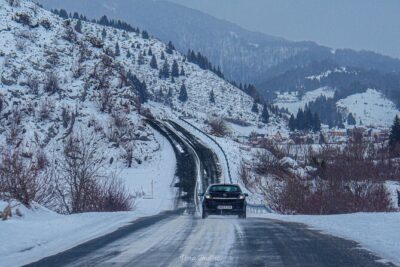
Sarajevo: Olympic Mountains and Spring of Bosna River Tour
Read our review →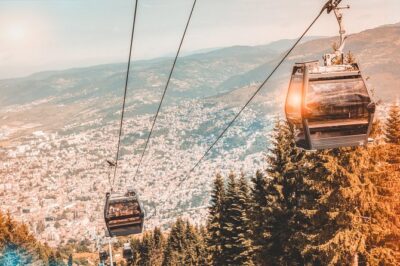
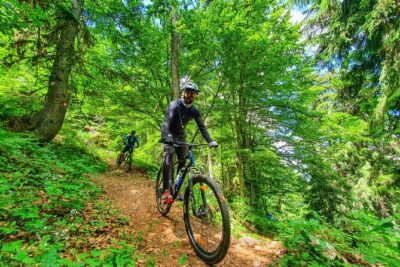
Trebevic Mountain Biking Tour from Sarajevo – Bobsleigh Track
Read our review →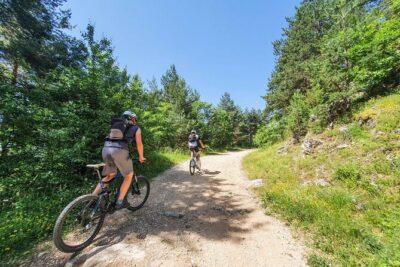
Skakavac Waterfall Mountain Biking Tour from Sarajevo MTB
Read our review →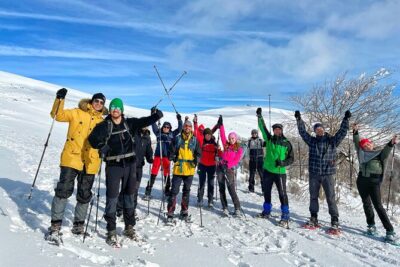
Experience Snowshoeing in Olympic Mountain Bjelašnica
Read our review →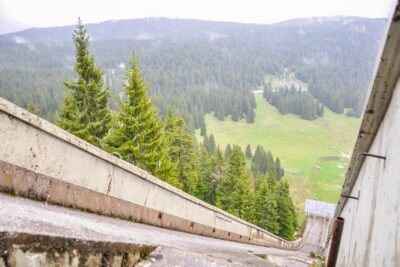
Sarajevo Olympic mountains – Driving and Walking Tour
Read our review →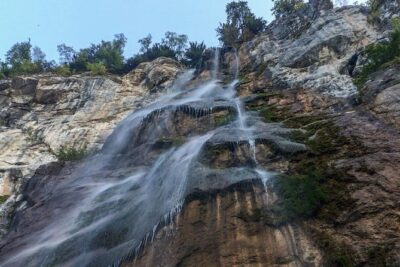
Browse the lists this tour appears in