
REVIEW · WALKING TOURS IN MOSTAR
Mostar War Heritage Walking Tour
Mostar’s beauty has a painful story. This private walking tour connects the Old Bridge, former front line, war cemeteries, and rebuilt city with a guide who can explain both the damage and the recovery. I like the personal war stories and the walk along places where the conflict shaped daily life. I also like the short film, which gives you useful context before or during the tour.
The main consideration is emotional weight. This is not a light stroll through old streets. You will hear about civilians, soldiers, destruction, and loss, so it may not suit you if you want only architecture and river views. The $47.66 price is also easier to justify for a private group than for one person traveling alone.
- A private walk at 9:00 am lets your group ask questions and set the pace.
- Personal stories from the war give the history a human scale.
- The Old Bridge and former front line show how beauty and conflict meet in Mostar.
- Liska Park cemetery reflects the city’s divided wartime experience.
- Spanish Square and the Old Gymnasium reveal damage, memory, and reconstruction.
- The tour ends where it begins, at the Spanish Square skate plaza.
In This Review
- Why this Mostar tour is different
- Meeting the group at Spanish Square
- The Old Bridge, from masterpiece to war symbol
- Liska Park and the city’s difficult burial ground
- Spanish Square and the Old Gymnasium
- Kujundziluk, where craft keeps the old town alive
- The Carinski Bridge and the former front line
- Kriva Cuprija, a smaller bridge with a useful lesson
- The short film and the value of a personal account
- How much value do you get for $47.66?
- Timing, pace, and what to bring
- Who should book this walk?
- Should you book the Mostar War Heritage Walking Tour?
- FAQ
- Where does the Mostar War Heritage Walking Tour start?
- Where does the tour end?
- How long does the walking tour last?
- What language is the tour offered in?
- Is this a private tour?
- What is included in the price?
- Is lunch included?
- Are entrance tickets included?
- Are service animals allowed?
- Can I cancel for a full refund?
Why this Mostar tour is different
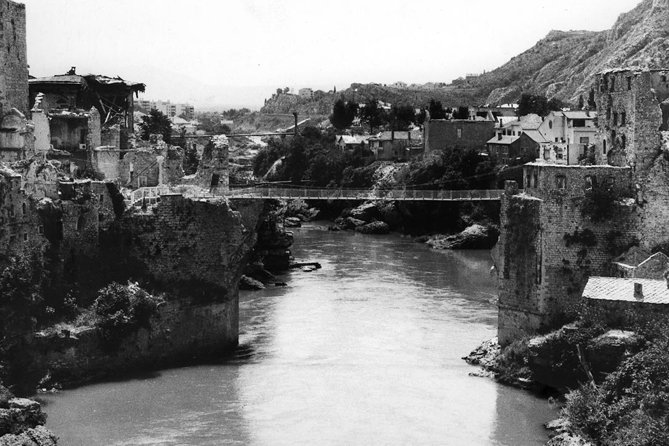
Mostar is easy to admire and easy to misunderstand. The Old Bridge, Neretva River, stone lanes, and small craft shops can make the city feel like a picture postcard. Yet the 1992 to 1995 war is not distant here. It remains visible in the city’s memorials, buildings, burial grounds, and the memories of people who lived through it.
This walk helps you put those pieces together. Rather than stopping at the famous bridge and moving on, you visit places linked to the conflict and the city’s recovery. The guide explains what happened, but the strongest part appears to be the human side. One guide, Serdin, is praised for showing both important sites and less obvious corners. Another guide, Elma, is described as friendly, flexible, and well informed.
The private format matters. Only your group takes part, so you can ask about a damaged building, pause when a subject needs more explanation, or keep moving if the material becomes difficult. The exact feel will depend on your guide, but the available feedback points to warm, personal guiding rather than a rushed script.
Meeting the group at Spanish Square
The walk begins at 9:00 am at the Spanish Square skate plaza, written in the location details as Španski trg, Mostar 88000. This is a practical starting point because Spanish Square itself is part of the story.
The square received its name in 1995 to honor 21 Spanish troops serving with UNPROFOR who were killed during the last war. That fact gives the opening stop a serious tone. You are not simply gathering in a central city plaza. You are beginning beside a public memorial connected to international involvement in Mostar.
The square is also home to the Old Gymnasium, or Stara Gimnazija. Finished in 1902, the building is one of the oldest schools in the former Yugoslavia. Its Moorish Revival design makes it one of Mostar’s most striking buildings, and it is listed as a national monument.
The contrast is useful. The square lets you see three layers at once: the Austro-Hungarian period, the city’s modern wartime memory, and the present-day public center. Arriving a few minutes early is sensible, since the meeting point is specific and the tour starts in the morning.
More Walking Tours in Mostar
- Mostar Private Walking Tour
★ 5.0 · 93 reviews - Charming Mostar: Private Mostar Walking Tour
★ 5.0 · 23 reviews - Best of Mostar – Private Walking Tour
★ 5.0 · 21 reviews
The Old Bridge, from masterpiece to war symbol
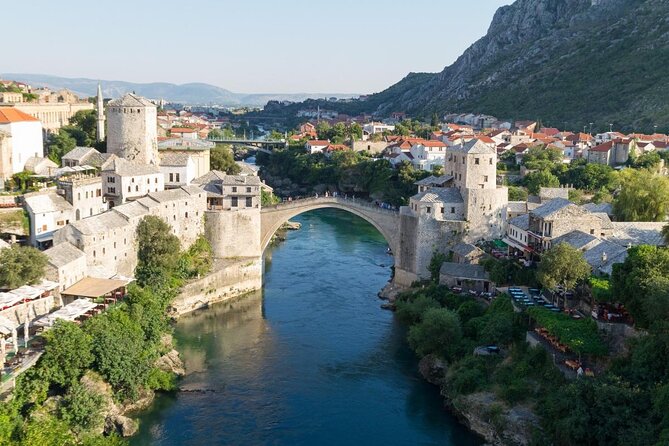
The Old Bridge is the tour’s most famous stop, but the guide gives you reasons to look beyond the standard photograph. A wooden bridge once crossed the Neretva here. It hung on chains and was difficult to cross safely, so people in Mostar eventually asked authorities in Istanbul for a stronger replacement.
The stone bridge was designed by Hajrudin, a pupil of the celebrated Ottoman architect Sinan. It was completed in July or August 1566. Its single arch spans 28.70 meters, measures 4.49 meters wide, and rises about 21 meters above the summer water level.
Those figures help you understand the engineering. The bridge was built from square stones, joined with iron hooks set in lead. It was not just a route across the river. It became the center of Mostar’s old town, with forts, towers, gates, and homes growing around it.
On this tour, the bridge also takes on a harder meaning. Its destruction during the war became one of the most powerful symbols of Mostar’s suffering. The guide can connect the old Ottoman monument to the conflict and the city’s rebuilding without treating the bridge as only a pretty landmark.
You get about 15 minutes here. That is enough for explanation and photographs, though not a long independent visit. If you want extended time on the bridge, plan to return after the tour. The admission is free.
Liska Park and the city’s difficult burial ground
Mezarje, or Groblje Liska Park, is a short stop of about five minutes, but its importance is much greater than the time suggests. The green space was first established in 1954. During the 1992 to 1995 war, it became a burial place for civilians and soldiers of different nationalities because existing cemeteries could not meet the need.
That detail gives the site its painful force. It reflects the disorder of wartime death rather than a neatly planned memorial. The park still carries a sensitive place in Mostar’s public memory.
You should expect this part of the walk to be quiet and brief. Five minutes will not allow for a long examination of every aspect of the site, but the guide’s explanation helps connect the cemetery to the wider story of a city under pressure. If you prefer history presented through monuments and personal accounts rather than dates alone, this is an important stop.
The subject can be difficult. A respectful attitude is essential, and you may want to give yourself some quiet time afterward rather than rushing straight into shopping or lunch.
Spanish Square and the Old Gymnasium
Spanish Square is both the meeting point and one of the tour’s central history lessons. The memorial connection to the 21 Spanish UNPROFOR troops gives the place a clear link to the international peacekeeping presence during the war.
The Old Gymnasium adds an older layer. Its 1902 Moorish Revival design recalls a period when public buildings in Mostar were shaped by Austro-Hungarian rule and a deliberate use of Islamic architectural forms. The school once carried the name of the poet Aleksa Šantić, another reminder that Mostar’s story includes literature, education, and civic life as well as conflict.
The stop lasts about five minutes. That is enough for an introduction and a look at the square, but you should not expect an in-depth architectural visit inside the school. The value lies in the pairing of the building and memorial. One represents civic ambition and education; the other recalls the cost of the recent war.
For you, this is also a convenient orientation point. The tour begins and ends here, so you can return later if you want more photographs or a slower look at the square.
Other tours covering the siege of Sarajevo:
- Break-up of Yugoslavia & The War in Mostar: Life Under Siege
★ 5.0 · 136 reviews - The Death of Yugoslavia Tour in Mostar
★ 5.0 · 102 reviews - War Photo Exhibition Tour in Mostar
★ 5.0 · 2 reviews - Fall of Yugoslavia, Sarajevo War Tour with Tunnel of Hope Museum and Frontlines
★ 5.0 · 1,314 reviews
Kujundziluk, where craft keeps the old town alive
Kujundziluk is the old bazaar on the left bank of the Neretva. Its name comes from the many coppersmiths who once worked here. Tailors were also present, while tanners were among the most numerous artisans, known for processing leather.
Today, the area has small craft workshops and handmade goods. This part of the walk gives you a needed change of pace after the war memorials. You can see how the old quarter functions as a living place rather than a museum display.
The tour allows about 15 minutes here. That is enough to notice the workshops and get a sense of the lane, but not necessarily enough for serious shopping. If you find something you like, make a note of the shop and return after the tour. The guide’s historical context can also help you see why the bazaar looks the way it does.
Kujundziluk works best when you pay attention to the work itself. Look for the connection between the old trades and today’s handicrafts. You are seeing continuity, even after a period when much of the city had to rebuild.
The Carinski Bridge and the former front line
The Carinski Bridge, or Customs Bridge, is a less familiar crossing over the Neretva north of the Old Bridge. It was originally built during the Austro-Hungarian period and served as an important link between parts of Mostar.
The supplied route does not give a fixed stop time here, so the amount of explanation may depend on the guide and the walking pace. Its importance is clear, though. A bridge is never just a structure in Mostar. It controls movement, joins neighborhoods, and can become strategically important in wartime.
The tour’s promise to walk along the former front line is one of its strongest features. The front line is not an abstract military term when you are walking through the city. Streets, crossings, buildings, and riverbanks become part of the explanation. You can better understand how close the fighting came to ordinary homes and public spaces.
This is where a private tour can offer real value. You can ask how the line affected movement or why certain places mattered. The precise details will depend on the guide’s route, but the walk is intended to connect the physical city with the recent past.
Kriva Cuprija, a smaller bridge with a useful lesson
The Crooked Bridge, or Kriva Ćuprija, crosses the Radobolja River in the old quarter. It is often described as a small prototype of the Old Bridge and dates from the 16th century.
At about five minutes, this is a quick stop. Its appeal is not scale. The smaller arch gives you a chance to look at bridge design without the crowds and visual drama of Stari Most. It also reinforces a central idea of the tour: Mostar’s identity is tied to crossings, water, trade, and the links between neighborhoods.
The Crooked Bridge is a pleasant counterpoint to the war material. After hearing about destruction and burial grounds, you return briefly to the craftsmanship and civic design that shaped the old city. The stop is short, so treat it as a focused explanation rather than a long photo break.
The short film and the value of a personal account
A short film about Mostar’s history is included in the experience. The information does not specify its exact length or precisely where it is shown, so you should think of it as a compact visual introduction rather than a full documentary.
Its value is practical. A film can help you see the city’s wartime damage and reconstruction before the guide points out related places on foot. It gives the walking route a clearer sequence, especially if you do not already know the history of the Bosnian War.
The personal stories are likely to be the most affecting part. One guide who led the experience had lived through the war as a teenager. His account included the atrocities he experienced, but also the city’s earlier history and its rebuilding. That balance matters. You are not given only a catalogue of destruction. You also hear about the place Mostar was, and the place it is trying to become.
This kind of conversation can change the mood of the day. It may leave you thoughtful rather than cheerful, but that is appropriate for a war heritage tour. The best approach is to listen carefully and ask respectful questions.
How much value do you get for $47.66?
The listed price is $47.66 per person. Since the activity is private, the value improves when two or more people share the cost. A couple or small family group gets a guide focused only on them, rather than paying for a large group where questions may be limited.
You are paying for an authorized professional guide, not for meals, museum entry, or transport. The main attractions on the route have free admission, and lunch is optional and not included. So the price is primarily for the interpretation, route, personal context, and convenience of a private walk.
I would call it fair for a small group that wants a focused understanding of Mostar’s recent history. It is harder to justify for a solo visitor who wants a cheap orientation walk, especially since the tour lasts only about two to three hours. Group discounts may help reduce the per-person cost.
The strongest value comes from the guide. Elma is praised for being friendly, flexible, and well informed. Serdin is praised for leading a very informative walk and pointing out many interesting places. Those comments suggest that the quality of the conversation is central to the experience.
Timing, pace, and what to bring
The 9:00 am start gives you a useful first activity in Mostar. A morning walk can help you understand the city before you explore independently. The total duration is approximately two to three hours, although the listed stop times add up to only part of that period, leaving room for walking and explanation between sites.
You should wear comfortable shoes. The route includes old-town streets, bridges, and walking between central locations. The tour is offered in English and uses a mobile ticket, so keep your booking accessible on your phone.
The tour is near public transportation, and most people can participate. Service animals are allowed. The activity ends back at the Spanish Square meeting point, which makes it easy to continue sightseeing afterward.
Lunch is not included. Since the walk can run into late morning or midday, plan to eat before or after rather than expecting a meal during the tour. Tips are also not included.
Free cancellation is available if you cancel at least 24 hours before the local start time. Changes or cancellations made inside that period are not accepted for a refund.
Who should book this walk?
I would choose this tour if you want more than the Old Bridge photograph. It suits you if you care about recent European history, local testimony, memorial sites, and the way a city rebuilds after war.
It is also a good choice for couples, families with older children, and small groups who prefer to ask direct questions. The private arrangement gives you more room for conversation than a large shared walk.
I would be cautious if you want a purely scenic tour. The bridge, bazaar, and historic buildings are attractive, but the focus remains the war and its human cost. The subject is serious, and the personal stories may stay with you.
Should you book the Mostar War Heritage Walking Tour?
Book it if you want a clear, human account of Mostar’s recent past, tied to places you can see on foot. The former front line, Liska Park, Spanish Square, and the Old Bridge create a strong route, while the private guide format lets you ask questions as the story unfolds.
The tour is best value when shared with another person or a small group. If you are alone and watching every dollar, you may find the price high for a two to three-hour walk. But if you want context that you will not get from photographs alone, the personal accounts and focused route make this a worthwhile addition to a Mostar visit.
FAQ
Where does the Mostar War Heritage Walking Tour start?
It starts at 9:00 am at the Spanish Square skate plaza, Španski trg, Mostar 88000, Bosnia and Herzegovina.
Where does the tour end?
The activity ends back at the meeting point at Spanish Square.
How long does the walking tour last?
The tour lasts approximately two to three hours.
What language is the tour offered in?
The tour is offered in English.
Is this a private tour?
Yes. Only your group participates in the activity.
What is included in the price?
A professional authorized guide is included.
Is lunch included?
No. Lunch is not included, although it is available as an optional expense.
Are entrance tickets included?
The listed stops have free admission. The tour price does not list separate paid admissions.
Are service animals allowed?
Yes. Service animals are allowed.
Can I cancel for a full refund?
Yes, if you cancel at least 24 hours before the experience’s local start time. Cancellations made less than 24 hours before the start are not refunded.
More History Tours in Mostar
- Mostar gastro and historical treasures
★ 5.0 · 6 reviews - Sarajevo Full Day Tour: History, Culture, Nature, War & Olympics
★ 5.0 · 27 reviews - Sarajevo genuine walking tour: Steps through history
★ 5.0 · 22 reviews - SARAJEVO STREET ART TOUR (art, history & mystery) – sARTajevo!
★ 5.0 · 18 reviews
Just added in Mostar
- War Photo Exhibition Tour in Mostar★ 5.0 · 2 reviews
- Walking Tour in Old Town Mostar★ 5.0 · 5 reviews
- The Ottoman Experience Tour in Mostar★ 5.0 · 1 review
- Wine Tour & Tasting (Herzegovina)★ 5.0 · 1 review
- Transfer service from Mostar-Sarajevo★ 5.0 · 1 review
- Herzegovina Highlights Tour from Mostar★ 5.0 · 2 reviews
- Private Tour in Croatia★ 5.0 · 1 review
- Pocitelj City Tour★ 4.5 · 3 reviews
Walking Tours in Mostar, compared.
2-Hour Cultural Walking Tour in One City-Three Stories of Mostar
Read our review →Browse the lists this tour appears in